Synonyms
More meanings
Tip: select a single word for meaning & synonyms.
Select multiple words normally to copy text.

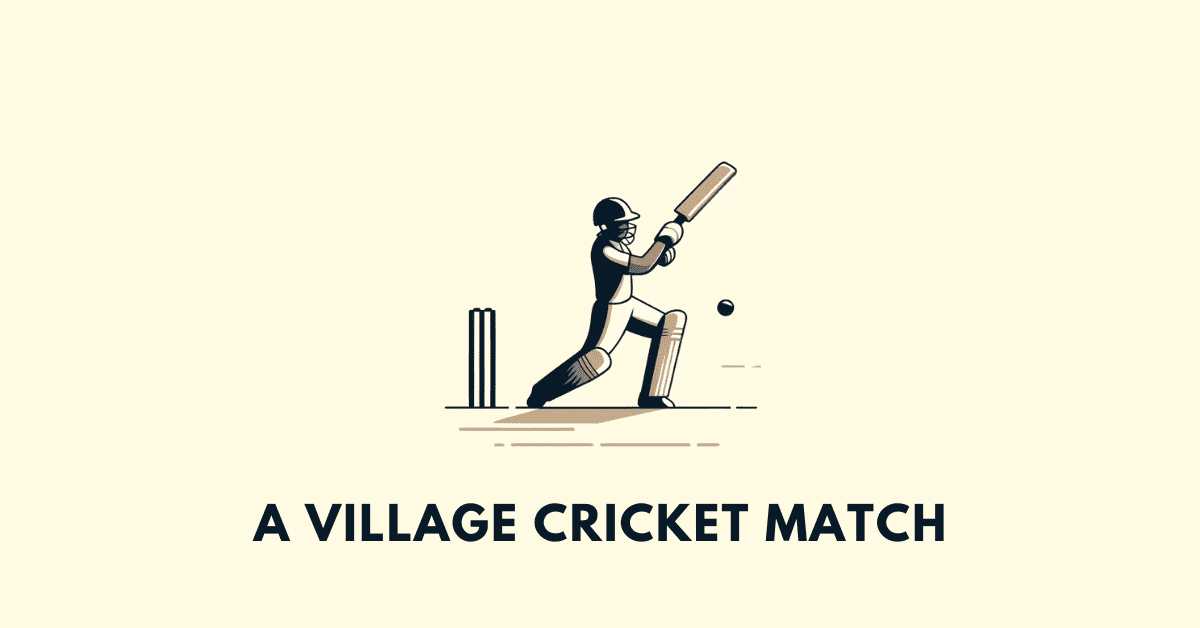
Get summaries, questions, answers, solutions, notes, extras, PDF of Class 12 Voices (English Supplementary reader textbook) chapter A Village Cricket Match by AG Macdonell which is part of the syllabus of students studying under MBOSE (Meghalaya Board). These solutions, however, should only be treated as references and can be modified/changed.
“A Village Cricket Match” by A.G. Macdonell narrates a humorous and vivid account of a cricket match between a team of villagers from Fordenden and a visiting team of gentlemen from London. The story highlights the eccentricities and charms of village life while capturing the essence of the game and the characters involved.
As the story begins, the villagers eagerly await the start of the match, which is a significant event for them. They exhibit patience, an inherent trait of village folk accustomed to the unpredictability of life. The scene is idyllic, with dragonflies, swans, and a serene landscape setting the stage for the match.
Mr. Hodge, the captain of the visiting team, encounters initial difficulties arranging the match. He negotiates with the Fordenden captain to borrow two players, ensuring each team has enough members. Just before the match begins, three late arrivals from the visiting team complicate matters, necessitating further negotiations and resulting in a twelve-a-side game.
Mr. Hodge wins the toss through a peculiar method and sends in his opening batsmen, James Livingstone, a proficient club cricketer, and Boone, a massive and imposing figure with the prestigious Cambridge Blue, though later revealed to be for rowing, not cricket. The Fordenden team, led by their baker-captain, positions themselves amidst the flowers and grass, ready for the challenge.
The match starts with the blacksmith as the bowler, taking a long run-up from a slope that makes him invisible until the last few yards. His first ball is a fast, erratic delivery that results in four byes. The village umpire reluctantly signals the runs, causing the spectators to react with surprise and calls for more beer.
Livingstone adeptly scores a six off the third ball but is soon dismissed. The professor, next to bat, is injured by a fast delivery, and the third player, Harcourt, hits his wicket before the ball is even bowled. The formidable Boone is stumped quickly, revealing his lack of cricketing prowess. The score stands at ten runs for three wickets and one player hurt.
Robert Southcott, a famous novelist and an unexpectedly modest figure, comes in next. Encouraged by Mr. Hodge to play cautiously, Southcott surprises everyone by hitting the first two balls for six. His unorthodox batting style baffles the rate-collector bowler and delights the crowd.
A dramatic moment unfolds when the blacksmith, determined to prove his worth, delivers a powerful ball only to be interrupted by a humorous call of “No ball!” from the tipsy umpire, Harcourt. This leads to a chaotic scene where the blacksmith falls, injuring himself, and the fielders and spectators erupt in laughter and confusion.
As the innings progress, the score reaches sixty-nine for six, with Southcott contributing significantly. The final incident involves Shakespeare Pollock, an American journalist unfamiliar with cricket. His comical attempt to play the game like baseball leaves the field in stunned silence before he realizes his mistake and laughs it off.
The story concludes with a reflection on the team spirit and the unique character of village cricket, where the game is played with passion, humor, and a sense of community. The vivid descriptions and the light-hearted tone make “A Village Cricket Match” an enjoyable and memorable portrayal of English village life and its love for cricket.
1. The text recounts a cricket match. Who were the two teams that played the match? Who were the two captains?
Answer: The text recounts a cricket match between the Fordenden Cricket Club and a team of gentlemen from London. Mr. Hodge captained the visiting team from London, and the Fordenden baker captained the home team.
2. What ‘tricky negotiations’ did Mr Hodge have to complete with the captain of the home team?
Answer: Mr. Hodge had to arrange for two substitutes to be lent by Fordenden so the visitors could field eleven men, and that nine men on each side should bat. This was because two of Mr. Hodge’s players didn’t show up.
3. Who arrived in the motor-car? What did this result in?
Answer: The motor-car brought Mr. Hodge’s two missing players and a third gentleman in flannels who insisted on playing. This meant that more negotiations were required, and eventually the game began with twelve players on each side.
4. Which team batted first? Who were the opening players? What word has been used to describe their skills?
Answer: Mr Hodge’s team batted first. The opening players were James Livingstone and Boone. James Livingstone was described as a very sound club cricketer, and Boone was described as a huge, awe-inspiring colossus of a man.
5. What effect did the slope of the field have on the batsmen?
Answer: The slope of the field made it difficult for the batsmen to see the bowler until the last few yards of his run. This was especially true for the blacksmith, who took a long run.
6. Why has the first bowler been compared to Roman gods? What effect did he have on the batsmen?
Answer: The blacksmith, who was the first bowler, is compared to Vulcan, the Roman god of fire, and Venus Anadyomene, the goddess of beauty, because of his strength and powerful delivery. His speed and ferocious bowling scared the batsmen and resulted in several runs being scored, including a six and a wicket being taken.
7. How was the second bowler different from the first bowler?
Answer: The second bowler was different from the first bowler as he was a slow left-hand bowler, a local rate-collector, known for his patience and guile.
8. Why has the second batsman been described as ‘a singular young man’? Who did this person turn out to be? What did he achieve on the field?
Answer: The second batsman is described as a singular young man because of his quiet and unassuming nature, his refined clothing, and his gentle movements. This person turned out to be the famous novelist Robert Southcott. He hit sixes off the first two balls he faced, one over the Three Horseshoes and another into the saloon bar.
9. ‘He had never known such a travesty of the game.’ Who is being referred to? What does the word ‘travesty’ convey in the context? What did the umpire decide?
Answer: The rate-collector is being referred to. The word “travesty” means a mockery or distortion. He was surprised and upset because Mr. Southcott’s batting was so unconventional and effective, mocking the skills he had relied on to bowl. The umpire decided to call “Over” and bring in a new bowler.
10. ‘No Ball!’ Describe the scene that followed. Why did this happen?
Answer: Following the call of ‘No Ball!’ by Mr Harcourt, the blacksmith bowler released the ball which hit third-slip on the knee, causing chaos and a lot of laughter. This happened because Mr Harcourt, slightly drunk, mischievously decided to call ‘No Ball!’ at a critical moment.
11. Who was Mr Pollock? Why was he the centre of attention in the second incident in the story? Why was there a paralysed silence?
Answer: Mr. Pollock was an American journalist roped in at the last moment to make up the eleven. He was the centre of attention because he confused cricket with baseball, resulting in a paralysed silence as he ran towards the cover -point instead of running towards the other end of the pitch.
12. Explain with reference to the context:
a. ‘It was the team spirit at work.’
Answer: ‘It was the team spirit at work’ refers to the moment when Mr. Hodge instructed Mr. Southcott to play carefully for the sake of the team, and Mr. Southcott suppressed his own instincts to follow his captain’s instructions.
b. ‘Village folk are seldom impatient.’
Answer: ‘Village folk are seldom impatient’ refers to the villagers’ patient and calm demeanour while waiting for the cricket match to begin, showing their general contentment and lack of urgency in life.
1. What is the central theme of this story? Did you enjoy the story? Why or why not?
Answer: The central theme of this story is the charm and eccentricities of village life as exemplified through a cricket match. The narrative highlights the quirks and character of the village players and their interactions with outsiders. It underscores the idea that village life, with its simple pleasures and unique characters, holds a special kind of joy and amusement.
Yes, I enjoyed the story because it is light-hearted and humorous, with a focus on the characters and their individual personalities rather than the game itself. The author’s use of vivid descriptions and witty dialogue makes the story engaging and entertaining.
2. The author has made the game vivid and interesting by his detailed descriptions of the various players. Choose any one character you find the most interesting. Describe him, his qualities and explain why he is your best choice.
Answer: One of the most interesting characters is Boone, the huge, awe-inspiring colossus of a man who wore the majestic trappings of a Cambridge Blue. Despite his intimidating appearance and impressive background, it turns out that Boone gained his Blue at Cambridge for rowing, not for cricket. This twist adds a humorous element to his character, making him memorable. His presence on the field, despite not being a skilled cricketer, highlights the eccentricities and unpredictability of the village cricket match.
3. Mr Southcott gazed modestly at the ground. Mr Harcourt gazed at the heavens. Compare these two men and their game of cricket.
Answer: Mr Southcott and Mr Harcourt present contrasting characters in their demeanor and approach to the game. Mr Southcott, a famous novelist, is depicted with a gentle and modest demeanor, treating the game with a delicate touch. His style is understated yet effective, managing to hit impressive shots despite his unassuming nature. On the other hand, Mr Harcourt, who is described as having a sense of humor, especially when rather drunk, adds a chaotic and comical element to the game. His actions, such as calling a ‘No ball’ in a crucial moment, disrupt the match but also add a layer of humor and unpredictability. The contrast between Mr Southcott’s modesty and Mr Harcourt’s impishness enriches the narrative, highlighting the varied personalities involved in the match.
4. The story describes a simple cricket match. Yet, it forms the most celebrated episode in Macdonell’s famous novel England, Their England. How do you think the writer has achieved this? What words would you use to describe Macdonell’s writing style?
Answer: The writer has achieved this by infusing the narrative with rich, detailed descriptions and humorous anecdotes that bring the characters and the setting to life. Macdonell’s writing style is vivid, engaging, and full of wit. His ability to capture the essence of the village and its inhabitants through humorous and exaggerated portrayals makes the story memorable. Words to describe Macdonell’s writing style include “humorous,” “vivid,” “engaging,” and “detailed.”
5. What is the tone of the author throughout the piece? Is it serious or light-hearted? Substantiate your answer with instances from the text.
Answer: The tone of the author throughout the piece is light-hearted. The humorous descriptions of the players, such as the blacksmith who bowls with the combined energy of Vulcan and Venus Anadyomene and the comical mishaps on the field, contribute to a playful and amusing narrative. For instance, the scene where the blacksmith’s ball hits third-slip on the knee-cap and the subsequent chaos is described in a way that evokes laughter rather than seriousness. Additionally, the light-hearted exchanges between the characters, such as Mr Hodge’s rustic roars and Mr Southcott’s modest replies, further illustrate the humorous and whimsical tone of the story.
1. Write a notice to be displayed in the village square of Fordenden about the forthcoming cricket match. Give all the relevant details, using information from the story.
Answer: Notice to be displayed in the village square of Fordenden:
Notice: Upcoming Village Cricket Match
Date: 3rd June
Time: 2:30 PM
Location: Fordenden Cricket Ground
We are excited to announce a thrilling cricket match between our local Fordenden team and a team of gentlemen from London. This match promises to be a significant event in our village, with plenty of excitement and competition. Come and support our players as they showcase their skills and sportsmanship. Refreshments will be available at the Three Horseshoes pub. Let’s make this a memorable day for everyone!
Fordenden Cricket Club Committee
2. It is not whether you win or lose, but how you play the game. Do you agree? Give your views on this in a paragraph.
Answer: Yes, I agree with the statement, “It is not whether you win or lose, but how you play the game.” The true spirit of any sport lies in the way it is played, emphasizing fair play, respect, and teamwork over the final outcome. Winning or losing is a part of the game, but the manner in which the game is played reflects the character and values of the players. Good sportsmanship, respect for opponents, and integrity are essential qualities that make the game enjoyable and meaningful for everyone involved. This ethos fosters a positive environment and ensures that the game remains a source of joy and learning.
The game of cricket can be compared to the game of life. Discuss.
Answer: Cricket, like life, is a game filled with uncertainties, challenges, and opportunities for growth. Both require strategy, patience, and perseverance. In cricket, players must make quick decisions, adapt to changing circumstances, and work as a team to achieve their goals. Similarly, in life, individuals face unexpected situations, need to adjust their plans, and collaborate with others to succeed.
Just as in cricket, where a single moment can change the course of the game, life too can be altered by seemingly small decisions or events. Both involve periods of calm and intense activity, demanding a balance between action and reflection. The values of fair play, respect for others, and integrity are crucial in cricket and are equally important in life.
Ultimately, both cricket and life are about enjoying the journey, learning from experiences, and striving to improve oneself, regardless of the outcome. The true measure of success lies not in winning or losing, but in how one plays the game and lives their life.
1. All round the cricket field, small parties of villagers were patiently waiting for the great match to ______. (End/Begin)
Answer: Begin
2. An ancient man leaned upon a ______, his sharpening-stone sticking out of a pocket in his velveteen waistcoat. (Scythe/Bat)
Answer: Scythe
3. At twenty minutes to three, Mr Hodge had completed his rather tricky ______ with the Fordenden captain. (Negotiations/Conversation)
Answer: Negotiations
4. Boone was a huge, awe-inspiring colossus of a man, weighing at least ______ stone. (Eighteen/Fifteen)
Answer: Eighteen
5. The Fordenden team ranged themselves at the bidding of their captain, the Fordenden ______. (Baker/Blacksmith)
Answer: Baker
6. The blacksmith prepared to open the ______. (Attack/Field)
Answer: Attack
7. The sound club player was somewhat surprised to find that, although the field was ready, no ______ was visible. (Batsman/Bowler)
Answer: Bowler
8. The first ball which he delivered was a high full-pitch to ______. (Leg/Head)
Answer: Leg
9. The row of gaffers on the rustic bench shook their heads and called for more pints of ______. (Old-and-mild/Bitter)
Answer: Old-and-mild
10. The professor muttered something about muzzle velocities and started to do a sum on the back of an ______. (Envelope/Book)
Answer: Envelope
11. The massive Cambridge Blue was easily stumped, having executed a movement that aroused the professional admiration of the ______. (Ancient/Umpire)
Answer: Ancient
12. The next player was a singular young man, wearing perfectly creased white ______. (Flannels/Socks)
Answer: Flannels
13. Donald was astonished to learn that the singular young man was the famous novelist, ______ Southcott himself. (Robert/John)
Answer: Robert
14. Mr Southcott hit the rate-collector’s first ball over the Three Horseshoes into a ______. (Hay-field/Stream)
Answer: Hay-field
15. The ball was retrieved by a mob of screaming ______. (Urchins/Adults)
Answer: Urchins
16. The rate-collector’s next ball was very slow and ______. (Crafty/Fast)
Answer: Crafty
17. The village umpire called ‘______’ firmly and marched off to square-leg. (Over/Out)
Answer: Over
18. Mr Pollock, the American journalist, stepped up to the wicket in the lively manner of his native ______. (Mustang/Eagle)
Answer: Mustang
19. Mr Pollock thought he was playing ______. (Baseball/Football)
Answer: Baseball
20. The score at this point was sixty-nine for six, last man ______. (Fifty-two/Forty)
Answer: Fifty-two
1. Village folk are often impatient.
Answer: False
2. A magpie flapped lazily across the meadows.
Answer: True
3. Mr Hodge’s team batted first in the match.
Answer: True
4. The blacksmith bowler was visible to the batsman throughout his run-up.
Answer: False
5. Boone gained his Cambridge Blue for cricket.
Answer: False
6. Robert Southcott was a famous novelist.
Answer: True
7. Mr Southcott hit the rate-collector’s first ball over the pavilion.
Answer: False
8. The umpire declared Mr Southcott out when the ball struck his person.
Answer: True
9. The American journalist, Shakespeare Pollock, was familiar with the rules of cricket.
Answer: False
10. The ancient man leaned upon a cricket bat.
Answer: False
11. The blacksmith’s first ball went into the hedge for four byes.
Answer: True
12. Mr Southcott modestly took guard and hit the first ball for six.
Answer: True
13. The rate-collector was confused by Mr Southcott’s style of play.
Answer: True
14. Mr Hodge completed his tricky negotiations without any issues.
Answer: False
15. The match began with twelve players on each side.
Answer: True
16. The blacksmith’s deliveries were slow and crafty.
Answer: False
17. The umpire called ‘No ball!’ just before the blacksmith bowled.
Answer: True
18. The score at one point was ten runs for three wickets.
Answer: True
19. Mr Pollock thought he was playing football.
Answer: False
20. The captain instructed Mr Southcott to play his own game after an incident on the field.
Answer: True
1. What were the villagers doing around the cricket field?
Answer: The villagers were patiently waiting for the great match to begin, as a match against gentlemen from London is an event in the village. Some of them had been waiting for a long time but were not impatient.
2. How is the patience of the village folk described?
Answer: Village folk are very seldom impatient. Those whose lives are occupied in combating the eccentricities of God regard as very small beer the eccentricities of man.
Q. What activities of nature are described before the match?
Answer: Blue-and-green dragonflies played hide-and-seek among the thistledown, a pair of swans flew overhead, a magpie flapped lazily across the meadows, and doves cooed.
Q. What was the agreement made by Mr Hodge with the Fordenden captain?
Answer: Mr Hodge arranged that two substitutes should be lent by Fordenden in order that the visitors should field eleven men, and that nine men on each side should bat.
Q. Who arrived in the motor-car, and what was the outcome?
Answer: The motor-car contained Mr Hodge’s two defaulters and a third gentleman in flannels who insisted on playing. This led to reopening negotiations and recalling the local Achilles.
Q. How did Mr Hodge win the toss?
Answer: Mr Hodge won the toss by a system of his own, founded upon the differential calculus and the Copernican theory.
Q. Who were the opening batsmen for Mr Hodge’s team?
Answer: The opening batsmen were James Livingstone, a very sound club cricketer, and Boone, a huge, awe-inspiring colossus of a man with the majestic trappings of a Cambridge Blue.
Q. What happened to the first ball bowled by the blacksmith?
Answer: The first ball was a high full-pitch to leg, of appalling velocity, which rocketed into the hedge for four byes, reluctantly signalled by the village umpire.
Q. What was the effect of the blacksmith’s third ball?
Answer: The third ball, making a noise like a partridge, was dexterously struck out of the ground for six by Mr Livingstone.
Q. What did the youngish professor of ballistics do after witnessing the blacksmith’s bowling?
Answer: The youngish professor of ballistics muttered something about muzzle velocities and started to do a sum on the back of an envelope.
Q. What was the performance of the massive Cambridge Blue, Boone?
Answer: Boone was easily stumped off the first ball of the local rate-collector, revealing later that he had gained his Blue for rowing, not cricket.
Q. How is the next player, Robert Southcott, described?
Answer: Robert Southcott was a small, quiet man with perfectly creased white flannels, white silk socks, a pale-pink silk shirt, and a white cap, showing a retiring modesty and gentleness in his movements.
Q. How did Mr Southcott perform initially on the field?
Answer: Mr Southcott hit the rate-collector’s first ball over the Three Horseshoes into a hay-field and the second ball into the saloon bar of the Shoes.
Q. What was the reaction of the village umpire to the rate-collector’s bewilderment?
Answer: The village umpire, seeing the rate-collector’s bewilderment, called ‘Over’ firmly and marched off to square-leg.
Q. What happened when Mr Southcott was given the instruction to play his own game?
Answer: Mr Southcott fell into a cricketing trance, defending his wicket skilfully from straight balls, ignoring crooked ones, and scoring one more run in a quarter of an hour before he was out.
Q. Describe the arrival and impact of the motor-car containing Mr Hodge’s defaulters and a third gentleman.
Answer: The motor-car arrived containing Mr Hodge’s two defaulters and a third gentleman in flannels. The third gentleman insisted that he had been invited by Mr Hodge to play and affirmed that he was jolly well going to play, resulting in the need to reopen negotiations and recall the two local Achilles who had gone home in high dudgeon. This led to the match beginning on a twelve-a-side basis at ten minutes to three.
Q. What was the nature of Mr Hodge’s system for winning the toss, and who did he send to bat first?
Answer: Mr Hodge won the toss by a system of his own, founded upon the differential calculus and the Copernican theory. He sent in James Livingstone, a very sound club cricketer, and Boone, a huge, awe-inspiring colossus of a man wearing the majestic trappings of a Cambridge Blue, to bat first.
Q. Explain the performance and fate of Mr Livingstone as the first batsman.
Answer: Mr Livingstone, after taking guard and twiddling his bat, faced the blacksmith’s first ball, which was a high full-pitch to leg. He dexterously struck the third ball out of the ground for six but was eventually dismissed with his leg bail taken by a bullet-like full-pitch, resulting in ten runs for one wicket.
Q. What was the significance of the rate-collector’s bowling, and how did Mr Southcott respond to it?
Answer: The rate-collector, a slow left-hand bowler, delivered his first ball which was hit over the Three Horseshoes into a hay-field by Mr Southcott. His next ball was hit into the saloon bar of the Shoes. Despite the rate-collector’s skill and guile, Mr Southcott continued to score runs, treating even his famous deliveries with contempt, which bewildered the rate-collector.
Q. How did Mr Southcott’s performance affect the local urchins and spectators?
Answer: Mr Southcott’s powerful hits delighted the local urchins, who retrieved the ball from various places, including a trout stream. The spectators, especially the rate-collector, were bewildered by Mr Southcott’s performance, which they saw as wild, unscientific bashing, and not true cricket.
Q. Describe the sequence of events that led to the blacksmith’s unfortunate accident.
Answer: The blacksmith, aiming to produce a supreme effort on the last ball of the over, prepared meticulously, glaring at Mr Harcourt and Mr Southcott, and running up with great force. Mr Harcourt, slightly inebriated and feeling impish, bellowed ‘No ball!’ just as the blacksmith delivered, causing him to fall heavily, twist his ankle, and knock over third-slip, resulting in chaos on the field.
Q. How did Mr Southcott’s innings end, and what was the team’s score at that point?
Answer: Mr Southcott, after being instructed to play his own game, fell into a cricketing trance, defending his wicket and scoring slowly. His innings ended when he was declared out after inadvertently allowing a ball to strike his person. The team’s score at that point was sixty-nine for six, with the last man scoring fifty-two runs.
Q. Analyze the character of Mr Hodge and his role in organizing the cricket match.
Answer: Mr Hodge is portrayed as a meticulous and determined character. His role in organizing the cricket match involved tricky negotiations with the Fordenden captain to ensure that the visitors could field eleven men by borrowing two substitutes. He displayed ingenuity in winning the toss using a system based on differential calculus and the Copernican theory. Mr Hodge also handled the unexpected arrival of additional players with diplomacy, reopening negotiations and recalling the local Achilles. His leadership and strategic thinking were pivotal in managing the team and setting the stage for the match.
Q. Compare and contrast the bowling styles and effectiveness of the blacksmith and the rate-collector.
Answer: The blacksmith, with his long run and ferocious pace, bowled with a dynamic, energetic style reminiscent of Roman gods, intimidating the batsmen with his high full-pitches and appalling velocity. His dramatic approach and sheer physicality made him a formidable opponent, though not always accurate. In contrast, the rate-collector bowled with slow, crafty precision, relying on patience and guile. His deliveries included leg-breaks, fast yorkers, and slow, swinging off-breaks, which he delivered with subtle skill. While the blacksmith’s bowling was raw and powerful, the rate-collector’s was strategic and cerebral, though both faced challenges from the skilled batsmen.
Q. Discuss the significance of the character Robert Southcott in the narrative.
Answer: Robert Southcott is a significant character who brings an element of surprise and depth to the narrative. As a famous novelist, his presence on the cricket field contrasts sharply with the more rugged and athletic players. His modesty, gentleness, and almost finicky movements make him seem out of place, yet he proves to be an adept and powerful batsman, hitting sixes with ease. His interaction with Mr Hodge, who advises him to play carefully, highlights the team spirit and the strategic nature of the game. Southcott’s performance, hitting powerful strokes while maintaining a calm demeanor, adds a layer of complexity and unexpected talent to the story.
Q. How does the author use humor and irony to enhance the story?
Answer: The author employs humor and irony masterfully throughout the story to enhance its appeal. The humorous descriptions of the blacksmith’s dramatic bowling style, the bewilderment of the rate-collector, and the antics of Mr Harcourt, who bellowed ‘No ball!’ at a critical moment, create a light-hearted and entertaining narrative. The irony in the character of Robert Southcott, a gentle novelist who turns out to be a formidable batsman, adds an unexpected twist. The humorous portrayal of the village cricket match, with its eccentric characters and amusing incidents, highlights the author’s skill in blending wit with storytelling, making the story engaging and memorable.
27. Evaluate the portrayal of village life and the significance of the cricket match in the community.
Answer: The portrayal of village life in the story is rich with detail and affection, capturing the patience, simplicity, and community spirit of the villagers. The cricket match is depicted as a significant event, bringing together various members of the village, from the parson and the squire to the blacksmith and the rate-collector. The meticulous preparations, the interactions among the villagers, and the excitement surrounding the match reflect the importance of such events in fostering a sense of community and camaraderie. The cricket match serves as a microcosm of village life, showcasing the unique characters, their relationships, and the collective joy derived from a shared experience. The story highlights how a seemingly simple event can become a celebrated and cherished memory in the life of a village.

Only for registered users