Synonyms
More meanings
Tip: select a single word for meaning & synonyms.
Select multiple words normally to copy text.

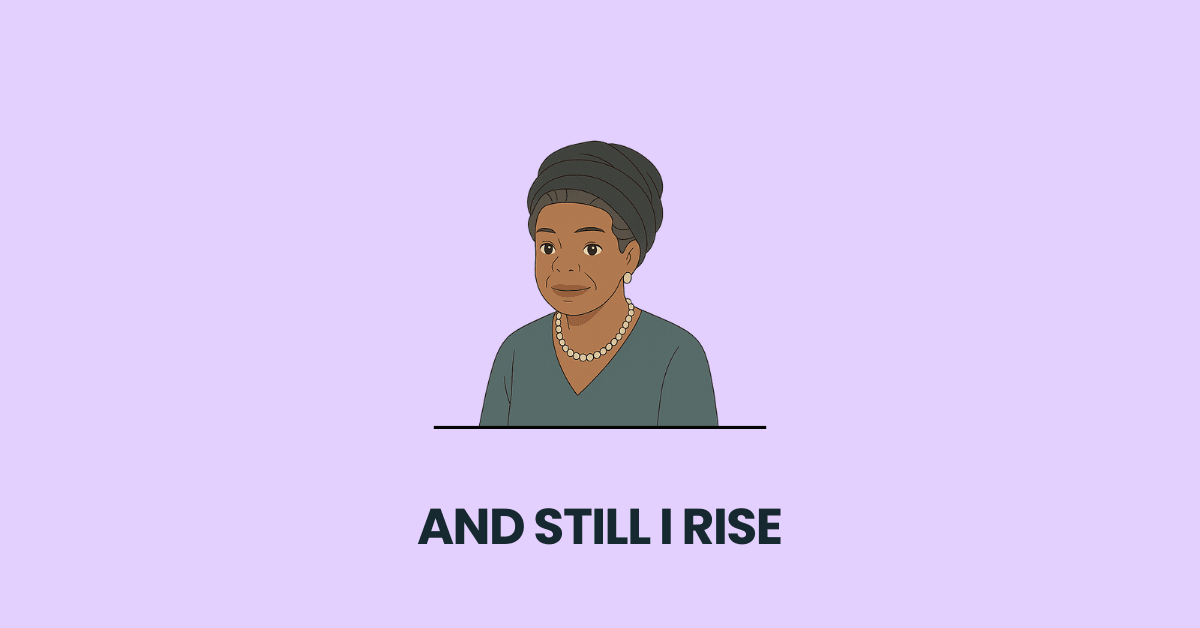
Get summaries, questions, answers, solutions, notes, extras, PDF and guides for Maya Angelou’s And Still I Rise: WBCHSE Class 11 English Literature textbook A Realm of English (B) Selection, which is part of the Semester III syllabus for students studying under WBBSE (West Bengal Board-Uccha Madhyamik). These solutions, however, should only be treated as references and can be modified/changed.
The poem “Still I Rise” is about a woman who faces cruelty and hatred. She speaks directly to those who try to bring her down. They may write lies about her in history or treat her like dirt. She says that no matter what they do, she will always rise up again.
She asks her oppressors if her confidence upsets them. She walks with pride, as if she has “oil wells pumping in my living room.” This is a metaphor for her inner wealth and power. She laughs as if she has “gold mines diggin’ in my own backyard.” This means her happiness comes from within and cannot be taken away. Her pride in her body is like having “diamonds at the meeting of my thighs.”
The speaker compares her strength to nature. She says she will rise with the same certainty as the sun, the moon, and the ocean tides. Even if people try to hurt her with words or hateful looks, she will rise above it all. She compares this to air, which cannot be kept down.
The poem connects her personal strength to the history of her people. She is rising from a past filled with shame and pain. She calls herself a “black ocean,” showing her great power. She is leaving behind the fear of the past for a clear, new day. She is the living dream and hope of her ancestors who were slaves. The poem ends with her repeating “I rise” again and again, showing her spirit cannot be broken.
You may write me down in history / With your bitter, twisted lies,
The speaker directly addresses those who oppress her. She acknowledges that they can try to record her and her people’s story in a false and hateful way, using dishonest words to create a negative image.
You may trod me in the very dirt
This line uses a strong image. To “trod” means to step on or crush underfoot. The speaker is saying that her oppressors can treat her with the utmost disrespect, as if she is worthless, like dirt on the ground.
But still, like dust, I’ll rise.
Despite any attempt to degrade or bury her, she will overcome it. The comparison to dust is effective because dust is light and seems insignificant, yet it cannot be kept down permanently; it always settles and rises again. This shows her resilience.
Does my sassiness upset you?
The speaker asks her oppressors a direct question. She wants to know if her bold, confident, and spirited attitude (“sassiness”) makes them uncomfortable or angry.
Why are you beset with gloom?
She continues questioning them, asking why they are filled with sadness and negativity (“beset with gloom”). She suggests that her own confidence seems to create unhappiness in them.
‘Cause I walk like I’ve got oil wells / Pumping in my living room.
The speaker explains the source of her confident walk. This is a comparison (a simile) suggesting she moves with the pride and security of someone who possesses great, unimaginable wealth. The image of oil wells in a living room shows a personal and private source of power and value.
Just like moons and like suns, / With the certainty of tides,
Here, the speaker compares her ability to rise to the constant and predictable patterns of nature. The moon, the sun, and the ocean’s tides are powerful, unstoppable forces that follow their own natural laws, regardless of what humans do.
Just like hopes springing high,
She also likens her resilience to the feeling of hope, which can appear and grow strong even in the most difficult situations.
Still I’ll rise.
This is a repeated declaration that serves as the poem’s central message. It confirms that, like the natural forces she just mentioned, her rise is certain and cannot be stopped.
Did you want to see me broken? / Bowed head and lowered eyes?
The speaker confronts her oppressors about their intentions. She asks if their goal was to destroy her spirit completely, forcing her into a posture of defeat and shame, which is shown by a “bowed head and lowered eyes.”
Shoulders falling down like teardrops, / Weakened by my soulful cries?
She continues to paint a picture of utter defeat. The image of shoulders drooping like teardrops powerfully communicates deep sadness. She asks if they wished to see her made weak by her own sorrow and pain.
Does my haughtiness offend you?
She asks if her sense of pride and self-worth (“haughtiness”) is offensive to them. She uses a word that her critics might use against her, turning it into a statement of her own strength.
Don’t you take it awful hard
In a slightly mocking manner, she tells her oppressors not to be too upset or distressed by her confident attitude.
‘Cause I laugh like I’ve got gold mines / Diggin’ in my own backyard.
This is another comparison that explains her inner strength. Her laughter is rich and full because she possesses a secret, personal source of joy and value, like discovering a gold mine. This wealth is internal and cannot be taken away by others.
You may shoot me with your words, / You may cut me with your eyes,
The speaker describes the pain of non-physical attacks. Cruel words can feel as hurtful as being shot, and hateful looks can feel as sharp as a cut. These lines describe the emotional and psychological violence she endures.
You may kill me with your hatefulness,
She states that the intensity of their hatred is so strong that it feels like it has the power to destroy her completely.
But still, like air, I’ll rise.
Despite these severe attacks, she will overcome them. She compares herself to air—something that is essential for life, is everywhere, and cannot be contained or destroyed. This shows an even greater level of resilience than the earlier comparison to dust.
Does my sexiness upset you?
The speaker now points to her physical self and her femininity as a source of power. She asks if her confidence in her own body and her attractiveness are disturbing to her oppressors.
Does it come as a surprise / That I dance like I’ve got diamonds / At the meeting of my thighs?
She challenges the idea that she should be ashamed of her body or her sensuality. She describes her way of moving as joyful and precious, as if she is decorated with valuable jewels. This is a celebration of her womanhood, which she presents as a source of personal power.
Out of the huts of history’s shame / I rise
The speaker connects her personal story to the collective, painful history of her ancestors. “Huts of history’s shame” refers to the degrading conditions of slavery and racial oppression. She is rising above this shameful past.
Up from a past that’s rooted in pain / I rise
She repeats the idea that she is moving upward from a history that was defined by deep and continuous suffering. The repetition of “I rise” creates a powerful rhythm, like a chant of victory.
I’m a black ocean, leaping and wide, / Welling and swelling I bear in the tide.
She uses a powerful metaphor to describe her identity. By calling herself a “black ocean,” she represents the immense strength, depth, and power of her people. An ocean is vast and cannot be controlled. “Welling and swelling” suggests a growing, unstoppable force that moves with the natural power of the tide.
Leaving behind nights of terror and fear / I rise
She is moving on from the darkness of the past, a time filled with constant violence and fear.
Into a daybreak that’s wondrously clear / I rise
She is moving toward a future that is bright and full of hope, like a beautiful, clear morning (“daybreak”). This represents freedom and a new beginning.
Bringing the gifts that my ancestors gave,
She carries with her the resilience, talents, and spiritual strength that were passed down to her from her ancestors who survived unimaginable hardship.
I am the dream and the hope of the slave.
The speaker sees herself as the living fulfillment of the dreams her enslaved ancestors had for future generations. They longed for a day when their descendants would be free, proud, and successful, and she embodies that very hope.
I rise / I rise / I rise.
The poem concludes with this triumphant, repeated statement. This final chant confirms her absolute victory over oppression and celebrates her unbreakable spirit.
1. What reflection of the society do we find in the poem?
Answer: The poem reflects a society marked by oppression and prejudice, where some people attempt to control history by writing bitter, twisted lies. It is a society where individuals can be trodden into the very dirt and attacked with hateful words, scornful eyes, and sheer hatefulness. This society wants to see its victims broken, with bowed heads, lowered eyes, and shoulders falling like teardrops. The oppressors are beset with gloom and are upset and offended by the confidence and pride of those they try to suppress. The poem points to a history of shame and a past rooted in pain, terror, and fear, specifically referencing the experience of slavery.
2. Who is YOU addressed in the poem? Who is “I”?
Answer: The word YOU in the poem addresses the oppressors. These are the people who write lies in history, who try to crush the speaker’s spirit, and who use words, looks, and hatefulness as weapons. They are the ones who are upset by the speaker’s sassiness and offended by her haughtiness, wishing to see her broken and weakened.
The “I” in the poem is the speaker, who represents not only herself but also her entire community that has faced oppression. She is a figure of immense resilience who rises from a past of pain and shame. She identifies herself as a black ocean, the dream and the hope of the slave, and the inheritor of the gifts her ancestors gave.
3. How is Identity presented in Still I Rise?
Answer: In the poem, identity is presented as being incredibly resilient and defiant. Despite all attempts to crush her spirit—through lies, physical degradation, and hateful attacks—the speaker repeatedly affirms that she will rise. This shows an identity that cannot be defeated.
The identity is also one of great confidence and self-worth. The speaker’s sassiness and haughtiness are presented as sources of strength that offend her oppressors. She describes her walk as if she owns oil wells, her laugh as if she has gold mines, and her dance as if she possesses diamonds. These images portray an inner richness and value that is independent of external opinion.
Furthermore, the identity is deeply connected to history and community. The speaker rises from the huts of history’s shame and a past rooted in pain. She sees herself as the fulfillment of the dreams of her ancestors, stating that she is the dream and the hope of the slave. This gives her identity a collective and historical weight.
Finally, this identity is likened to powerful and inevitable forces of nature. The speaker’s rising is compared to the certainty of suns, moons, and tides. She describes herself as a vast and powerful black ocean. This presents an identity that is natural, unstoppable, and eternal, moving from the nights of terror and fear into a wondrously clear daybreak.
4. Analyse the various images as found in Still I Rise.
Answer: The poem uses several powerful images to convey its message. The central image is that of rising, which is repeated throughout the poem. The speaker rises like dust, which seems humble but is persistent and cannot be kept down, and like air, which is formless, essential, and free. This recurring image shows unstoppable perseverance.
There are also strong images of oppression. The speaker is trodden in the very dirt, and the attacks against her are described with violent imagery, such as being shot with words, cut with eyes, and killed with hatefulness. History itself is depicted as a place of bitter, twisted lies and huts of shame, grounding the struggle in a painful reality.
To counter this, the speaker uses images of immense wealth to represent her inner confidence and self-worth. She walks as if she has oil wells, laughs as if she owns gold mines, and dances as if she is adorned with diamonds. These images create a picture of a person whose spirit is rich and unbreakable, regardless of her circumstances.
The poem is also rich with images from the natural world. The speaker’s resilience is compared to the certainty of moons, suns, and tides, suggesting her rise is a natural and inevitable event. She also presents herself as a black ocean, leaping and wide, an image of immense, untamable power and depth.
Finally, there is a strong contrast between images of despair and hope. The oppressors wish to see a broken figure with a bowed head and shoulders falling like teardrops. This is set against the hopeful images of hopes springing high and the speaker leaving behind nights of terror and fear to enter a wondrously clear daybreak, symbolizing liberation and a new beginning.
1. How does the speaker say she will react to being trodden in the dirt?
Answer: The speaker says that even if her oppressors trod her in the very dirt, she will still react by rising. She compares this action to the way dust rises, showing that her spirit cannot be kept down, no matter how much others try to degrade or bury her.
2. What does the simile “like dust, I’ll rise” suggest about the speaker’s resilience?
Answer: The simile which states that like dust, she will rise, suggests that the speaker’s resilience is natural and unstoppable. Dust is a common substance that can be disturbed and stepped on, but it never truly goes away. It always settles and then rises again. This comparison shows that the speaker’s ability to overcome hardship is just as certain and persistent.
3. What does the speaker mean by having “oil wells pumping in my living room”?
Answer: The statement about having oil wells pumping in her living room is a way for the speaker to describe her immense inner wealth, confidence, and self-worth. Oil wells are a symbol of great riches, and by saying they are in her private living space, she indicates that this value comes from within herself. This inner power is what allows her to walk with pride and sassiness.
4. Why, according to the speaker, are her oppressors “beset with gloom”?
Answer: According to the speaker, her oppressors are beset with gloom because her own sassiness and confidence upset them. She asks why they are so gloomy and then explains it is because she walks with the pride of someone who has oil wells pumping in her living room. Her unapologetic self-assurance and joy are a direct challenge to their desire to see her defeated, which makes them unhappy.
5. To what natural elements does the speaker compare her certainty of rising?
Answer: The speaker compares her certainty of rising to several powerful and constant natural elements. She says she will rise just like:
These comparisons show that her ability to rise is as predictable and unstoppable as these forces of nature.
6. What does the comparison to moons, suns, and tides imply about her spirit?
Answer: The comparison to moons, suns, and tides implies that the speaker’s spirit is powerful, constant, and cannot be controlled by human actions. Just as no one can stop the sun from rising, the moon from appearing, or the tides from turning, no one can stop her from rising above her circumstances. Her spirit operates with the same natural and inevitable force.
7. Describe the broken image the speaker’s oppressors wished to see.
Answer: The broken image the speaker’s oppressors wished to see is one of complete submission and despair. They wanted to see her with a bowed head and lowered eyes. They hoped to see her shoulders falling down like teardrops, and to see her weakened by her own soulful cries. This is a picture of a person who has been utterly defeated in body and spirit.
8. What does the metaphor of “gold mines diggin’ in my own backyard” signify?
Answer: The metaphor of having gold mines digging in her own backyard signifies that the speaker possesses a deep, personal, and inherent source of joy and value. Gold mines represent great wealth and happiness. By saying they are in her backyard, she shows that this joy is self-generated and belongs to her alone. This inner richness is the source of her laughter, which she knows offends her oppressors.
9. How does the speaker counter the attacks of words, eyes, and hatefulness?
Answer: The speaker counters the attacks of words, eyes, and hatefulness not by fighting back, but by transcending them. She acknowledges that her oppressors may shoot her with their words, cut her with their eyes, and even try to kill her with their hatefulness. However, her response to all of this is to declare that still, like air, she will rise, showing that their attacks cannot truly harm her indestructible spirit.
10. What does the simile “like air, I’ll rise” reveal about the speaker’s nature?
Answer: The simile which states that like air, she will rise, reveals that the speaker’s nature is intangible, free, and indestructible. Air is all around us, but it cannot be held, cut, or permanently damaged. By comparing herself to air, the speaker shows that her spirit is beyond the reach of physical or emotional harm. She is free and cannot be contained or destroyed by her oppressors.
11. What does the speaker suggest by dancing like she has “diamonds at the meeting of my thighs”?
Answer: By dancing as if she has diamonds at the meeting of her thighs, the speaker celebrates her own body, femininity, and sexuality as sources of great value and power. Diamonds are precious and beautiful. This image suggests that she finds immense worth and beauty in her own physical being. Her dance is a confident expression of this self-worth, which she knows may be surprising or upsetting to those who wish to devalue her.
12. What is the “history’s shame” that the speaker is rising from?
Answer: The “history’s shame” that the speaker is rising from refers to the painful and degrading history of slavery and racial oppression. The poem mentions rising from the huts of this shame and later identifies the speaker as the hope of the slave. This history is shameful because of the immense cruelty and injustice inflicted upon her ancestors, and she is determined to rise above that legacy.
13. What does the metaphor “I’m a black ocean, leaping and wide” convey about the speaker?
Answer: The metaphor of being a black ocean, leaping and wide, conveys a sense of immense, powerful, and collective strength. An ocean is a vast and unstoppable force of nature. By identifying as a black ocean, the speaker connects her personal strength to the collective power of her people. The words “leaping,” “welling,” and “swelling” suggest a dynamic and growing force that cannot be contained.
14. What “nights of terror and fear” is the speaker leaving behind?
Answer: The “nights of terror and fear” that the speaker is leaving behind are the long, dark periods of slavery and racial oppression. This refers to the historical and ongoing experiences of violence, intimidation, and systemic injustice that her people have endured. She is rising out of this past of constant fear and into a new, hopeful future.
15. What does the “daybreak that’s wondrously clear” symbolize for the speaker?
Answer: The “daybreak that’s wondrously clear” symbolizes a new beginning filled with hope, freedom, and clarity. After leaving behind the “nights of terror and fear,” this daybreak represents a future free from the darkness of oppression. It is a symbol of liberation and the promise of a new era where her worth and identity are seen and celebrated without obstruction.
16. What are the “gifts that my ancestors gave” that the speaker brings?
Answer: The “gifts that my ancestors gave” are the qualities of strength, hope, and resilience that were passed down through generations of enslaved people. These gifts include the ability to endure hardship, the capacity for joy and laughter despite pain, and a rich cultural spirit. The speaker carries these gifts forward as she becomes the living embodiment of her ancestors’ dream of freedom.
17. What does the speaker mean by calling herself “the dream and the hope of the slave”?
Answer: By calling herself “the dream and the hope of the slave,” the speaker means that she is the living fulfillment of her ancestors’ greatest wish. Enslaved people dreamed of a future where their children would be free, proud, and successful. The speaker, with her unbreakable spirit and confident defiance, represents the realization of that long-held dream and the embodiment of that enduring hope for liberation.
18. What is the effect of the repeated phrase “I rise” at the end of the poem?
Answer: The repetition of the phrase “I rise” at the end of the poem creates a powerful and triumphant conclusion. It functions like a chant, building in power with each repetition. This repetition reinforces the central message of inevitable and continuous victory over oppression. It leaves a final, strong impression of her absolute and unstoppable ascent.
19. How does the speaker use rhetorical questions to challenge her oppressors and assert her confidence?
Answer: The speaker uses rhetorical questions to directly confront her oppressors. She asks if her sassiness, haughtiness, or sexiness upsets or offends them. These questions are not for getting answers but are a way to challenge and taunt those who wish to see her fail.
For example, she asks, “Does my sassiness upset you?” and immediately follows it with a confident statement about her walk, comparing it to having oil wells. By doing this, she shows that she is fully aware of their negative feelings but is completely unaffected. Instead, she uses their disapproval as an opportunity to declare her own strength and confidence.
20. Explain the contrast between the oppressor’s actions and the speaker’s reactions in the first and sixth stanzas.
Answer: In the first stanza, the oppressor’s actions are to “write me down in history / With your bitter, twisted lies” and to “trod me in the very dirt.” These are acts of defamation and degradation. The speaker’s reaction is to rise “like dust,” suggesting an inevitable and natural return from being pushed down.
In the sixth stanza, the oppressor’s actions become more violent, even if metaphorical: “You may shoot me with your words, / You may cut me with your eyes, / You may kill me with your hatefulness.” The speaker’s reaction is to rise “like air,” which is intangible and cannot be harmed. This shows a progression in her resilience, from something that can be pushed down but will return, to something that cannot be touched or destroyed at all.
21. Discuss how the speaker uses imagery of natural resources like oil, gold, and diamonds to express her self-worth.
Answer: The speaker uses images of valuable natural resources to show her high self-worth. She says she walks “like I’ve got oil wells / Pumping in my living room,” which means her confidence comes from a deep, powerful source of inner value. She also says she laughs “like I’ve got gold mines / Diggin’ in my own backyard,” suggesting her joy comes from a personal and rich source that she owns herself.
Finally, she dances “like I’ve got diamonds / At the meeting of my thighs,” connecting great value directly to her body and her femininity. These images show that her worth is not external but is an immense, inherent part of who she is.
22. How does the speaker’s tone shift from defiant taunting to a powerful declaration of historical identity?
Answer: The poem begins with a defiant and taunting attitude towards the oppressors. The speaker asks questions like “Does my sassiness upset you?” and “Does my haughtiness offend you?” This is a direct challenge, almost mocking them for their inability to break her spirit.
Later in the poem, this changes. The speaker begins to talk about rising “Out of the huts of history’s shame” and from a “past that’s rooted in pain.” Here, the “I” becomes a representative of a whole group of people. The poem ends with the powerful declaration, “I am the dream and the hope of the slave.” The personal taunting transforms into a grand statement of collective historical identity, survival, and triumph.
23. Explain the transition the speaker makes from “huts of history’s shame” to a “daybreak that’s wondrously clear.”
Answer: The phrase “huts of history’s shame” represents the painful past of slavery and racial injustice. “Huts” suggest poverty and poor living conditions, while “history’s shame” points to a legacy of suffering and degradation. This is a place of darkness and pain.
The speaker makes a transition from this past by rising “Into a daybreak that’s wondrously clear.” “Daybreak” symbolizes a new beginning after the long “nights of terror and fear.” The description “wondrously clear” suggests a future of freedom, hope, and truth, without the oppression of the past. The transition is an active one, where the speaker consciously leaves the darkness behind to enter a bright new reality.
24. How does the poem connect the speaker’s personal struggle to a larger, collective history of pain and survival?
Answer: The poem links the speaker’s personal fight to a larger collective history. It starts with a personal “I” being attacked by a “you.” However, the poem soon broadens its scope. The speaker declares that she rises “Out of the huts of history’s shame” and “Up from a past that’s rooted in pain.” These lines show that her struggle is not just her own but is part of the shared history of her people.
She further connects to this collective identity by describing herself as a “black ocean, leaping and wide.” The connection is made completely clear when she says, “I am the dream and the hope of the slave.” Here, her individual identity merges with the history of her ancestors, showing her personal victory is a fulfillment of their hopes for freedom.
25. Discuss the significance of the natural imagery used in the poem. How do dust, air, and the ocean represent different aspects of her resilience?
Answer: The natural imagery in the poem shows different aspects of the speaker’s resilience. First, she is “like dust.” Dust can be trodden into the dirt, but it is impossible to keep down forever; it will always rise again. This represents a persistent and inevitable resilience.
Later, she is “like air.” Air is essential to life, but it is formless and cannot be cut, shot, or killed. This shows a higher form of resilience, suggesting her spirit is indestructible and cannot be physically harmed. Finally, she becomes a “black ocean, leaping and wide.” The ocean is a symbol of immense, deep, and uncontrollable power. This image transforms her from one person into a vast, collective force of nature that is swelling with unstoppable strength.
26. Analyse the portrayal of confident femininity and sensuality in the poem. How does this defy the oppressor?
Answer: The poem presents confident femininity and sensuality as a form of defiance. The speaker directly asks her oppressors if her “sassiness” and “sexiness” upset them. By asking this, she acknowledges that her confidence is a challenge to them.
She celebrates her body and its power, stating she walks “like I’ve got oil wells” and dances “like I’ve got diamonds / At the meeting of my thighs.” She connects her physical self and her sensuality with things of great value. This is a powerful act of defiance because oppressors often try to devalue and control the bodies of those they oppress. By claiming her femininity and sensuality as sources of wealth and power, she rejects their control and asserts her own unbreakable self-worth.

Only for registered users