Synonyms
More meanings
Tip: select a single word for meaning & synonyms.
Select multiple words normally to copy text.

Here, you will find summaries, questions, answers, textbook solutions, pdf, extras etc. of (Nagaland Board) NBSE Class 12 (Arts/Commerce) Economics Chapter 5: Aggregate Demand and its Component. These solutions, however, should be only treated as references and can be modified/changed.
In macroeconomics, two fundamental concepts are aggregate demand and aggregate supply. These concepts are the backbone of economic analysis, providing a comprehensive view of economic activity at a national level.
Aggregate demand refers to the total demand for final goods and services in an economy within a specific time frame. It comprises various components, including household consumption demand, private investment demand, government demand for goods and services, and net export demand. Each of these components plays a crucial role in shaping the overall demand in an economy.
On the other hand, aggregate supply represents the total output of goods and services produced for sale in an economy. It is the money value of total output available for purchase during a given period. The main components of aggregate supply are consumption and saving. A significant portion of income is spent on consumption of goods and services, and the balance is saved.
The relationship between consumption and income is known as the consumption function or propensity to consume. As income increases, consumption expenditure also increases, but the increase in consumption is less than the increase in income. This relationship is crucial in understanding the spending behavior of consumers in an economy.
Similarly, the saving function represents the relationship between saving and income. The part of income not spent on current consumption is saved. As income increases, the propensity to save also increases.
1. Consumption function is the functional relationship between ___________ and __________.
Answer: consumption, income
2 . What does C/Y indicate?
Answer: Average Propensity to Consume (APC)
3. The ratio of change in consumption to change in income is called ___________.
Answer: Marginal Propensity to Consume (MPC)
4. What is the shape of AD curve?
Answer: upward sloping
5. In a two-sector economy, what are the components of aggregate demand (AD)?
Answer: In a two-sector economy, the components of aggregate demand (AD) are Household (or private) consumption demand and Private investment demand.
6. If APC=0.7, then what will be APS?
Answer: If APC=0.7, then APS will be 0.3, as APC + APS = 1.
7. What refers to actual saving in an economy during a year?
Answer: Ex-post savings refers to actual saving in an economy during a year.
8. What assumption is Keynesian theory of employment based on?
Answer: Keynesian theory of employment is based on the assumption of less than full employment in the economy.
9. What s Breakeven Point?
Answer: Break-even Point refers to that point in the level of income at which consumption expenditure becomes exactly equal to income.
10. When planned savings exceed planned investment, the level of income and employment will tend to ___________.
Answer: fall
1. What are the two approaches to macroeconomics?
Answer: The two approaches to macroeconomics are the Classical Theory and the Keynesian Theory. The Classical Theory assumes full employment in the economy, while the Keynesian Theory criticizes this assumption and instead focuses on the determination of income, employment, and output at a level lower than full employment.
2. What are the components of aggregate demand?
Answer: The components of aggregate demand (aggregate expenditure) in a four-sector economy are:
3. Define aggregate supply.
Answer: Aggregate supply is the money value of total output available in the economy for purchase during a given period.
4. What are the components of aggregate supply?
Answer: The main components of aggregate supply are consumption and saving.
5. State the consumption function.
Answer: The consumption function is represented by the equation C = C + bY, where C is total consumption, C is autonomous consumption (i.e., consumption at zero level of income), b is the Marginal Propensity to Consume (i.e., the rate at which consumption increases for every rupee increase in income), and Y is the level of income.
6. What is autonomous consumption?
Answer: Autonomous consumption is the consumption that occurs even when income is zero. It is the minimum level of consumption that has to be maintained for survival.
7. How is autonomous consumption different from induced consumption?
Answer: Autonomous consumption is different from induced consumption in that autonomous consumption is the minimum level of consumption that occurs even when income is zero, while induced consumption is the additional consumption that occurs when income increases. Induced consumption is less than additional income, meaning that when income increases, consumption expenditure does not increase at the same rate as income. This is known as induced consumption.
8. State any two features of APC.
Answer: Two features of Average Propensity to Consume (APC) are:
9. State any two features of MPC.
Answer: Two features of MPC are:
10. When can savings be negative?
Answer: Savings can be negative at zero or low level of income. At lower level of income, saving is negative.
11. Define Marginal Propensity to Consume (MPC).
Answer: The ratio of change in consumption (AC) due to change in income (AY) is called marginal propensity to consume (MPC). Marginal literally means additional (or incremental) and propensity to consume means desire to consume. Thus, MPC is that part of additional income which is spent on additional consumption.
12. Define Marginal Propensity to save (MPS).
Answer: The Marginal Propensity to Save (MPS) is the proportion of an additional income that the consumer spends on saving. It is the slope of the saving function.
13. What is autonomous investment?
Answer: Autonomous investment refers to an investment which is autonomous (independent) of the level of income and not influenced by profit expectation. It is generally done in the government sector. It is income-inelastic, i.e., it is not affected by change in income level.
14. What is induced investment?
Answer: Induced investment refers to the investment which is made with the motive of earning profit and is directly influenced by income level. Private investment is almost induced investment.
1. Write a short note on aggregate demand.
Answer: Aggregate demand refers to the total demand for all goods and services in an economy at a given price level and in a given time period. It is the sum of all personal consumption expenditures (C), investments (I), and government spending (G), plus the difference between the country’s exports (X) and imports (M). It is represented as AD = C + I + G + (X-M). Aggregate demand curve slopes downwards due to the wealth effect, interest rate effect, and international trade effect.
2. What is meant by aggregate supply? What are its components?
Answer: Aggregate supply is the money value of total output available in the economy for purchase during a given period. When expressed in physical terms, aggregate supply refers to the total output of goods and services produced for sale in an economy. It is assumed that in the short run, prices of goods do not change and the elasticity of supply is infinite.
The main components of aggregate supply are consumption and saving.
3. What is APC? Give its features.
Answer: Average Propensity to Consume (APC) is the ratio of total consumption expenditure to total income. It gives the average consumption-income relationship at different levels of income. It is worked out by dividing total consumption expenditure (C) by total income (Y).
Features of APC include:
4. What is MPC? Write its features.
Answer: Marginal Propensity to Consume (MPC) is the ratio of change in consumption due to change in income. It measures the ratio of change in consumption expenditure as a result of change in income.
Features of MPC include:
5. How is APC different from MPC?
Answer: Total consumption expenditure divided by total income is APC whereas change in consumption expenditure divided by change in income is MPC. When income increases, both APC and MPC fall but MPC falls more rapidly. Between APC and MPC, the value of APC can be greater than 1 when consumption expenditure becomes greater than income. However, the value of MPC cannot be greater than 1 because the increase in consumption cannot be more than the corresponding increase in income.
6. What is the savings function?
Answer: The savings function shows the relationship between total savings and total income. It is represented as S = -a + (1-b)Y, where ‘a’ is the intercept, ‘b’ is the slope, and ‘Y’ is the total income. The negative intercept indicates that at zero income, the savings are negative, which means the economy is dissaving. The slope (1-b) is the Marginal Propensity to Save (MPS).
7. What is APS? Write its features.
Answer: Average Propensity to Save (APS) is the ratio of total savings (S) to total income (Y). It gives the average saving-income relationship at different levels of income. It is worked out by dividing total savings (S) by total income (Y).
Features of APS include: (i) APS can be negative when consumption expenditure is more than income, (ii) APS can be less than 1 when consumption expenditure is less than income, (iii) APS can never be more than 1 because savings can never be more than income, and (iv) APS rises with an increase in income.
8. What is MPS? Write its features.
Answer: Marginal Propensity to Save (MPS) is the ratio of change in saving (ΔS) to change in income (ΔY). It is that part of additional income which is saved. In other words, it is a measure of additional Saving as a proportion of additional (incremental) income. MPS is worked out by dividing change in saving (ΔS) with the corresponding change in income (ΔY).
Features of MPS include: (i) Value of MPS lies always between 0 and 1. If entire additional income is consumed, then there is no saving making MPS = 0. If entire additional income is saved, then MPS = 1. (ii) MPS (like MPC) can never be negative because MPS is the ratio between additional saving (ΔS) and additional (incremental) income (ΔY).
9. What is the relationship between APS and APC?
Answer: The sum of APC and APS is always equal to unity (i.e., APC + APS = 1). It is so because income is either consumed or saved. Again, the relationship can be stated in the following way as well: APC = 1 – APS and APS = 1 – APC. If one is given, the other can be worked out. Again, the value of APS can be negative when consumption expenditure exceeds income. When income increases, APC decreases continuously but APS increases continuously.
10. What is the relationship between MPS and MPC?
Answer: The sum of MPC and MPS is equal to unity (i.e., MPC + MPS = 1). For instance, if a person’s income increases by 1 and out of it, they spend 70 paise on consumption (i.e., MPC = 0.7) and save 30 paise (i.e., MPS = 0.3), then MPC + MPS = 0.7 + 0.3 = 1. This relationship can also be expressed as MPC = 1 – MPS and MPS = 1 – MPC. If one is given, we can find out the other because the sum of MPC and MPS is equal to unity, i.e., incremental (additional) income.
1. Explain in detail aggregate demand and its components.
Answer: Aggregate demand refers to the total demand for final goods and services in the economy. It includes Household (or private) consumption demand, Private investment demand, Government demand for goods and services, Net export demand. Household (or Private) Consumption Demand (C) is defined as ‘Value of goods and services that households are able and willing to buy. Private Investment Demand (I) refers to planned (ex-ante) expenditure on the creation of new capital assets like machines, buildings, and raw materials by private entrepreneurs. Government Demand for Goods and Services (G) refers to government planned (ex-ante) expenditure on the purchase of consumer and capital goods to fulfill common needs of the society. Net Exports (Exports- Imports) Demand is the difference between the export of goods and services and import of goods and services during a given period.
2. Write a note on the consumption function.
Answer: The consumption function, or propensity to consume, is the functional relationship between consumption and income. Consumption, being a part of income, directly depends upon income itself. Thus, consumption (C) is a function (f) of income (Y). Symbolically: C=f(Y). The consumption function means the proportion of income spent on consumption goods.
The consumption function (linear, i.e., straight-line consumption function) is represented by the following equation: C=C+bY. Here, C is total consumption, C is autonomous consumption (i.e., consumption at zero level of income), b is the Marginal Propensity to Consume — MPC (i.e., the rate at which consumption increases for every rupee increase in income), and Y is the level of income.
3. Write a note on APC and MPC.
Answer: Average Propensity to Consume (APC): The ratio of total consumption expenditure to total income is called APC. It gives the average consumption-income relationship at different levels of income. It is worked out by dividing total consumption expenditure (C) by total income (Y). APC can be greater than 1 when consumption expenditure is more than income. APC can be less than 1 when consumption expenditure is less than income. APC can never be zero because at zero income, survival needs minimum consumption (called Autonomous Consumption). APC falls with an increase in income.
Marginal Propensity to Consume (MPC): The ratio of change in consumption (ΔC) due to change in income (ΔY) is called MPC. MPC is that part of additional income which is spent on additional consumption. The value of MPC is equal to unity (i.e.,1) when MPS is zero since the whole of disposable income is spent on consumption. Again, the value of MPC cannot be greater than 1 because change in consumption (i.e., additional consumption) cannot be more than change in income (i.e., additional income).
4. What do you mean by break-even point? Explain with the help of an example.
Answer: The break-even point refers to the point at which total cost equals total revenue, resulting in neither profit nor loss.
For instance, if a company sells a product for Rs 20 per unit, and the total fixed costs are Rs 1000, and the variable cost per unit is Rs 10, then the break-even point in units would be 100. This means the company needs to sell 100 units of the product to cover its total costs. If it sells less than 100 units, it will incur a loss, and if it sells more than 100 units, it will make a profit
5. Explain the meaning of MPS and its features with an example.
Answer: MPS, or Marginal Propensity to Save, is the ratio of change in saving (ΔS) to change in income (ΔY). It is that part of additional income which is saved. In other words, it is a measure of additional Saving as a proportion of additional (incremental) income. MPS is worked out by dividing change in saving (ΔS) with the corresponding change in income (ΔY).
For instance, when national income goes up from < 100 crore to € 200 crore, saving also goes up from zero to % 30 crore. In this case, MPS = ΔS / ΔY = 30 / 100 = 0.3 or 30%.
Features of MPS include:
(i) Value of MPS lies always between 0 and 1. If entire additional income is consumed, then there is no saving making MPS = 0. If entire additional income is saved, then MPS = 1. (ΔS=ΔY) In short,0< MPS <1.
(ii) MPS (like MPC) can never be negative because MPS is the ratio between additional saving (ΔS) and additional (incremental) income (ΔY)
6. What do you understand by APS and APC? Derive their relationship?
Answer: APS (Average Propensity to Save) is the ratio of total saving to total income. It represents the part of total income which is saved. APS can be calculated by dividing total saving (S) by total income (Y).
APC (Average Propensity to Consume) is the ratio of total consumption expenditure to total income. It represents the percentage of income which is spent on consumption.
The relationship between APC and APS is such that the sum of APC and APS is always equal to unity (i.e., APC + APS = 1). This is because income is either consumed or saved. If one is given, the other can be worked out. Again, the value of APS can be negative when consumption expenditure exceeds income.
7. What do you understand by MPS and MPC? Derive their relationship?
Answer: MPS (Marginal Propensity to Save) is the ratio of change in saving (ΔS) to change in income (ΔY). It represents the part of additional income which is saved. The value of MPS lies always between 0 and 1. If the entire additional income is consumed, then there is no saving making MPS = 0. If the entire additional income is saved, then MPS = 1. MPS can never be negative.
MPC (Marginal Propensity to Consume) is the ratio of change in consumption (ΔC) due to change in income (ΔY). It represents the part of additional income which is spent on additional consumption. The value of MPC is equal to unity (i.e.,1) when MPS is zero since the whole of disposable income is spent on consumption. Again, the value of MPC cannot be greater than 1 because change in consumption (i.e., additional consumption) cannot be more than change in income (i.e., additional income). MPC or MPS cannot be negative.
The relationship between MPC and MPS is such that the sum of MPC and MPS is equal to unity (i.e., MPC + MPS = 1). This is because incremental (additional) income is either consumed or saved. If one is given, the other can be worked out.
8. Differentiate between induced investment and autonomous investment?
Answer: Induced investment refers to the investment which is made with the motive of earning profit and is directly influenced by income level. Private investment is almost always induced investment. Induced investment depends directly upon profit expectations. It is income-elastic, i.e., it changes as income changes. If national income goes up, induced investment also goes up, i.e., an increase in income induces investment.
On the other hand, autonomous investment refers to the investment which is autonomous (independent) of the level of income and not influenced by profit expectation. It is generally done in the government sector. It is income-inelastic, i.e., it is not affected by change in income level. The volume of autonomous investment is the same at all levels of income. Autonomous investment is generally affected by autonomous factors (other than income) such as public utility works, changes in the nature of consumer demand, increase in population, discovery of new resources, new technology, etc.
1. What is aggregate demand? What are its components?
Answer: Aggregate demand refers to the total demand for final goods and services in the economy. It is measured by the total expenditure of the community on goods and services, therefore, aggregate demand is also defined as the ‘total amount of money which all sectors (households, firms, government) of the economy are ready to spend on the purchase of goods and services. Alternatively, it is the total expenditure which the community intends to incur on the purchase of goods and services during the year.
The main components of aggregate demand (aggregate expenditure) in a four-sector economy are:
2. What is the relationship between income and saving? Explain.
Answer: The relationship between income and saving is direct, meaning that if income increases, saving also increases, but by less than the increase in income. This implies that as income increases, the proportion of income saved increases because the proportion of income consumed decreases.
At a lower level of income, saving can be negative. In the initial stages when there is a very low level of income, consumption expenditure is more than income, leading to negative saving (i.e., dissaving).
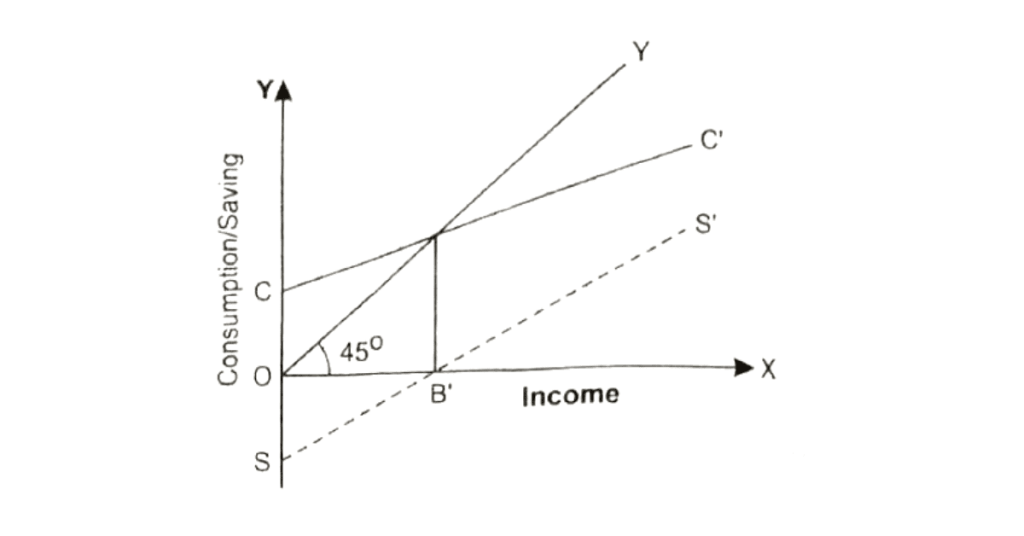
The saving function curve, which is a diagrammatic representation of the relationship between income and savings level, depicts a direct relationship between income and saving. The savings function line cuts the income line at a point called the Break-even point because at this point consumption expenditure is equal to income (or savings are zero). To the left of the break-even point, savings are negative, indicating consumption being more than income. To the right of the break-even point, savings are positive, indicating consumption expenditure being less than income.
The sum of Average Propensity to Consume (APC) and Average Propensity to Save (APS) is always equal to unity (i.e., APC + APS = 1). This is because income is either consumed or saved. If one is given, the other can be worked out. Again, the value of APS can be negative when consumption expenditure exceeds income. When income increases, APC decreases continuously but APS increases continuously.
3. What is savings function? Derive the savings curve from the consumption curve.
Answer: The savings function refers to the relationship between income and savings. As income increases, savings also increase but by less than the increase in income. This means that as income increases, the proportion of income saved increases because the proportion of income consumed decreases. At a lower level of income, saving is negative. In the initial stages when there is a very low level of income, consumption expenditure is more than income leading to negative saving (i.e., dissaving).
The savings curve can be derived from the consumption curve as they are complementary curves. We know that consumption (C) + saving (S) is always equal to income (Y) because income is either consumed or saved. It implies that consumption and saving curves are complementary curves as Y = C + S. Therefore, we can derive the saving function or curve directly from the consumption function or curve.
4. How is consumption curve derived from saving curve?
Answer: The consumption curve is derived from the saving curve by understanding the relationship between consumption and savings. Consumption and savings are two sides of the same coin, representing different uses of income. When income is consumed, it is not saved, and vice versa. Therefore, if we know the saving at each level of income, we can derive the consumption. If S(Y) is the saving function, representing saving at each level of income Y, then the consumption function C(Y) can be derived as C(Y) = Y – S(Y). This means that consumption at each level of income is equal to income minus saving at that level of income.
5. Write a note on investment function and its types.
Answer: The investment function is the behavior of investment corresponding to different levels of income or employment. In other words, it is the desire or willingness of producers (firms) to invest corresponding to different levels of income or employment. In money terms, investment means expenditure made on the purchase of new capital assets, like machines, equipment, inventories, etc. Investment is defined as an addition to the existing stock of physical assets (like the creation of new buildings, machinery, etc.) and changes in inventories (or stock of finished goods). Investment includes anything that adds to the future productive capacity of the economy. Broadly, components of investment are (i) plant and machinery, (ii) construction, and (iii) stocks.
Investment can be induced or autonomous. Induced investment refers to the investment which is made with the motive of earning profit and is directly influenced by the income level. Private investment is almost induced investment. Induced investment depends directly upon profit expectations. It is income-elastic, i.e., it changes as income changes. If the national income goes up, induced investment also goes up, i.e., an increase in income induces investment. Its reason is that an increase in national income leads to an increase in demand for goods and services and for meeting the same, investment is increased. In short, induced investment takes place when the level of income and demand in the economy goes up.
6. Differentiate between
(i) Planned savings and Actual savings.
Answer: Planned savings, also known as ex-ante savings, are the savings which all the households plan (desire) to make at different levels of income during a period. The amount of planned savings is given by the saving function (i.e., propensity to consume). On the other hand, actual savings, also known as ex-post savings, refer to the actual amount of savings made in the economy during a period. In other words, realized savings of a period, say a year, are called actual (ex-post) savings.
(ii) Ex-Ante investment and Ex-Post investment.
Answer: Ex-ante investment, or planned investment, is the investment which is desired to be made by the firms and planners in the economy during a particular period in the beginning of the period. It is the amount of planned investment, given by the investment demand function (i.e. relation between investment demand and rate of interest).
Ex-post investment, or actual investment, of a period (e.g. a year), measured after the fact, is called actual or ex-post investment. It includes the investment of unsold goods which are referred to as unplanned investment. Thus, actual investment equals planned + unplanned investment. Sometimes investment is made which was not included in the planned (intended) investment. This type of investment is called unplanned investment. Unplanned investment takes place when unsold finished goods accumulate due to poor sales. Thus, actual investment of an economy is the total of planned investment and unplanned investment.
1. What are the two main approaches to macroeconomics?
Answer: There are two theories of macroeconomics—one by Classical economists and the other by Keynes.
2. What did Classical economists believe about a capitalist economy?
Answer: Classical economists believed that a capitalist economy would normally be in full employment and at no point of time, can there be general over-production in an economy. They maintained that with the free play of economic forces, an economy would always be in a position to attain a level of full employment of its resources.
3. What event exploded the myth of the automatic working of the market mechanism?
Answer: The Great Depression of the 1930s (1929-33) exploded the myth that the automatic working of the market mechanism would ensure an equilibrium level of income consistent with full employment.
4. Who was J.M. Keynes? What is the name of his famous book published in 1936?
Answer: J.M. Keynes was a well-known English economist. His famous book, published in 1936, is titled “General Theory of Employment, Interest and Money”.
5. What revolution in economic thought did Keynes bring about?
Answer: Keynes brought about a revolution in economic thought called the Keynesian Revolution.
6. What is the core issue of macroeconomics?
Answer: The core issue of macroeconomics is the determination of the level of income, employment, and output.
7. At what level are income and employment in equilibrium?
Answer: In an economy, income and employment are in equilibrium at that level at which Aggregate Demand equals Aggregate Supply.
8. What is the main determinant of equilibrium in the Keynesian framework?
Answer: In the Keynesian framework, the determination of equilibrium depends mainly on the level of aggregate demand because, during the short run, aggregate supply is constant with respect to the given price.
9. Define Aggregate Demand.
Answer: Aggregate demand refers to the total demand for final goods and services in the economy. In simple words, aggregate demand is the total expenditure on consumption and investment.
10. How is aggregate demand measured?
Answer: Since aggregate demand is measured by the total expenditure of the community on goods and services, it is also defined as the ‘total amount of money which all sectors (households, firms, government) of the economy are ready to spend on the purchase of goods and services’. Alternatively, it is the total expenditure which the community intends to incur on the purchase of goods and services during the year.
11. What are the four main components of aggregate demand in a four-sector economy?
Answer: The main components of aggregate demand (aggregate expenditure) in a four-sector economy are:
12. What does Household (or Private) Consumption Demand refer to?
Answer: Household (or Private) Consumption Demand is defined as the ‘Value of goods and services that households are able and willing to buy.’ Alternatively, it refers to the ex-ante (planned) consumption expenditure to be incurred by all households on the purchase of goods and services.
13. Consumption is a function of what?
Answer: Consumption (C) is a function (f) of disposable income (Yd).
14. What is the relationship between income and consumption called?
Answer: The relationship between income and consumption is called ‘propensity to consume’ or consumption function.
15. What does Private Investment Demand refer to?
Answer: Private Investment Demand refers to the planned (ex-ante) expenditure on the creation of new capital assets like machines, buildings, and raw materials by private entrepreneurs.
16. What is the investment demand function?
Answer: The relationship between investment demand and the rate of interest is called the investment demand function.
17. What does Government Demand for Goods and Services refer to?
Answer: Government Demand for Goods and Services refers to the government’s planned (ex-ante) expenditure on the purchase of consumer and capital goods to fulfil the common needs of society.
18. What are Net Exports?
Answer: Net export is the difference between the export of goods and services and the import of goods and services during a given period. Net exports reflect the demand of foreign countries for our goods and services over our demand for foreign countries’ goods and services.
19. How is aggregate demand represented in a two-sector economy?
Answer: In the context of a two-sector (Household and Firm) economy, aggregate demand (AD) includes only two broad components of demand: consumption demand (C) and investment demand (I). In symbols: AD = C + I.
20. Why does the AD curve have a positive slope?
Answer: The AD curve has a positive slope, which means when income increases, AD (expenditure) also increases.
21. Why does the AD curve not originate from point O?
Answer: The AD curve does not originate at point O, which shows that even at a zero level of income, some minimum level of consumption is essential.
22. Why is the investment curve a straight line parallel to the X-axis?
Answer: The investment curve is a straight line parallel to the X-axis because, according to Keynes, the level of investment remains constant at all levels of income during the short period.
23. Define Aggregate Supply.
Answer: Aggregate supply is the money value of the total output available in the economy for purchase during a given period.
24. What does aggregate supply represent in the short run?
Answer: In the short run, aggregate supply represents national income. AS = Y, where Y is national income. Thus, income or total output measures the aggregate supply of goods and services.
25. What are the main components of aggregate supply?
Answer: The main components of aggregate supply are two, namely consumption and saving. A major portion of income is spent on the consumption of goods and services (C) and the balance is saved (S).
26. How is the Aggregate Supply curve represented graphically? Why?
Answer: The AS curve is artificially represented by a 45° line from the point of origin. Its significance is that every point on this line is equidistant from the X-axis and Y-axis because both axes have the same scale. Each point on this line indicates Expenditure (AD) = Income (AS).
27. What is the consumption function?
Answer: The functional relationship between consumption and income is called the consumption function (or propensity to consume).
28. What are the two noteworthy features of the consumption function?
Answer: Two noteworthy features of consumption functions are:
29. What are the two types of propensity to consume?
Answer: Propensity to consume is of two types—Average Propensity to Consume (APC) and Marginal Propensity to Consume (MPC).
30. Define Average Propensity to Consume (APC). How is it calculated?
Answer: The ratio of total consumption expenditure to total income is called APC. It is the percentage (or ratio) of income which is spent on consumption. It is worked out by dividing total consumption expenditure (C) by total income (Y). Symbolically: APC = C/Y.
31. Can APC be greater than 1? When?
Answer: Yes, APC can be greater than 1 (APC > 1) when consumption expenditure is more than income.
32. Can APC ever be zero? Why or why not?
Answer: APC can never be zero because at zero income, survival needs minimum consumption, which is called Autonomous Consumption.
33. What happens to APC as income increases?
Answer: APC falls with an increase in income.
34. Define Marginal Propensity to Consume (MPC). How is it calculated?
Answer: The ratio of change in consumption (ΔC) due to change in income (ΔY) is called marginal propensity to consume (MPC). It measures the ratio of change in consumption expenditure as a result of a change in income. MPC is worked out by dividing the increment in consumption with the corresponding increment in income. Symbolically: MPC = ΔC/ΔY.
35. What is the range of the value of MPC?
Answer: MPC is always greater than zero (MPC > 0) but less than 1 (MPC < 1). Hence, the value of MPC always lies between 0 and 1. It means 0 < MPC < 1.
36. What happens to MPC as income increases?
Answer: MPC falls with an increase in income. As a person becomes richer, he tends to consume a smaller portion of the increase in income.
37. What is the break-even point?
Answer: The break-even point refers to that point in the level of income at which consumption expenditure becomes exactly equal to income. In other words, the whole of the income is spent on consumption, and as a result, there is no saving.
38. What is autonomous consumption?
Answer: Autonomous consumption is the consumption at a zero level of income. Consumption can never be zero even if income is zero because some minimum level of consumption has to be maintained for survival. Such subsistence consumption is called autonomous consumption.
39. What is induced consumption?
Answer: Induced consumption is the portion of consumption that is influenced by a change in income. For instance, if income increases by ₹100, the tendency is to spend a part, say, ₹75, on consumption and save the remaining part, i.e. ₹25. This is known as induced consumption.
40. What is propensity to save?
Answer: Saving is that part of income which is not spent on current consumption. This is also called propensity to save. Simply put, propensity to save relates the level of saving to the level of income.
41. Can saving be negative? When?
Answer: Yes, saving can be negative at zero or a low level of income. At a lower level of income, saving is negative when consumption expenditure is more than income, leading to dissaving.
42. Define Average Propensity to Save (APS). How is it calculated?
Answer: The ratio of total saving to total income is called APS. Alternatively, it is that part of total income which is saved. It is calculated by dividing total saving (S) with total income (Y). Symbolically: APS = S/Y.
43. Can APS be negative? When?
Answer: Yes, APS can be negative when saving is negative. This occurs when the income level is below the break-even point, leading to dissaving.
44. What is the value of APS at the break-even point?
Answer: APS can be zero at the break-even point, where consumption equals income, and hence saving is zero.
45. Define Marginal Propensity to Save (MPS). How is it calculated?
Answer: MPS is the ratio of change in saving (ΔS) to change in income (ΔY). It is that part of additional income which is saved. MPS is worked out by dividing the change in saving (ΔS) with the corresponding change in income (ΔY). Symbolically: MPS = ΔS/ΔY.
46. What is the range of the value of MPS?
Answer: The value of MPS always lies between 0 and 1. In short, 0 < MPS < 1.
47. Can MPS be negative?
Answer: MPS can never be negative because it is the ratio between additional saving (ΔS) and additional (incremental) income (ΔY).
48. What is the relationship between MPC and MPS?
Answer: The sum of MPC and MPS is equal to unity, i.e., MPC + MPS = 1.
49. What is the relationship between APC and APS?
Answer: The sum of APC and APS is always equal to unity, i.e., APC + APS = 1. This is because income is either consumed or saved.
50. What is an investment function?
Answer: The investment function is the behaviour of investment corresponding to different levels of income/employment. In other words, it is the desire or willingness of producers (firms) to invest corresponding to different levels of income/employment.
51. Define induced investment. What is its main motive?
Answer: Induced investment refers to the investment which is made with the motive of earning profit and is directly influenced by the income level. Private investment is almost induced investment, and it depends directly upon profit expectations.
52. Define autonomous investment. Who generally undertakes it?
Answer: Autonomous investment refers to the investment which is autonomous (independent) of the level of income and not influenced by profit expectation. It is generally done in the government sector.
53. What is the shape of the induced investment curve?
Answer: The induced investment curve is positively sloped, which means with an increase in income, induced investment also goes up.
54. What is the shape of the autonomous investment curve?
Answer: The autonomous investment curve is a straight line parallel to the X-axis.
55. What is ex-ante saving?
Answer: Ex-ante saving refers to the savings which all households plan (desire) to make at different levels of income during a period. It is also called planned savings.
56. What is ex-ante investment?
Answer: Ex-ante investment is the investment which the firms or investors plan (desire) to make at different levels of income in the economy during a period. It is also called planned investment.
57. When does equilibrium occur in the economy in terms of saving and investment?
Answer: Equilibrium in the economy occurs only when planned investment is equal to planned savings, which means Ex-ante saving (S) = Ex-ante investment (I).
58. What is ex-post saving?
Answer: Ex-post savings refers to the actual amount of savings made in the economy during a period. In other words, realised savings of a period, say a year, are called actual (ex-post) savings.
59. What is ex-post investment?
Answer: Ex-post investment refers to the actual amount of investment made by all the entrepreneurs in the economy during a period.
60. What is unplanned investment?
Answer: Unplanned investment is a type of investment that was not included in the planned (intended) investment. Unplanned investment takes place when unsold finished goods accumulate due to poor sales.
61. Explain the two main approaches to macroeconomics.
Answer: There are two theories of macroeconomics—one by Classical economists and the other by Keynes.
Classical economists believed that a capitalist economy would normally be in full employment and at no point of time can there be general over-production in an economy. They maintained that with the free play of economic forces, an economy would always be in a position to attain a level of full employment of its resources.
Keynes criticised the Classical assumption of full employment and developed a new theory known as Macroeconomic Theory in which he analysed the factors which cause national income at a level lower than the full employment level.
62. How did the Great Depression challenge the beliefs of Classical economists?
Answer: Classical economists believed that the automatic working of the market mechanism would ensure an equilibrium level of income consistent with full employment. However, the Great Depression of the 1930s (1929-33) exploded this myth.
Although the USA and other Western countries were highly industrialised, there was a persistent fall in the level of output, income, and employment. Classical economists could not explain the widespread fall in prices, income, and employment during the worldwide depression, which challenged their belief in the self-correcting nature of a capitalist economy.
63. Explain the meaning of Aggregate Demand. What are its components in a four-sector economy?
Answer: Aggregate demand refers to the total demand for final goods and services in the economy. Since aggregate demand is measured by total expenditure of the community on goods and services, it is also defined as the ‘total amount of money which all sectors (households, firms, government) of the economy are ready to spend on the purchase of goods and services’. Alternatively, it is the total expenditure which the community intends to incur on the purchase of goods and services during the year. Thus, aggregate demand is synonymous with aggregate expenditure in the economy.
The main components of aggregate demand (aggregate expenditure) in a four-sector economy are:
Thus, AD = C + I + G + (X – M).
64. What is household consumption demand? Explain the relationship between consumption and disposable income.
Answer: Household (or Private) Consumption Demand (C) is defined as the ‘Value of goods and services that households are able and willing to buy.’ Alternatively, it refers to ex-ante (planned) consumption expenditure to be incurred by all households on the purchase of goods and services.
Consumption (C) is a function (f) of disposable income (Yd), i.e., C = f(Yd). As disposable income increases, consumption expenditure also increases. The amount by which it increases depends upon the propensity to consume. The relationship between income and consumption is called ‘propensity to consume’ or the consumption function.
65. What is private investment demand? What are the main factors that determine it?
Answer: Private Investment Demand (I) refers to the planned (ex-ante) expenditure on the creation of new capital assets like machines, buildings, and raw materials by private entrepreneurs. Investment is made not only to maintain the present level of production but also to increase production capacity in the future.
Investment demand in a private enterprise economy depends mainly on two factors: MEI (Marginal Efficiency of Investment) and the Rate of Interest. Investors judge whether the expected rate of return on new investment is equal to, greater than, or less than the market rate of interest. The three elements which are important in understanding investment are:
66. Explain the difference between induced investment and autonomous investment.
Answer: Induced investment refers to the investment which is made with the motive of earning profit and is directly influenced by the income level. It is income-elastic, meaning it changes as income changes. If national income goes up, induced investment also goes up.
Autonomous investment refers to the investment which is autonomous (independent) of the level of income and not influenced by profit expectation. It is generally done in the government sector. It is income-inelastic, meaning it is not affected by a change in the income level. The volume of autonomous investment is the same at all levels of income.
67. Explain the concept of Aggregate Supply. Why is it represented by a 45-degree line?
Answer: Aggregate supply is the money value of total output available in the economy for purchase during a given period. In physical terms, aggregate supply refers to the total output of goods and services produced for sale in an economy. Aggregate supply represents the national income of a country. Since the sum of factor incomes (rent, wages, interest, and profit) at the national level is called national income, aggregate supply (AS), output, and national income are the same.
The AS curve is represented by a 45° line from the point of origin. Its significance is that every point on this line is equidistant from the X-axis and Y-axis because both axes have the same scale. Each point on this line indicates Expenditure (AD) = Income (AS). The 45° line, also called a line of reference, helps us to identify equilibrium when two variables are shown to be graphically equal. That is why the AS curve is represented by a 45° line, so that when the AD curve intersects it, AD becomes equal to AS.
68. What is the consumption function? Explain its two main features with an example.
Answer: The functional relationship between consumption and income is called the consumption function (or propensity to consume). Simply put, the consumption function means the proportion of income spent on consumption goods. Consumption (C) is a function (f) of income (Y), symbolically represented as C = f(Y).
Two noteworthy features of consumption functions are:
For example, in an economy, the consumption function is given as C = 100 + 0.5Y. When income (Y) is ₹400, consumption is C = 100 + 0.5 × 400 = ₹300. When income rises to ₹600, consumption is C = 100 + 0.5 × 600 = ₹400. This shows that as income increases, consumption also increases, but by a smaller amount.
69. Distinguish between Average Propensity to Consume (APC) and Marginal Propensity to Consume (MPC).
Answer: The main distinctions between Average Propensity to Consume (APC) and Marginal Propensity to Consume (MPC) are:
Total consumption expenditure divided by total income is APC (APC = C/Y), whereas the change in consumption expenditure divided by the change in income is MPC (MPC = ΔC/ΔY).
When income increases, both APC and MPC fall, but MPC falls more rapidly.
The value of APC can be greater than 1 when consumption expenditure becomes greater than income. However, the value of MPC cannot be greater than 1 because the increase in consumption (ΔC) cannot be more than the corresponding increase in income (ΔY).
70. Explain the features of Average Propensity to Consume (APC).
Answer: The features of Average Propensity to Consume (APC) are:
71. Explain the features of Marginal Propensity to Consume (MPC).
Answer: The features of Marginal Propensity to Consume (MPC) are:
72. What is the Keynesian Psychological Law of Consumption?
Answer: According to Keynes, as income increases, consumption expenditure also increases but by less than the increase in income. In other words, when income increases, consumption expenditure does not increase at the same rate as income. This is called the Keynesian Psychological Law of Consumption. There is a tendency for people not to spend the whole of their incremental income on consumption, i.e., additional consumption is less than additional income. In other words, MPC is less than 1 (MPC < 1).
73. Explain the concept of the saving function. What are its main features?
Answer: The relationship between saving and income is called the saving function. Saving is that part of income which is not spent on current consumption. This is also called propensity to save. Simply put, propensity to save relates the level of saving to the level of income. It is the desire or tendency of households to save at a given level of income. Thus, saving (S) is a function (f) of income (Y).
The main features of the saving function are:
74. Distinguish between Average Propensity to Save (APS) and Marginal Propensity to Save (MPS).
Answer: Total saving (S) divided by total income (Y) is called APS (APS = S/Y), whereas the change in savings (ΔS) divided by the change in income (ΔY) is called MPS (MPS = ΔS/ΔY).
The value of APS can be negative when consumption expenditure is higher than income, leading to dissaving. However, the value of MPS can never be negative and always lies between 0 and 1.
75. Explain the relationship between MPC and MPS. Why must their sum be equal to one?
Answer: The sum of MPC and MPS is equal to unity, i.e., MPC + MPS = 1. This is because income (Y) is either spent on consumption (C) or saved (S).
Symbolically:
Y = C + S
or ΔY = ΔC + ΔS
By dividing both sides by ΔY, we get:
ΔY/ΔY = ΔC/ΔY + ΔS/ΔY
or 1 = MPC + MPS
The sum of MPC and MPS is equal to unity because they represent the two parts of any incremental (additional) income.
76. Explain the relationship between APC and APS. Why is their sum always equal to one?
Answer: The sum of APC and APS is always equal to unity, i.e., APC + APS = 1. It is so because income is either consumed or saved. Since APC is the proportion of income consumed (C/Y) and APS is the proportion of income saved (S/Y), their sum must account for the total income.
77. Distinguish between ex-ante saving and ex-post saving.
Answer: Ex-ante saving refers to the savings which all households plan (desire) to make at different levels of income during a period. The amount of planned savings is given by the saving function.
Ex-post saving refers to the actual amount of savings made in the economy during a period. In other words, realised savings of a period, say a year, are called actual (ex-post) savings.
78. Distinguish between ex-ante investment and ex-post investment.
Answer: Ex-ante or planned investment is the investment which is desired to be made by firms and planners in the economy during a particular period in the beginning of the period. It is the amount of planned investment, given by the investment demand function.
Ex-post or actual investment of a period, measured after the fact, is called actual or ex-post investment. It is noteworthy to mention that Keynes included in the investment of unsold goods which he called unplanned investment. Thus, actual investment equals planned investment + unplanned investment.
79. Explain why ex-post saving is always equal to ex-post investment.
Answer: Ex-post saving and ex-post investment are equal at all levels of income because it is an accounting identity. Since unplanned investment also gets included in realised investment, therefore, realised investment is always equal to realised saving.
80. Explain in detail the various components of Aggregate Demand in an open economy.
Answer: Aggregate demand (AD) refers to the total demand for final goods and services in the economy. In a four-sector, or open, economy, AD consists of planned spending by households on consumption, by firms on investment goods, by the government on the purchase of goods and services, and net exports. The main components of aggregate demand are:
Household (or private) consumption demand (C): This is defined as the ‘Value of goods and services that households are able and willing to buy.’ It refers to the ex-ante (planned) consumption expenditure to be incurred by all households on the purchase of goods and services. For instance, households’ demand for food, clothing, housing, books, and educational and medical services is called household consumption demand.
Private investment demand (I): This refers to the planned (ex-ante) expenditure on the creation of new capital assets like machines, buildings, and raw materials by private entrepreneurs. Investment means expenditures on the creation of new capital assets such as plants and equipment, inventories, and construction works that help in production.
Government demand for goods and services (G): This refers to the government’s planned (ex-ante) expenditure on the purchase of consumer and capital goods to fulfil the common needs of society. The government’s demand may be for satisfying public needs for roads, schools, hospitals, or for infrastructure, maintenance of law and order, and defence from external aggression.
Net export demand (X – M): Net export is the difference between the export of goods and services (X) and the import of goods and services (M) during a given period. Net exports reflect the demand of foreign countries for our goods and services over our demand for foreign countries’ goods and services. Thus, net exports show the expected (ex-ante) net foreign demand.
Thus, the equation for aggregate demand in an open economy is: AD = C + I + G + (X – M).
81. What is meant by propensity to consume? Explain its two types, APC and MPC, in detail.
Answer: Propensity to consume means the proportion of income spent on consumption. Consumption, being a part of income, directly depends upon income itself. It is of two types: Average Propensity to Consume (APC) and Marginal Propensity to Consume (MPC).
Average Propensity to Consume (APC):
The ratio of total consumption expenditure to total income is called APC. It is the percentage or ratio of income which is spent on consumption. It is worked out by dividing total consumption expenditure (C) by total income (Y).
Symbolically: APC = C/Y
For instance, if the aggregate income of an economy is ₹5,000 crore and aggregate consumption is ₹4,500 crore, then APC = 4,500 / 5,000 = 0.90 or 90%. This means that 90% of income is spent on consumption.
The features of APC are:
Marginal Propensity to Consume (MPC):
The ratio of the change in consumption (ΔC) due to the change in income (ΔY) is called the marginal propensity to consume (MPC). Marginal literally means additional, so MPC is that part of additional income which is spent on additional consumption. It is worked out by dividing the increment in consumption by the corresponding increment in income.
Symbolically: MPC = ΔC / ΔY
For instance, if the income of a country increases from ₹5,000 crore to ₹5,500 crore (by ₹500 crore) and consumption expenditure goes up from ₹4,000 crore to ₹4,300 crore (by ₹300 crore), then MPC = 300 / 500 = 0.6. This shows that a one-rupee change in income causes a 0.6 rupee change in consumption.
The features of MPC are:
82. What is meant by propensity to save? Explain its two types, APS and MPS, in detail.
Answer: The relationship between saving and income is called the saving function. Saving is that part of income which is not spent on current consumption. This is also called propensity to save, which relates the level of saving to the level of income. It is the desire or tendency of households to save at a given level of income. Its two types are Average Propensity to Save (APS) and Marginal Propensity to Save (MPS).
Average Propensity to Save (APS):
The ratio of total saving to total income is called APS. It is that part of total income which is saved. It is calculated by dividing total saving (S) by total income (Y).
Symbolically: APS = S/Y
For instance, if the national income is ₹200 crore and saving is ₹30 crore, then APS = 30 / 200 = 0.15 or 15%.
The features of APS are:
Marginal Propensity to Save (MPS):
MPS is the ratio of the change in saving (ΔS) to the change in income (ΔY). It is that part of additional income which is saved. MPS is worked out by dividing the change in saving by the corresponding change in income.
Symbolically: MPS = ΔS / ΔY
For instance, when national income goes up from ₹100 crore to ₹200 crore, and saving goes up from zero to ₹30 crore, then MPS = 30 / 100 = 0.3 or 30%.
The features of MPS are:
83. Explain the difference between ex-ante and ex-post concepts of saving and investment. Why is this distinction important?
Answer: The terms ex-ante and ex-post are used to differentiate between planned (or desired) and actual (or realised) economic variables. Briefly, ex-ante indicates ‘before the event’ and ex-post indicates ‘after the event’.
Ex-ante (Planned) Saving and Investment:
Ex-post (Actual) Saving and Investment:
Importance of the Distinction:
The distinction between ex-ante and ex-post is important for understanding the determination of equilibrium income.
Equilibrium in the economy occurs only when planned (ex-ante) investment is equal to planned (ex-ante) savings. If they are not equal, then output will tend to adjust up or down until the two are equal again. It is the ex-ante measures which form the basis of the theory of income determination.
In contrast, ex-post saving and ex-post investment are equal at all levels of income because it is an accounting identity. Since unplanned investment also gets included in realised investment, realised investment is always equal to realised saving.
1: Who is the author of the book “General Theory of Employment, Interest and Money”?
A. Adam Smith
B. J.M. Keynes
C. David Ricardo
D. Alfred Marshall
Answer: B. J.M. Keynes
2: In a two-sector economy, the components of aggregate demand (AD) are:
A. Consumption and investment
B. Government expenditure and investment
C. Domestic expenditure and exports
D. Consumption and government expenditure
Answer: A. Consumption and investment
3: The functional relationship between consumption and income is known as the:
A. Saving function
B. Investment function
C. Consumption function
D. Production function
Answer: C. Consumption function
4: What does the sum of Marginal Propensity to Consume (MPC) and Marginal Propensity to Save (MPS) equal?
A. 0
B. 1
C. Less than 1
D. Greater than 1
Answer: B. 1
5: The point at which consumption expenditure becomes exactly equal to income is called the:
A. Equilibrium point
B. Saturation point
C. Break-even point
D. Shutdown point
Answer: C. Break-even point
6: Investment that is independent of the level of income and not influenced by profit expectation is known as:
A. Induced investment
B. Private investment
C. Gross investment
D. Autonomous investment
Answer: D. Autonomous investment
7: The ratio of total consumption expenditure to total income is called:
A. Marginal Propensity to Consume (MPC)
B. Average Propensity to Consume (APC)
C. Marginal Propensity to Save (MPS)
D. Average Propensity to Save (APS)
Answer: B. Average Propensity to Consume (APC)
8: In the Keynesian framework, the aggregate supply curve is represented by:
A. A vertical line
B. A horizontal line
C. A 45° line from the origin
D. A downward sloping curve
Answer: C. A 45° line from the origin
9: The term ‘ex-ante’ refers to which of the following?
A. Actual or realized values
B. Planned or intended values
C. Historical average values
D. Equilibrium values only
Answer: B. Planned or intended values
10: In the consumption function equation C = C̄ + bY, what does ‘b’ represent?
A. Autonomous consumption
B. Level of income
C. Marginal Propensity to Consume
D. Average Propensity to Consume
Answer: C. Marginal Propensity to Consume
11: According to Keynesian theory, equilibrium income and employment are determined at the level where:
A. Aggregate Demand > Aggregate Supply
B. Aggregate Demand < Aggregate Supply
C. Aggregate Demand = Aggregate Supply
D. Savings = Consumption
Answer: C. Aggregate Demand = Aggregate Supply
12: If the Average Propensity to Consume (APC) is 0.6, what will be the Average Propensity to Save (APS)?
A. 0.6
B. 1.6
C. 0.4
D. -0.6
Answer: C. 0.4
13: The value of which metric can be negative when consumption exceeds income?
A. Marginal Propensity to Consume (MPC)
B. Marginal Propensity to Save (MPS)
C. Average Propensity to Save (APS)
D. National Income
Answer: C. Average Propensity to Save (APS)
14: Investment that is made with the motive of earning profit and is directly influenced by the income level is called:
A. Autonomous investment
B. Public investment
C. Foreign investment
D. Induced investment
Answer: D. Induced investment
15: The ‘Keynesian Revolution’ in economic thought was a critique of which school of thought?
A. Monetarist economics
B. Classical economics
C. Mercantilist economics
D. Neoclassical economics
Answer: B. Classical economics
16: Which of the following is NOT a component of aggregate demand in a four-sector economy?
A. Household consumption demand
B. Private investment demand
C. Government demand for goods and services
D. Savings by households
Answer: D. Savings by households
17: Which of the following statements about the Marginal Propensity to Consume (MPC) is NOT true?
A. Its value always lies between 0 and 1.
B. It can be greater than 1.
C. It represents the slope of the consumption curve.
D. It is the ratio of change in consumption to change in income.
Answer: B. It can be greater than 1.
18: All of the following are considered synonymous with Aggregate Supply (AS) in the short run EXCEPT:
A. National Income
B. Total Output
C. Consumption plus Saving (C+S)
D. Consumption plus Investment (C+I)
Answer: D. Consumption plus Investment (C+I)
19: Which of the following is NOT a feature of autonomous investment?
A. It is generally done in the government sector.
B. It is influenced by profit expectations.
C. It is independent of the level of income.
D. Its curve is a horizontal line parallel to the income axis.
Answer: B. It is influenced by profit expectations.
20: Which of the following statements about the Average Propensity to Consume (APC) is NOT correct?
A. APC can be greater than 1.
B. APC can never be zero.
C. APC rises as income increases.
D. APC is calculated as C/Y.
Answer: C. APC rises as income increases.
21: The determination of investment in a private enterprise economy depends on several factors. Which of the following is NOT one of them?
A. Marginal Efficiency of Investment (MEI)
B. Rate of Interest
C. Disposable income of households
D. Expectations of profit
Answer: C. Disposable income of households
22: Which of the following is NOT a characteristic of the Keynesian theory of income and employment?
A. It assumes a short-run period.
B. It assumes perfect competition.
C. It assumes the economy is always at full employment.
D. It focuses on aggregate demand as the main determinant of output.
Answer: C. It assumes the economy is always at full employment.
23: In the context of the saving function, which statement is NOT accurate?
A. Saving can be negative at low levels of income.
B. The relationship between saving and income is called the saving function.
C. As income increases, savings also increase but by more than the increase in income.
D. Saving is the part of income that is not spent on current consumption.
Answer: C. As income increases, savings also increase but by more than the increase in income.
24: All of the following are true about the break-even point EXCEPT:
A. Consumption is equal to income.
B. Saving is equal to zero.
C. The Average Propensity to Consume (APC) is equal to 1.
D. The Marginal Propensity to Save (MPS) is equal to zero.
Answer: D. The Marginal Propensity to Save (MPS) is equal to zero.
25: Which of the following is NOT a component of the consumption function C = C̄ + bY?
A. Autonomous consumption (C̄)
B. Induced consumption (bY)
C. Level of income (Y)
D. Rate of interest (r)
Answer: D. Rate of interest (r)
26: Assertion (A): The value of Average Propensity to Consume (APC) can be greater than 1.
Reason (R): At very low levels of income, consumption expenditure can be higher than income to meet basic survival needs.
A. Both A and R are true and R is the correct explanation of A.
B. Both A and R are true but R is not the correct explanation of A.
C. A is true, but R is false.
D. A is false, but R is true.
Answer: A. Both A and R are true and R is the correct explanation of A.
27: Assertion (A): The aggregate supply curve is represented by a 45° line from the origin.
Reason (R): Every point on this line signifies that total spending is equal to total income.
A. Both A and R are true and R is the correct explanation of A.
B. Both A and R are true but R is not the correct explanation of A.
C. A is true, but R is false.
D. A is false, but R is true.
Answer: A. Both A and R are true and R is the correct explanation of A.
28: Assertion (A): The value of the Marginal Propensity to Save (MPS) must always be between 0 and 1.
Reason (R): Additional income can either be entirely consumed or entirely saved, or a portion can be consumed and the rest saved.
A. Both A and R are true and R is the correct explanation of A.
B. Both A and R are true but R is not the correct explanation of A.
C. A is true, but R is false.
D. A is false, but R is true.
Answer: A. Both A and R are true and R is the correct explanation of A.
29: Assertion (A): The consumption curve never starts from the origin.
Reason (R): There is always some minimum level of consumption, called autonomous consumption, even at a zero level of income.
A. Both A and R are true and R is the correct explanation of A.
B. Both A and R are true but R is not the correct explanation of A.
C. A is true, but R is false.
D. A is false, but R is true.
Answer: A. Both A and R are true and R is the correct explanation of A.
30: Assertion (A): As income increases, the Average Propensity to Consume (APC) falls.
Reason (R): The proportion of income spent on consumption decreases as people become richer.
A. Both A and R are true and R is the correct explanation of A.
B. Both A and R are true but R is not the correct explanation of A.
C. A is true, but R is false.
D. A is false, but R is true.
Answer: A. Both A and R are true and R is the correct explanation of A.
31: Assertion (A): The autonomous investment curve is a horizontal straight line parallel to the X-axis (income axis).
Reason (R): Autonomous investment changes with changes in the level of national income.
A. Both A and R are true and R is the correct explanation of A.
B. Both A and R are true but R is not the correct explanation of A.
C. A is true, but R is false.
D. A is false, but R is true.
Answer: C. A is true, but R is false.
32: Assertion (A): In a two-sector economy, Aggregate Demand is the sum of consumption and saving.
Reason (R): Aggregate Demand refers to the total planned expenditure on final goods and services in the economy.
A. Both A and R are true and R is the correct explanation of A.
B. Both A and R are true but R is not the correct explanation of A.
C. A is true, but R is false.
D. A is false, but R is true.
Answer: D. A is false, but R is true.
33: Assertion (A): The sum of APC and APS is always equal to 1.
Reason (R): Income is either consumed or saved.
A. Both A and R are true and R is the correct explanation of A.
B. Both A and R are true but R is not the correct explanation of A.
C. A is true, but R is false.
D. A is false, but R is true.
Answer: A. Both A and R are true and R is the correct explanation of A.
34: (I) At the break-even point, savings are zero.
(II) At the break-even point, consumption expenditure is exactly equal to income.
A. I is the result of II.
B. I is a contradiction of II.
C. I is independent of II.
D. II is the result of I.
Answer: A. I is the result of II.
35: (I) The consumption curve is an upward sloping straight line.
(II) The Marginal Propensity to Consume is assumed to be constant.
A. I is independent of II.
B. I is a contradiction of II.
C. II is the cause of I.
D. I is the cause of II.
Answer: C. II is the cause of I.
36: (I) The value of Average Propensity to Save (APS) can be negative.
(II) At low income levels, consumption can exceed income, leading to dissaving.
A. I is independent of II.
B. I is a contradiction of II.
C. I is an example of II.
D. II is the cause for I.
Answer: D. II is the cause for I.
37: (I) Keynesian theory is applicable in the short run.
(II) In the short run, aggregate supply is assumed to be constant with respect to the given price.
A. I is the cause for II.
B. II is an assumption that supports the focus of I.
C. I is independent of II.
D. I is a contradiction of II.
Answer: B. II is an assumption that supports the focus of I.
38: (I) Ex-post saving and ex-post investment are always equal.
(II) This equality is an accounting identity.
A. I is the result of II.
B. I is a contradiction of II.
C. I is independent of II.
D. II is a contradiction of I.
Answer: A. I is the result of II.
39: (I) An increase in the rate of interest generally leads to lower investment demand.
(II) The cost of borrowing funds for investment increases with a higher rate of interest.
A. I is independent of II.
B. I is a contradiction of II.
C. I is the result of II.
D. II is the result of I.
Answer: C. I is the result of II.
40: (I) Classical economists believed a capitalist economy would normally be in full employment.
(II) The Great Depression of the 1930s showed persistent high unemployment.
A. I is the cause for II.
B. II is an example of I.
C. II contradicts the belief stated in I.
D. I and II are independent statements.
Answer: C. II contradicts the belief stated in I.

Only for registered users