Synonyms
More meanings
Tip: select a single word for meaning & synonyms.
Select multiple words normally to copy text.

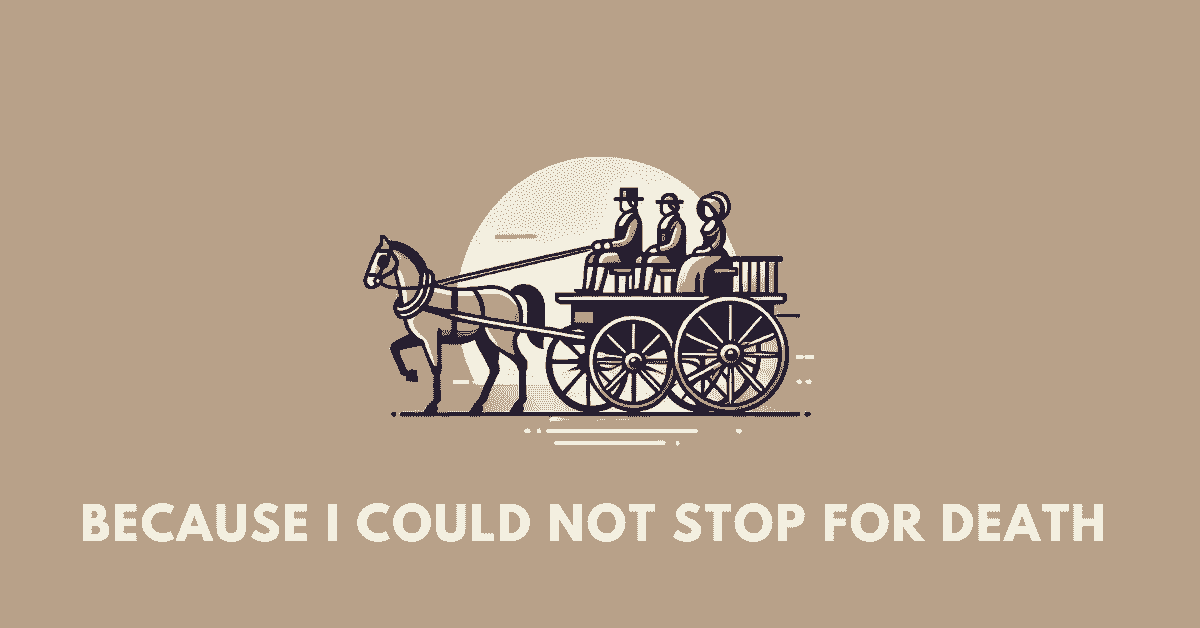
Get summaries, questions, answers, solutions, notes, extras, PDF and guide of Class 12 (second year) Alternative English textbook, chapter/poem 2, Because I Could Not Stop for Death by Emily Elizabeth Dickinson, which is part of the syllabus of students studying under AHSEC/ASSEB (Assam Board). These solutions, however, should only be treated as references and can be modified/changed.
“Because I Could Not Stop for Death” by Emily Dickinson is a poem about a woman’s journey with Death. The poem begins with the speaker saying she was too busy to stop for Death, so he kindly stops for her. Death is personified as a kind and courteous figure, and they travel together in a carriage with Immortality, symbolizing the journey to the afterlife.
During their slow journey, the speaker leaves behind her work and leisure, showing her acceptance of Death’s civility. They pass a school where children are playing, which represents childhood. Then they pass fields of grain, symbolizing adulthood and maturity. Finally, they pass the setting sun, which signifies the end of life. These scenes represent different stages of life.
As the sun sets, the speaker feels cold, highlighting the transition from life to death. She wears light, delicate clothes, such as a gossamer gown and a tulle tippet, which reflect the fragile and ethereal nature of her journey. They stop at a house that seems to be a grave, with the roof barely visible and the cornice in the ground, symbolizing her final resting place.
The speaker realizes that it has been centuries since this journey, but it feels shorter than a single day. She understands that the horses pulling the carriage are heading toward eternity, representing the endless nature of the afterlife.
The poem uses metaphors and personification to explore the inevitability of death and the serene acceptance of it as a natural part of life’s journey. The personification of Death as kind and gentle contrasts with the common fear of death, presenting it as a peaceful transition to eternity. The tone is calm and reflective, showing that death is not something to fear, but a part of life that leads to eternity.
Because I could not stop for Death —
The speaker begins by saying they were too busy with their everyday life to think about or stop for Death.
He kindly stopped for me —
Death, personified as a gentle and polite being, decided to stop for the speaker instead.
The Carriage held but just Ourselves —
In the carriage, there were only the speaker and Death.
And Immortality.
The idea of living forever, or Immortality, is also with them on this journey.
We slowly drove — He knew no haste
They traveled slowly, without any rush, showing that Death is patient and unhurried.
And I had put away / My labor and my leisure too, / For His Civility —
The speaker had to leave behind all their work and relaxation because of Death’s politeness.
We passed the School, where Children strove / At Recess — in the Ring —
They pass a school where children are playing, which represents the speaker’s childhood.
We passed the Fields of Gazing Grain —
Then they pass fields of grain, which symbolize the speaker’s adulthood and maturity.
We passed the Setting Sun —
Finally, they pass the setting sun, which stands for the end of the speaker’s life and the arrival of death.
Or rather — He passed Us —
The speaker corrects themselves, noting that it is actually the sun that moves past them, highlighting the passage of time.
The Dews drew quivering and Chill —
As evening comes, the dew makes the air cold and shivery, indicating the chilling presence of death.
For only Gossamer, my Gown —
The speaker realizes they are wearing a light, delicate gown, which suggests they are not prepared for the coldness of death.
My Tippet — only Tulle —
Their tippet, a type of shawl, is also made of fine, delicate tulle, reinforcing their fragile and unprepared state.
We paused before a House that seemed / A Swelling of the Ground —
They stop in front of a structure that looks like a house but is actually a burial mound, symbolizing a grave.
The Roof was scarcely visible — / The Cornice — in the Ground —
The roof of this house is barely visible because it is underground, emphasizing that it is indeed a grave.
Since then — ’tis Centuries — and yet / Feels shorter than the Day
The speaker reflects that although it has been centuries since their death, it feels like a shorter time than a single day.
I first surmised the Horses’ Heads / Were toward Eternity —
The speaker remembers the moment they realized that the horses pulling their carriage were heading towards eternity, signifying the journey to the afterlife.
1. Which country does Emily Dickinson belong to?
Answer: America
2. What is the ‘House’ referred to in the fourth stanza?
Answer: Grave
3. What does the word ‘immortality’ mean?
Answer: Eternal life
4. Where does the carriage stop?
Answer: Eternity
1. Describe the scenes witnessed by the speaker as she passes by during her carriage ride with Death.
Answer: The school, the fields, and the setting sun
2. Which words are used to describe Death in the poem?
Answer: Kind and civil
3. What is symbolic about the Carriage in the poem?
Answer: It represents the journey towards death
4. Why does Dickinson describe death as being kind and civil in the poem?
Answer: To depict death as a gentle and inevitable part of life
5. What is the role of ‘immortality’ in the poem?
Answer: It signifies eternal life beyond death
1. What is the significance of the ‘Setting Sun’ in the poem?
Answer: The ‘Setting Sun’ symbolizes the end of life or death.
2. How does Dickinson indicate the impression of the grave?
Answer: Dickinson indicates the impression of the grave by describing it as a “House that seemed / A Swelling of the Ground”.
3. What is the main idea of the poem ‘Because I Could Not Stop for Death’?
Answer: The main idea of the poem is the inevitability of death and the journey towards eternity.
1. Comment on the significance of the title of the poem ‘Because I Could Not Stop for Death’.
Answer: The title of the poem ‘Because I Could Not Stop for Death’ is significant because it encapsulates the central theme of the inevitability of death. The speaker’s inability to stop for death suggests that life is busy and continuous, and death is an event that interrupts it. The title also indicates that death is a force that takes initiative, personified as a courteous and inevitable visitor who stops for the speaker, emphasizing that death is a part of life’s journey that one cannot avoid or ignore.
2. How is Death personified in the poem ‘Because I Could Not Stop for Death’?
Answer: In the poem ‘Because I Could Not Stop for Death’, Death is personified as a kind and polite gentleman. He is described as someone who ‘kindly stopped for me,’ indicating a sense of gentleness and civility. Death’s personification as a courteous suitor who takes the speaker on a carriage ride represents the idea that death is not something to be feared, but rather a natural and inevitable part of life’s journey. This personification helps to convey a sense of calm and acceptance towards death.
1. “Because I could not stop for Death — He kindly stopped for me — The Carriage held but just Ourselves — And Immortality.”
(i) Who is the speaker in these lines?
Answer: The speaker is the poet, Emily Dickinson, often writing in the first person.
(ii) Who stopped for the speaker in these lines?
Answer: Death stopped for the speaker.
(iii) What does the carriage hold?
Answer: The carriage holds the speaker, Death, and Immortality.
Q. “We slowly drove — He knew no haste And I had put away My labor and my leisure too, For His Civility —”
(i) How did the carriage drive?
Answer: The carriage drove slowly.
(ii) What did the speaker put away?
Answer: The speaker put away her labor and leisure.
(iii) What is the reason for putting away labor and leisure?
Answer: The speaker put away her labor and leisure for Death’s civility.
Q. “We passed the School, where Children strove At Recess — in the Ring — We passed the Fields of Gazing Grain — We passed the Setting Sun —”
(i) What places did the speaker pass by during the carriage ride?
Answer: The speaker passed by a school, fields of grain, and the setting sun.
(ii) What were the children doing at the school?
Answer: The children were at recess, striving in the ring.
(iii) What does the setting sun symbolize in the poem?
Answer: The setting sun symbolizes the end of life or approaching death.
Q. “Or rather — He passed Us — The Dews drew quivering and Chill — For only Gossamer, my Gown My Tippet — only Tulle —”
(i) Who or what passed the speaker and Death?
Answer: The setting sun passed the speaker and Death.
(ii) How did the speaker feel after the sun passed?
Answer: The speaker felt a quivering chill.
(iii) What was the speaker wearing?
Answer: The speaker was wearing a gown of gossamer and a tippet of tulle.
Q. “We paused before a House that seemed A Swelling of the Ground — The Roof was scarcely visible — The Cornice — in the Ground —”
(i) Where did the carriage pause?
Answer: The carriage paused before a house that seemed a swelling of the ground.
(ii) How is the roof described?
Answer: The roof was scarcely visible.
(iii) Where was the cornice?
Answer: The cornice was in the ground.
Q. “Since then — ’tis Centuries — and yet Feels shorter than the Day I first surmised the Horses’ Heads Were toward Eternity —”
(i) How long has it been since the events described in the poem?
Answer: It has been centuries.
(ii) How does this time feel to the speaker?
Answer: It feels shorter than a day.
(iii) What did the speaker realize about the horses’ heads?
Answer: The speaker realized that the horses’ heads were pointed towards eternity.
Q. What is the main theme of Emily Dickinson’s poem “Because I Could Not Stop for Death”?
Answer: The main theme of Emily Dickinson’s poem “Because I Could Not Stop for Death” is the inevitability of death.
Q. How does the speaker describe her journey with Death in the poem?
Answer: The speaker describes her journey with Death as a slow and leisurely ride in a carriage, where they pass by various scenes that represent different phases of life, ultimately leading towards eternity.
Q. What literary devices does Dickinson employ in the poem to create vivid imagery?
Answer: Dickinson employs literary devices such as alliteration, allusion, metaphors, and personification in her poem to create vivid and evocative imagery.
Q. How does Emily Dickinson personify Death in the poem “Because I Could Not Stop for Death”?
Answer: Emily Dickinson personifies Death as a kind-hearted and polite gentleman who stops for the speaker and takes her on a carriage ride. Death is depicted as courteous and civil, which contrasts with the common fear associated with it. This personification helps to convey the poem’s theme that death is a natural and inevitable part of life, rather than something to be feared.
Q. What scenes does the speaker pass by during her carriage ride with Death, and what do they symbolize?
Answer: During her carriage ride with Death, the speaker passes by scenes such as a school where children are playing, fields of gazing grain, and the setting sun. These scenes symbolize the different stages of life: childhood, adulthood, and the approach of death. The school represents the speaker’s childhood, the fields represent adulthood and maturity, and the setting sun symbolizes the end of life and the speaker’s realization of her own mortality.
12. How does the poem “Because I Could Not Stop for Death” illustrate the speaker’s realization of her mortality and journey towards eternity?
Answer: The poem illustrates the speaker’s realization of her mortality through the imagery of passing scenes, such as the school, fields, and setting sun, which represent different stages of life. As the carriage ride continues, the speaker becomes aware of her own mortality, particularly when she feels the chill and realizes she is inadequately dressed for the journey. The poem concludes with the speaker recognizing that centuries have passed since her death, emphasizing the eternal nature of the spirit and the brevity of earthly existence. The carriage, driven by the horses, ultimately symbolizes the transition from life to the afterlife, leading the speaker towards eternity.

Only for registered users