Synonyms
More meanings
Tip: select a single word for meaning & synonyms.
Select multiple words normally to copy text.


Here, you will find summaries, questions, answers, textbook solutions, pdf, extras etc. of (Nagaland Board) NBSE Class 12 (Arts/Commerce) Economics Chapter 2: Circular Flow of Income. These solutions, however, should be only treated as references and can be modified/changed.
The concept of the circular flow of income is a fundamental principle in economics, illustrating the continuous movement of goods, services, and money among different sectors of the economy. This flow is circular in nature because it moves in a cycle, returning to its starting point, with no defined beginning or end.
In a simplified model involving two sectors – the household sector and the firm sector – the circular flow of income becomes evident. Firms hire or purchase factor services from households, which are owners of factors of production such as land, labour, capital, and enterprise. By coordinating these factors, firms produce goods and services, thereby generating income. Households, as the recipients of this income, in turn, spend their earnings on goods and services produced by firms to satisfy their wants. This consumption expenditure by households forms a reverse flow of income, going back to the firms, completing the circular flow of income.
This circular flow of income and product is based on two fundamental principles. First, in any exchange process, the seller or producer receives the same amount that the buyer or consumer spends. Second, goods and services flow in one direction, and the money payment to acquire them flows in the reverse direction, giving rise to a circular flow. Thus, the product flow from the seller to the buyer is necessarily a complement of the money or income flow from the buyer to the seller.
In modern economies, all exchange activities take place through money, making it the medium of exchange. This leads to the concept of real flows and money flows. Real flows refer to the flows of actual goods and services. For instance, when factor services flow from households to firms, and when goods and services flow from firms to households, these are considered real flows. On the other hand, money flows refer to the flow of factor payments and payments for goods and services between households and firms. These flows of money facilitate various transactions, moving from one sector to another.
1. Define flow.
Answer: A flow refers to change in magnitude of a variable over time.
2. Define real flow.
Answer: Real flows refer to the flows of goods and services.
3. What do you mean by money flow?
Answer: Money flows refer to the flows of money in the form of factor payments and consumption expenditure.
1. What is circular flow of income?
Answer: Circular flow of income refers to continuous circular flow of goods, services and money among different sectors of economy. Flow of money is the aggregate value of goods and services either as factor payment or as expenditure on goods and services.
2. Name the two basic principles of circular flow of income.
Answer: The circular flow of income involves two basic principles: (i) In any exchange process, the seller (or producer) receives the same amount which the buyer (or consumer) spends. (ii) Goods and services flow in one direction and the money payment to acquire them, flows in the reverse direction giving rise to a circular flow.
1. Define circular flow of income. Discuss the principles of it.
Answer: The circular flow of income refers to the continuous circular flow of goods, services, and money among different sectors of the economy. It involves two basic principles: (i) In any exchange process, the seller (or producer) receives the same amount which the buyer (or consumer) spends. (ii) Goods and services flow in one direction and the money payment to acquire them, flows in the reverse direction giving rise to a circular flow.
2. What is real flow? Give examples.
Answer: Real flow refers to the flows of goods and services. These are real because they consist of actual goods and services.
For instance, when factor services (services of land, labour, capital, enterprise) flow from households to firms which require them for producing goods and services, these are called real flows. Similarly, when goods and services produced by firms flow from producing enterprises to households who buy them for satisfying their wants, these are also real flows.
3. What is money flow? Give examples.
Answer: Money flow is the flow of factor payments and payments for goods and services between households and firms. These refer to the flows of money in the form of factor payments and consumption expenditure.
For example, when factor incomes (rent, wages, interest, and profit) flow from firms to households as rewards for their factor services, these are called money flows. Similarly, when households spend their incomes on the purchase of goods and services and as a result, money flows back to firms, these also indicate money flows.
4. Define income flows.
Answer: Income flows refer to the flow of money in the form of income and expenditure among different sections of the society. It is money that facilitates various transactions, bringing flows of money from one sector to another. When factor incomes (rent, wages, interest, and profit) flow from firms to households as rewards for their factor services, these are called income flows. Similarly, when households spend their incomes on the purchase of goods and services and as a result, money flows back to firms, these also indicate income flows.
1. Distinguish between real flows and money flows.
Answer: All the flows in an economy can be classified into Real Flows or Money Flows. Real flows refer to the flows of goods and services. These are real because they consist of actual goods and services. When factor services (services of land, labour, capital, enterprise) flow from households to firms which require them for producing goods and services, these are called real flows. Similarly, when goods and services produced by firms flow from producing enterprises to households who buy them for satisfying their wants, these are also real flows.
Money flows, on the other hand, refer to the flow of factor payments and payments for goods and services between households and firms. These refer to the flows of money in the form of factor payments and consumption expenditures. When factor incomes (rent, wages, interest and profit) flow from firms to households as rewards for their factor services, these are called money flows. Similarly, when households spend their incomes on the purchase of goods and services and as a result, money flows back to firms, these also indicate money flows.
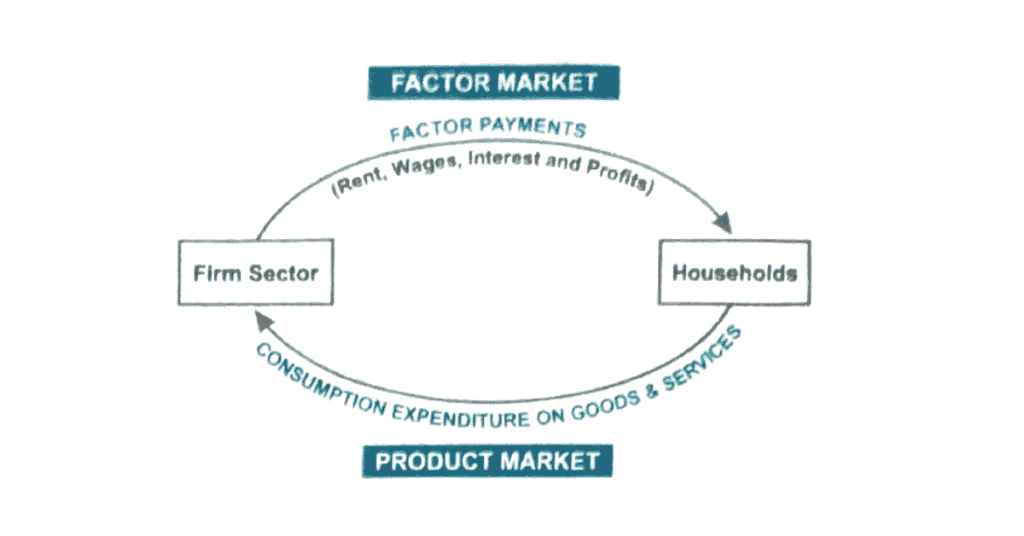
2. How are income flows and product flow equal? Explain with a diagram.
Answer: Income flows and product flows are equal. The circular flows in the economy prove that income flows in the form of factor income and consumption expenditure, and product flows in the form of factor services and final goods and services are equal.
The circular flow of income involves two basic principles:
(i) In any exchange process, the seller (or producer) receives the same amount which the buyer (or consumer) spends.
(ii) Goods and services flow in one direction and the money payment to acquire them, flows in the reverse direction giving rise to a circular flow.
Thus, product flow from the seller to the buyer is necessarily a complement of money (income) flow from the buyer to the seller. Money flow is the reciprocal (opposite) of real flow when money is used as a medium of exchange.
1. Explain the circular flow of income in an economy.
Answer: The circular flow of income refers to the continuous circular flow of goods, services, and money among different sectors of the economy. In an economy, there are two sectors, namely Household Sector and Firm Sector. Firms hire/purchase factor services from households and by coordinating them produce goods and services and thereby generate income. Households as owners of factors of production (land, labour, capital and enterprise) receive the payment in terms of money (rent, wages, interest and profit) as reward for rendering productive services. Thus, income is generated.
The recipients of these incomes (i.e., factor owners or households) in turn spend their incomes on purchase of goods and services (produced by firms) to satisfy their wants. Consumption expenditure by households is reverse flow of income going back to firms. This makes the circular flow of income complete.
The circular flow of income involves two basic principles:
(i) In any exchange process, the seller (or producer) receives the same amount which the buyer (or consumer) spends.
(ii) Goods and services flow in one direction and the money payment to acquire them, flows in the reverse direction giving rise to a circular flow.
Thus, product flow from the seller to the buyer is necessarily a complement of money (income) flow from the buyer to the seller. Money flow is the reciprocal (opposite) of real flow when money is used as a medium of exchange.
2. Discuss the circular flow of income in a two-sector economy.
Answer: In a two-sector economy, which includes the household sector and the firm sector, the circular flow of income refers to the continuous circular flow of goods, services, and money. The firm sector hires factor services from households who are owners of factors of production (land, labour, capital, and enterprise) for producing goods and services and pays them remuneration (or compensation) in the form of money for rendering the productive services.
These factor incomes are known as rent, wages, interest, and profit which have been generated in the production process. Thus, money income flows from the firm sector to the households. With this money, the households purchase from the firms, manufactured goods and services to satisfy their wants with the result that the same money flows back from households to the firm sector. Thus, the entire income of the economy comes back to firms in the form of sale revenue.
This circular flow of income and product involves two basic principles:
(i) In any exchange process, the seller (or producer) receives the same amount which the buyer (or consumer) spends.
(ii) Goods and services flow in one direction and the money payment to acquire them, flows in the reverse direction giving rise to a circular flow.
Thus, product flow from the seller to the buyer is necessarily a complement of money (income) flow from the buyer to the seller. Money flow is the reciprocal (opposite) of real flow when money is used as a medium of exchange.
1. What is a ‘flow’ concept in economics? Why is national income considered a flow?
Answer: A flow refers to a change in the magnitude of a variable over time. National income is a flow concept because it is measured over a period of time, which is a length of time.
2. What is meant by the circular flow of income and product?
Answer: A pictorial illustration of the interdependence between the major sectors of economic activity is called the circular flow of income and product.
3. Why is the flow of income described as ‘circular’ in nature?
Answer: The flow of income is described as circular in nature because it moves in a circle, coming back to the starting point. It is also circular because it has neither a beginning nor an end.
4. How does production generate income in an economy?
Answer: Production generates income when firms hire or purchase factor services from households. By coordinating these factors, firms produce goods and services, which in turn generates income. Households, as the owners of factors of production like land, labour, capital, and enterprise, receive payment in the form of money—such as rent, wages, interest, and profit—as a reward for rendering these productive services. In this way, income is generated.
5. What are the two main sectors in a simple economy? What are their roles?
Answer: In a simple economy, there are two main sectors: the Household Sector and the Firm Sector.
The role of households is to act as owners of the factors of production and as consumers. They provide factor services to firms. The role of firms, or producing enterprises, is to hire or purchase these factor services from households to produce goods and services.
6. What are factors of production? Who owns them in a two-sector model?
Answer: The factors of production are land, labour, capital, and enterprise. In a two-sector model, the households are the owners of these factors of production.
7. What are factor payments? Provide examples of different factor payments.
Answer: Factor payments are the payments that households receive in terms of money as a reward for rendering productive services to firms. Examples of different factor payments include rent for land, wages for labour, interest for capital, and profit for enterprise.
8. How does consumption expenditure complete the circular flow of income?
Answer: The recipients of incomes, who are the factor owners or households, in turn, spend their incomes on the purchase of goods and services produced by firms to satisfy their wants. This consumption expenditure by households is a reverse flow of income going back to the firms. This process makes the circular flow of income complete.
9. How do modern exchange economies differ from traditional economies?
Answer: Unlike a traditional economy where production is mainly for self-consumption, production in a modern economy is for exchange or sale. Modern economies have become exchange economies where all exchange activities take place through money, which acts as a medium of exchange.
10. Explain the complete process of income generation and distribution in a simple two-sector economy.
Answer: In a simple two-sector economy with a Household Sector and a Firm Sector, income is first generated by production units. Firms hire or purchase factor services like land, labour, capital, and enterprise from households. By coordinating these factors, firms produce goods and services, which generates income.
This income is then distributed among households, who are the owners of the factors of production. Households receive payments in the form of money, such as rent, wages, interest, and profit, as a reward for rendering their productive services. The recipients of these incomes, the households, in turn, spend their incomes to purchase goods and services produced by firms to satisfy their wants. This consumption expenditure by households is a reverse flow of income that goes back to the production units or firms, making the circular flow of income complete.
11. Describe the interdependence between the household sector and the firm sector.
Answer: The household and firm sectors are highly interdependent. The firm sector depends on the household sector for the supply of factor services, which are land, labour, capital, and enterprise. Firms hire these services from households to produce goods and services.
The household sector, as owners of these factors of production, depends on the firm sector for income. They receive factor payments like rent, wages, interest, and profit from firms. Households then depend on firms for the supply of goods and services, which they purchase with their income to satisfy their wants. This creates a continuous circular flow where each sector relies on the other for both inputs and outputs.
12. What are the key assumptions made when explaining the circular flow in a two-sector economy?
Answer: The key assumptions for explaining the circular flow in a simplified two-sector model are:
13. How does the diagram of the circular flow illustrate that income flows and product flows are equal?
Answer: The diagram of the circular flow illustrates that income flows and product flows are equal by showing two sets of circular movements. The inner arrows represent real flows (product flows), which include the flow of factor services from households to firms and the flow of goods and services from firms to households. The outer arrows represent money flows (income flows), which include factor payments from firms to households and consumption expenditure from households to firms.
The diagram proves that these flows are equal. The total production of goods and services by firms equals the total consumption by the household sector. Similarly, the factor payments made by firms are equal to the factor incomes of the household sector. The consumption expenditure of the household sector equals the income of the firm sector. Therefore, the real flows of production and consumption are equal to the money flows of income and expenditure.
14. Explain the dual role played by both the household and firm sectors in the economy.
Answer: The dual role of each sector as both a buyer and a seller perpetuates the circular flow. The household sector acts as a seller in the factor market, where it supplies factor services like land, labour, capital, and enterprise to firms. In the product market, the household sector acts as a buyer, purchasing goods and services from firms.
Conversely, the firm sector acts as a buyer in the factor market, where it hires factor services from households. In the product market, the firm sector acts as a seller, providing goods and services to households. This dual role ensures that each sector is both a source of supply and a source of demand in different markets, maintaining the continuous flow of income and products.
15. Explain Paul Studenski’s view that national income is both a flow of goods and a flow of money.
Answer: National income is both a flow of goods and services and a flow of money incomes. It is, therefore, called national product as often as national income. This view is based on the nature of modern exchange economies where money acts as a medium of exchange. The real flow of goods and services produced by firms (national product) is matched by an equivalent flow of money. This money flows from firms to households as factor incomes and then flows back from households to firms as expenditure on those goods and services. Thus, the total value of goods and services is equal to the total money income generated.
16. Describe the functions of the Factor Market and the Product Market in the circular flow model.
Answer: The Factor Market and the Product Market are the two types of markets in a simple two-sector economy.
The function of the Factor Market is to facilitate the exchange of factor services. In this market, households are the sellers who supply factors of production like land, labour, capital, and enterprise. Firms are the buyers who hire these services to produce goods. The firms make factor payments, such as rent, wages, interest, and profits, to the households in this market.
The function of the Product Market is to facilitate the exchange of goods and services. In this market, firms are the sellers who supply the goods and services they have produced. Households are the buyers who spend their income on these goods and services to satisfy their wants. The money that flows from households to firms in this market is called consumption expenditure.
17. “Income is first generated by production units, then distributed, and ultimately comes back to them.” Elaborate on this statement.
Answer: This statement describes the three phases of the circular flow of income.
First, income is generated by production units. Firms hire or purchase factor services from households and, by coordinating them, produce goods and services, thereby generating income.
Second, this income is distributed among households. Households, as owners of factors of production like land, labour, capital, and enterprise, receive payment in the form of money (rent, wages, interest, and profit) as a reward for rendering productive services.
Ultimately, this income comes back to the production units. The recipients of these incomes, the households, in turn, spend their incomes on the purchase of goods and services produced by firms to satisfy their wants. This consumption expenditure by households is a reverse flow of income going back to firms, which makes the circular flow of income complete.
18. Distinguish between Real Flows and Money Flows in detail.
Answer: The distinction between Real Flows and Money Flows is as follows:
Real Flows refer to the flows of goods and services. They are called real because they consist of actual goods and services. When factor services like the services of land, labour, capital, and enterprise flow from households to firms, which require them for producing goods and services, these are called real flows. Similarly, when goods and services produced by firms flow from producing enterprises to households who buy them for satisfying their wants, these are also real flows.
Money Flows, or Nominal Flows, refer to the flow of factor payments and payments for goods and services between households and firms. These flows occur because money facilitates transactions. When factor incomes like rent, wages, interest, and profit flow from firms to households as rewards for their factor services, these are called money flows. Similarly, when households spend their incomes on the purchase of goods and services and, as a result, money flows back to firms, these also indicate money flows.
In a simple two-sector economy, the firm sector hires factor services from households to produce goods and services; this is a real flow. In turn, the households receive factor income in the form of money from the firm sector; this is a money flow. With this money income, households purchase goods and services from firms; this is a real flow from the firm sector to the household sector. In return, households make payments to the firm sector in the form of money; this is a money flow from households to the firm sector.
19. Explain the two fundamental principles of the circular flow of income and how they are demonstrated in the interactions between households and firms.
Answer: The circular flow of income involves two basic principles:
These principles are demonstrated in the interactions between households and firms. For the first principle, when firms (buyers) purchase factor services from households (sellers), the amount spent by firms as factor payments is the same amount received by households as factor income. Similarly, when households (buyers) purchase goods and services from firms (sellers), the consumption expenditure by households is the same amount received by firms as revenue.
The second principle is demonstrated as the flow of factor services (a real flow) from households to firms is matched by a reverse flow of factor payments (a money flow) from firms to households. Likewise, the flow of goods and services (a real flow) from firms to households is met with a reverse flow of consumption expenditure (a money flow) from households to firms. This shows that the money flow is the reciprocal of the real flow.
20. Describe how total production by firms becomes equal to the total consumption by households in a simple economic model.
Answer: In a simple economic model with only two sectors, firms and households, the total production of goods and services by firms becomes equal to the total consumption of goods and services by the household sector. This equality is based on the assumption that households spend all the income they earn, and there are no savings.
The process begins when firms produce goods and services, which generates income. This income is then paid to households in the form of rent, wages, interest, and profit for their factor services. The total value of factor payments made by firms equals the total factor incomes of the household sector. Since it is assumed that households do not save, their entire income is spent on purchasing the goods and services produced by the firms. Therefore, the consumption expenditure of the household sector is equal to the income of the household sector. As the entire income comes back to the firms as sales revenue, the value of total production equals the value of total consumption.
1: A variable whose magnitude is measured over a period of time is known as a:
A. Stock concept
B. Flow concept
C. Equilibrium concept
D. Static concept
Answer: B. Flow concept
2: In a simple two-sector economy, what are the two primary sectors involved?
A. Households and Government
B. Firms and Government
C. Households and Firms
D. Firms and Foreign Sector
Answer: C. Households and Firms
3: The payments made by firms to households for their factor services, such as rent, wages, and interest, are collectively called:
A. Consumption expenditure
B. Factor payments
C. Real flows
D. National product
Answer: B. Factor payments
4: What is the term for the flow of actual goods and services between firms and households?
A. Money flow
B. Nominal flow
C. Capital flow
D. Real flow
Answer: D. Real flow
5: Which of the following is another name for Money Flow?
A. Physical flow
B. Real flow
C. Nominal flow
D. Product flow
Answer: C. Nominal flow
6: In the circular flow of income, production generates:
A. Expenditure
B. Savings
C. Income
D. Investment
Answer: C. Income
7: The flow of money from households to firms for the purchase of goods and services is known as:
A. Factor income
B. Investment
C. Consumption expenditure
D. Savings
Answer: C. Consumption expenditure
8: An amount of money that is withdrawn from the flow of income is referred to as a:
A. Injection
B. Transfer
C. Leakage
D. Subsidy
Answer: C. Leakage
9: In a modern economy, what typically acts as the medium of exchange for all economic activities?
A. Barter
B. Goods
C. Services
D. Money
Answer: D. Money
10: An amount of money that is added to the flow of income in the economy is called an:
A. Injection
B. Withdrawal
C. Leakage
D. Deficit
Answer: A. Injection
11: In a closed economy, which sector is not included?
A. Households
B. Firms
C. Government
D. Foreign sector
Answer: D. Foreign sector
12: Which of the following is NOT considered a factor of production owned by households?
A. Land
B. Labour
C. Goods and services
D. Capital
Answer: C. Goods and services
13: Which of the following is NOT an example of a factor payment?
A. Rent
B. Wages
C. Consumption expenditure
D. Profit
Answer: C. Consumption expenditure
14: Which of the following is NOT an assumption of the simple two-sector circular flow model described?
A. There is no government
B. Households save a portion of their income
C. The economy is closed (no exports or imports)
D. Firms do not make investments
Answer: B. Households save a portion of their income
15: Which of the following is NOT a phase of the circular flow of income?
A. Production Phase
B. Income Phase
C. Growth Phase
D. Expenditure Phase
Answer: C. Growth Phase
16: Which of the following is NOT considered a leakage from the circular flow of income?
A. Savings
B. Taxes
C. Government spending
D. Import spending
Answer: C. Government spending
17: Which of the following is NOT considered an injection into the circular flow of income?
A. Investment spending
B. Government spending
C. Export earnings
D. Taxes by households
Answer: D. Taxes by households
18: All of the following are components of real flow EXCEPT:
A. Factor services from households to firms
B. Goods and services from firms to households
C. Services of land and labour
D. Factor payments from firms to households
Answer: D. Factor payments from firms to households
19: Assertion (A): The flow of income in an economy is described as circular.
Reason (R): Income moves from one sector to another, eventually returning to its starting point without a clear beginning or end.
A. Both A and R are true and R is the correct explanation of A.
B. Both A and R are true but R is not the correct explanation of A.
C. A is true, but R is false.
D. A is false, but R is true.
Answer: A. Both A and R are true and R is the correct explanation of A.
20: Assertion (A): Money flow is the reciprocal of real flow.
Reason (R): Goods and services flow in one direction, while the money paid to acquire them flows in the opposite direction.
A. Both A and R are true and R is the correct explanation of A.
B. Both A and R are true but R is not the correct explanation of A.
C. A is true, but R is false.
D. A is false, but R is true.
Answer: A. Both A and R are true and R is the correct explanation of A.
21: Assertion (A): In a simple two-sector economy without savings, total production equals total consumption.
Reason (R): Households spend their entire income on goods and services produced by firms.
A. Both A and R are true and R is the correct explanation of A.
B. Both A and R are true but R is not the correct explanation of A.
C. A is true, but R is false.
D. A is false, but R is true.
Answer: A. Both A and R are true and R is the correct explanation of A.
22: Assertion (A): National income is considered a flow concept.
Reason (R): It is measured over a specific period of time, such as a year.
A. Both A and R are true and R is the correct explanation of A.
B. Both A and R are true but R is not the correct explanation of A.
C. A is true, but R is false.
D. A is false, but R is true.
Answer: A. Both A and R are true and R is the correct explanation of A.
23: Assertion (A): Savings by households are considered a leakage from the circular flow.
Reason (R): Savings represent money that is withdrawn from the current flow of consumption expenditure.
A. Both A and R are true and R is the correct explanation of A.
B. Both A and R are true but R is not the correct explanation of A.
C. A is true, but R is false.
D. A is false, but R is true.
Answer: A. Both A and R are true and R is the correct explanation of A.
24: Assertion (A): The flow of factor services from households to firms is a real flow.
Reason (R): Real flows consist of the actual goods and services, not monetary payments.
A. Both A and R are true and R is the correct explanation of A.
B. Both A and R are true but R is not the correct explanation of A.
C. A is true, but R is false.
D. A is false, but R is true.
Answer: A. Both A and R are true and R is the correct explanation of A.
25: (I) Firms produce goods and services.
(II) Production generates income for the factors of production.
A. I is a contradiction of II.
B. II is independent of I.
C. II is the result of I.
D. I is an example of II.
Answer: C. II is the result of I.
26: (I) The flow of goods and services from firms to households is a real flow.
(II) The flow of factor payments from firms to households is a money flow.
A. I is the cause for II.
B. I is a contradiction of II.
C. I and II are independent statements.
D. II is an example of I.
Answer: C. I and II are independent statements.
27: (I) In any exchange process, the amount the seller receives is the same as the amount the buyer spends.
(II) The circular flow principle is based on the idea that one person’s expenditure becomes another’s income.
A. I is a contradiction of II.
B. II is an explanation of I.
C. I is independent of II.
D. I is an example of II.
Answer: B. II is an explanation of I.
28: (I) Households spend their income on goods and services.
(II) Money flows back to the firms, completing the circular flow.
A. I is a contradiction of II.
B. II is the result of I.
C. I is independent of II.
D. I is an example of II.
Answer: B. II is the result of I.
29: (I) Modern economies are exchange economies.
(II) In modern economies, production is mainly for self-consumption.
A. I is the cause for II.
B. I is an example of II.
C. I is a contradiction of II.
D. I is independent of II.
Answer: C. I is a contradiction of II.

Only for registered users