Synonyms
More meanings
Tip: select a single word for meaning & synonyms.
Select multiple words normally to copy text.

Get summaries, questions, answers, solutions, extra MCQs, PDF for William Wordsworth’s Composed Upon Westminster Bridge: WBCHSE Class 11 English Literature textbook A Realm of English (B) Selection, which is part of the Semester I syllabus for students studying under WBBSE (West Bengal Board-Uccha Madhyamik). These solutions, however, should only be treated as references and can be modified/changed.
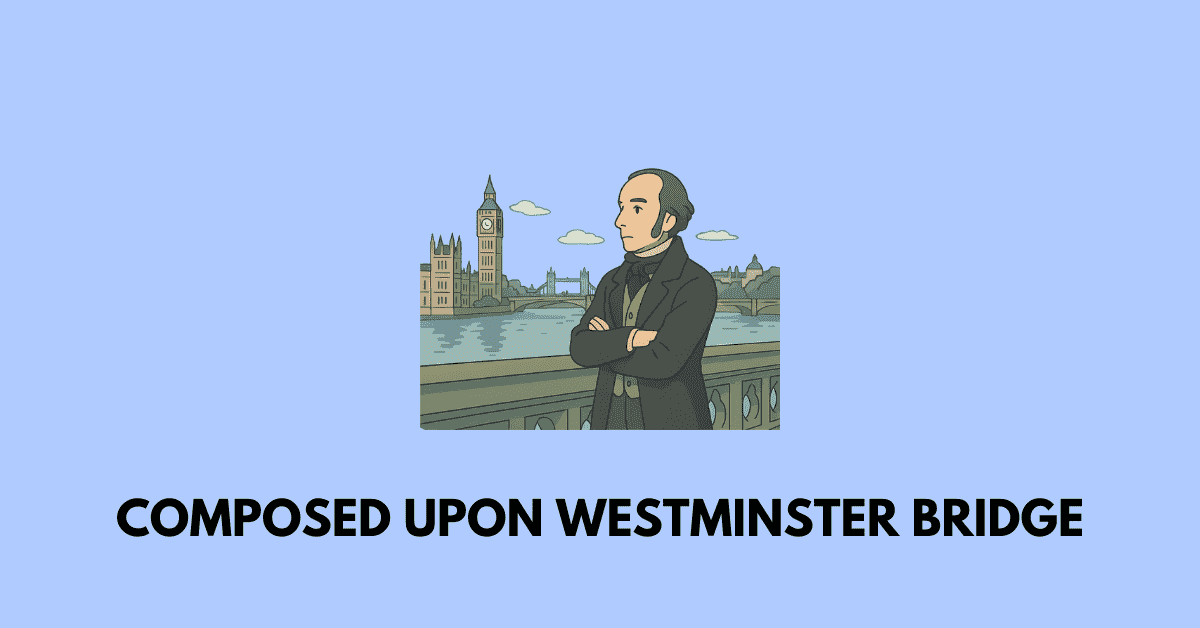
The poet, William Wordsworth, stands on Westminster Bridge early in the morning. He looks at the city of London and thinks it is the most beautiful sight on Earth. Wordsworth feels that only a person with a dull soul could pass by this view without noticing its majesty.
The city is quiet and seems to be wearing the morning’s beauty like a piece of clothing. All the buildings, like ships, towers, and temples, are visible under the open sky. The air is clear and smokeless. The rising sun shines brightly on the city. Wordsworth has never felt a calm so deep.
The poet observes the river flowing gently. He says it moves by “his own sweet will,” which gives the river a human-like quality of making its own choice. He also says the houses seem to be asleep, which is another way of giving them a human action.
Finally, Wordsworth describes the whole city as a “mighty heart” that is “lying still.” This is a metaphor. It means that the city, which is usually full of life and activity, is now quiet and at rest before the day begins.
Earth has not any thing to show more fair:
The speaker begins with a very strong and absolute statement. He declares that nothing else on the entire planet can compare in beauty to the scene he is looking at from Westminster Bridge. This immediately establishes the great admiration he feels for the view.
Dull would he be of soul who could pass by / A sight so touching in its majesty:
The speaker suggests that any person who could see this view and simply walk past without being affected must have a very boring and insensitive spirit (“dull of soul”). He describes the sight as both “touching,” meaning it stirs the emotions, and full of “majesty,” which means it has a grand, impressive, and noble quality.
This City now doth, like a garment, wear / The beauty of the morning; silent, bare,
Here, the poet uses a figure of speech called a simile to compare the city to a person. He says the city (“This City”) is wearing the morning’s beauty just as a person would wear a beautiful piece of clothing (“garment”). “Doth” is an old-fashioned word for “does.” The city is described as “silent” and “bare,” which is unusual for a large city. It is silent because it is early and the daily activities have not yet begun. It is “bare” because it is free from the smoke and crowds that will soon fill it.
Ships, towers, domes, theatres, and temples lie / Open unto the fields, and to the sky;
The speaker lists the various man-made structures that make up the London skyline: ships on the river, tall towers, the rounded roofs (“domes”) of large buildings, theatres for entertainment, and churches (“temples”). All of these structures seem to be completely exposed and visible, lying open to the surrounding countryside (“the fields”) and the wide-open sky above them.
All bright and glittering in the smokeless air.
This line explains why the view is so clear and beautiful. Everything is shining (“bright and glittering”) because the air is “smokeless.” In the early 19th century, London was typically filled with smoke from coal fires. However, in the very early morning, before the factories and homes have started their day, the air is clean, allowing for this perfectly clear and sparkling view.
Never did sun more beautifully steep / In his first splendour, valley, rock, or hill;
The speaker makes a surprising comparison. He claims that the sun has never shone more beautifully on natural scenery—like a valley, a rock, or a hill—than it does now on the city. To “steep” something means to soak it, so the sun is soaking the city in its morning light. “Splendour” refers to the magnificent, brilliant light of the sunrise. The speaker is suggesting that this urban scene surpasses the beauty of nature, a notable idea for a poet famous for his love of the natural world.
Ne’er saw I, never felt, a calm so deep!
“Ne’er” is a poetic shortening of the word “never.” The speaker expresses his personal, emotional reaction to the scene. He states that in his entire life, he has never witnessed or personally experienced a feeling of peacefulness and quiet that is as profound as this one. The stillness of the city has created a deep sense of tranquility within him.
The river glideth at his own sweet will:
The speaker turns his attention to the River Thames. He uses personification, giving the river a human-like quality. The river moves smoothly (“glideth” is an old word for glides) as if it is making its own choices and following its own desires (“at his own sweet will”). This image adds to the sense of natural, unforced peace in the scene.
Dear God! the very houses seem asleep;
The speaker lets out an exclamation of awe and wonder. He continues to use personification, saying that even the buildings (“the very houses”) appear to be sleeping. This contributes to the overall image of the city being in a state of complete rest and quiet.
And all that mighty heart is lying still!
In the final line, the speaker uses a powerful metaphor, comparing the entire city of London to a “mighty heart.” A city is often thought of as the heart of a nation, full of energy and life. By saying this great heart is “lying still,” the speaker perfectly captures the temporary, peaceful pause of the city before it awakens into its normal, active state.
1. At what time of the day did Wordsworth observe the beauty of the city of London?
a) At dawn
b) At noon
c) In the evening
d) At night
Answer: a) At dawn
2. What literary device is used in the line, ” The river glideth at his own sweet will”
a) Simile
b) Metaphor
c) Hyperbole
d) Personification
Answer: d) Personification
1. In the line “This City now doth, like a garment, wear / The beauty of the morning”, what literary device is used?
A. Metaphor
B. Simile
C. Personification
D. Hyperbole
Answer: B. Simile
2. According to the poet, what kind of person would be unimpressed by the sight of the city?
A. A person in a hurry
B. A person from the countryside
C. A person with a dull soul
D. A person who is tired
Answer: C. A person with a dull soul
3. What does the poet say the “very houses seem” to be doing?
A. Asleep
B. Glittering
C. Bare
D. Open
Answer: A. Asleep
4. Which of the following structures is NOT explicitly mentioned in the description of the city?
A. Domes
B. Theatres
C. Temples
D. Palaces
Answer: D. Palaces
5. How is the air over the city described?
A. Thick and foggy
B. Cold and crisp
C. Bright and smokeless
D. Dark and heavy
Answer: C. Bright and smokeless
6. In the final line, the city is compared to what?
A. A calm river
B. A sleeping giant
C. A silent garment
D. A mighty heart
Answer: D. A mighty heart
7. What feeling does the poet claim to have never experienced so deeply before?
A. Joy
B. Calm
C. Wonder
D. Sadness
Answer: B. Calm
8. Who is the author of “Composed upon Westminster Bridge”?
A. John Keats
B. William Shakespeare
C. Percy Bysshe Shelley
D. William Wordsworth
Answer: D. William Wordsworth
9. Which of the following is NOT mentioned as being part of the city view?
A. Factories
B. Theatres
C. Ships
D. Domes
Answer: A. Factories
10. Which of the following is NOT described with human-like qualities?
A. The houses
B. The smokeless air
C. The river
D. The city’s heart
Answer: B. The smokeless air
11. Which of the following statements about the setting is NOT true?
A. The air is described as being clear of smoke.
B. The time of day is early in the morning.
C. The city is bustling with activity and noise.
D. The speaker feels a sense of deep calm.
Answer: C. The city is bustling with activity and noise.
12. Which of the following is NOT a quality attributed to the sight?
A. Dull
B. Touching
C. Majestic
D. Fair
Answer: A. Dull
13. Which of these statements about the speaker’s experience is NOT true?
A. The speaker feels that nothing on Earth is more beautiful.
B. The speaker is annoyed by the stillness of the city.
C. The speaker has never felt such a profound sense of calm before.
D. The speaker believes a person would be soulless to ignore the sight.
Answer: B. The speaker is annoyed by the stillness of the city.
14. Which of the following is NOT a comparison used in the description?
A. The city’s beauty is compared to a garment.
B. The city is compared to a mighty, still heart.
C. The houses are compared to sleeping beings.
D. The sun’s splendour is compared to glittering gold.
Answer: D. The sun’s splendour is compared to glittering gold.
15. The city is described as wearing “The beauty of the morning” like a __________.
A. crown
B. jewel
C. garment
D. blanket
Answer: C. garment
16. According to the description, the air is clear and __________.
A. foggy
B. smokeless
C. humid
D. windy
Answer: B. smokeless
17. The line “the very houses seem asleep” is an example of __________.
A. Metaphor
B. Simile
C. Personification
D. Hyperbole
Answer: C. Personification
18. The poet feels a __________ that he has never felt before.
A. deep calm
B. great joy
C. profound sadness
D. sharp pain
Answer: A. deep calm
19. The “mighty heart” that is “lying still” refers to the __________.
A. river
B. sun
C. poet himself
D. city
Answer: D. city
20. A person who could pass by such a magnificent sight without being moved would be __________.
A. in a hurry
B. visually impaired
C. dull of soul
D. a city dweller
Answer: C. dull of soul
21. The structures mentioned lying open to the fields and sky include ships, towers, domes, temples, and __________.
A. castles
B. cottages
C. markets
D. theatres
Answer: D. theatres
22. The sun is described as steeping the valley, rock, and hill in its “first __________”.
A. light
B. splendour
C. warmth
D. glory
Answer: B. splendour
23. (I) The city is described as being “All bright and glittering”.
(II) The air is described as “smokeless”.
A. I is the cause for II.
B. II is the cause for I.
C. I and II are contradictory statements.
D. I is independent of II.
Answer: B. II is the cause for I.
24. (I) The poet feels a “calm so deep”.
(II) The “mighty heart is lying still”.
A. I is a contradiction of II.
B. I is independent of II.
C. II is the cause for I.
D. I is the cause for II.
Answer: C. II is the cause for I.
25. (I) A person who could pass by the sight is described as “dull of soul”.
(II) The sight is described as “so touching in its majesty”.
A. II is the reason for I.
B. I is an example of II.
C. I is a contradiction of II.
D. I is independent of II.
Answer: A. II is the reason for I.
26. (I) The houses seem asleep.
(II) The river glideth at his own sweet will.
A. I is the cause for II.
B. II is the result of I.
C. I is a contradiction of II.
D. I and II are independent observations of the same scene.
Answer: D. I and II are independent observations of the same scene.

Only for registered users