Synonyms
More meanings
Tip: select a single word for meaning & synonyms.
Select multiple words normally to copy text.

Get summaries, questions, answers, solutions, notes, extras, PDF and guide of Class 11 (first year) Economics textbook, chapter 6 Concepts of Costs, which is part of the syllabus of students studying under AHSEC/ASSEB (Assam Board). These solutions, however, should only be treated as references and can be modified/changed.
The chapter discusses different concepts of cost, including the cost of production, short-run costs, and long-run costs. It begins by explaining the cost of production as the total expenses incurred by a firm to purchase inputs. These include explicit costs, which are actual payments made to suppliers, and implicit costs, which refer to the value of resources owned by the firm, such as the rent of a building owned by the producer. The sum of both explicit and implicit costs makes up the total economic cost.
In the short run, some costs remain fixed, while others can vary. Fixed costs, such as rent, do not change with output and are incurred even if no production occurs. Variable costs, like wages or raw material expenses, change directly with the level of production. These costs together form the total cost, which is the sum of fixed and variable costs.
The chapter explains the behavior of these costs using tables and graphs. Fixed costs remain constant regardless of output, while variable costs increase as production increases. The total cost curve follows the pattern of the variable cost curve, with the vertical distance between them representing the fixed costs.
Average costs are also discussed, including average fixed cost (AFC), average variable cost (AVC), and average total cost (ATC). The AFC curve slopes downward because fixed costs are spread over an increasing number of output units. The AVC and ATC curves are U-shaped, first decreasing due to increasing returns to variable factors and later rising as diminishing returns set in.
Marginal cost (MC) is the additional cost incurred by producing one more unit. The marginal cost curve is also U-shaped, initially decreasing and then increasing. It intersects the AVC and ATC curves at their lowest points.
In the long run, all costs are variable. The long-run average cost curve (LAC) is derived from various short-run average cost curves and is U-shaped due to economies and diseconomies of scale. It reflects the least cost for producing each level of output. The long-run marginal cost curve (LMC) behaves similarly to the short-run marginal cost curve, with both curves following a U-shape.
1. Define economic costs.
Answer: Economic cost is the sum total of actual money expenditure on inputs (i.e., explicit costs) and the estimated value of self-supplied inputs by the owner (i.e., implicit costs) and normal profits.
2. What are implicit costs?
Answer: Implicit costs refer to the estimated (or imputed) value of inputs supplied by the owner of the firm, such as imputed salary of the owner or imputed rent of the building owned by the firm.
3. Give two examples of explicit costs in a tailoring shop.
Answer: Two examples of explicit costs in a tailoring shop are expenditure on the purchase of fabric and payment of wages to hired workers.
4. Give two examples of implicit costs of a firm.
Answer: Two examples of implicit costs of a firm are the imputed salary of the owner and the imputed rent for the use of a building owned by the firm.
5. What is meant by fixed cost?
Answer: Fixed cost refers to the cost that does not change with the level of output. Fixed costs remain constant regardless of the amount of goods produced. Examples include rent of the building and interest on loans.
6. What is meant by variable cost?
Answer: Variable cost refers to the cost that varies with the level of output. It changes as the quantity of goods produced increases or decreases. Examples include costs of raw materials and wages of temporary staff.
7. Give two examples of fixed costs.
Answer: Two examples of fixed costs are the rent for the building and the salaries of permanent staff.
8. Give two examples of variable costs.
Answer: Two examples of variable costs are the cost of raw materials and wages paid to casual or temporary workers.
9. What is the shape of TFC curve?
Answer: TFC curve is a horizontal straight line.
10. What is the shape of TVC curve?
Answer: TVC curve is initially concave downward and then concave upward.
11. What are the main constituents of total costs? Name them.
Answer: The main constituents of total costs are total fixed cost and total variable cost.
12. What is the difference between TC and TFC called?
Answer: The difference between TC and TFC is called total variable cost (TVC).
13. What is average cost?
Answer: Average cost is the total cost per unit of output.
14. Give the formula of calculating average cost.
Answer: The formula for calculating average cost is AC = TC/Q, where AC is average cost, TC is total cost, and Q is the quantity of output.
15. Define marginal cost. With the help of an example show how marginal cost can be obtained from total cost.
Answer: Marginal cost is defined as the increase in total cost when one extra unit of output is produced. For example, if the total cost of producing 5 units of a commodity is ₹36, and it goes to ₹45 when 6 units are produced, the marginal cost of the 6th unit is ₹9 (₹45 – ₹36).
16. Do fixed costs affect marginal cost?
Answer: No, fixed costs do not affect marginal cost.
17. What would you say about the average cost of a firm if the marginal cost of production is less than the average cost?
Answer: If the marginal cost of production is less than the average cost, then the average cost will be falling.
18. Can average cost fall when marginal cost is rising?
Answer: Yes, average cost may fall even when marginal cost is rising, as long as the marginal cost is still below the average cost.
19. Define average fixed cost.
Answer: Average fixed cost (AFC) is the per unit fixed cost of output. It is calculated as the ratio of total fixed cost to the output.
20. Fill in the blanks in the following:
(i) TC = TFC + _____
(ii) _____ = TVC/Q
(iii) AFC + AVC = _____
(iv) _____= ΔTC/ΔQ
Answer:
(i) TC = TFC + TVC
(ii) AVC = TVC/Q
(iii) AFC + AVC = ATC
(iv) MC = ΔTC/ΔQ
21. How does the AFC curve slope?
Answer: The AFC curve slopes downwards because as output increases, average fixed cost falls continuously.
22. How does the AVC curve slope?
Answer: The AVC curve first slopes downward as output increases, reflecting increasing returns, and then slopes upward after reaching a minimum point, due to diminishing returns.
23. Define (a) long run average cost and (b) long run marginal cost.
Answer: (a) Long-run average cost (LRAC) refers to the minimum achievable cost per unit of output when all factors of production are variable in the long run.
(b) Long-run marginal cost (LRMC) refers to the change in total cost that results from producing one more unit of output in the long run when all inputs are variable.
1. Define fixed costs of a firm. Give examples.
Answer: Fixed costs are the costs that a firm incurs to employ fixed inputs or factors (e.g., plant and equipment, building, etc.). These costs do not vary with the level of output produced. Fixed costs are incurred even if the output is zero, and they remain constant irrespective of the level of production. Examples of fixed costs include the rent of a factory building and the salaries of permanent staff.
2. Define variable costs of a firm. Give examples.
Answer: Variable costs are the costs incurred on inputs that vary with the level of output. These costs increase as the output increases and decrease when the output decreases. Variable costs are directly associated with production and become zero when no output is produced. Examples of variable costs include payments for raw materials and wages for temporary staff.
3. Distinguish between fixed cost and variable cost. Give two examples of each.
Answer:
Fixed costs:
Variable costs:
4. Can average fixed cost (AFC) be zero? Explain the shape of AFC curve.
Answer: Average fixed cost (AFC) can never be zero because fixed costs are constant, and AFC is derived by dividing the total fixed cost by the output. As long as the output is positive, AFC will always be positive, though it decreases as output increases. The AFC curve is a rectangular hyperbola because the total fixed cost remains the same while the output increases, leading to a continuously decreasing AFC.
5. Draw ATC, AVC and MC curves in a single diagram.
Answer: [The document does not provide the actual diagram, but the required curves, ATC (Average Total Cost), AVC (Average Variable Cost), and MC (Marginal Cost), are all U-shaped curves. The MC curve typically intersects both the ATC and AVC curves at their respective minimum points. This behavior is due to the law of diminishing returns.]
6. Do AVC curve and ATC curve intersect? State reasons for your answer.
Answer: No, the AVC curve and ATC curve do not intersect. This is because the ATC curve is the summation of the AVC and AFC curves. Since AFC is always positive, ATC will always be higher than AVC by the amount of AFC, and therefore, they cannot intersect.
7. Why is AC curve U-shaped?
Answer: The average cost curve (AC) is U-shaped because of the law of variable proportions. Initially, as the level of output increases, the firm experiences increasing returns to a factor, which leads to a fall in the average cost. After a certain point, however, diminishing returns to a factor set in, and the average cost begins to rise. Hence, the AC curve is U-shaped.
8. Describe the relationship between AVC and MC.
Answer: The relationship between average variable cost (AVC) and marginal cost (MC) is as follows:
9. The total cost of a firm is 100 when it produces 15 units of output. If the level of output increases to 30 units, what will be the fixed cost in the short run? Explain. (AHSEC Question Bank)
Answer: The fixed cost will remain the same in the short run, irrespective of the output level. Therefore, if the total cost of producing 15 units is ₹100, the fixed cost will remain ₹100 even if the output increases to 30 units. This is because fixed costs do not change with the level of output in the short run.
10. State the behaviour of Total Variable Cost. Draw Total Variable Cost, Total Cost and Total Fixed Cost Curves in a single diagram.
Answer: The behaviour of Total Variable Cost (TVC) is as follows:
(Total Variable Cost, Total Cost, and Total Fixed Cost Curves should be drawn as per standard economic diagrams, with Total Fixed Cost remaining constant, Total Variable Cost increasing, and Total Cost being the sum of both.)
11. State whether the following statements are true or false. Give reasons.
(i) Average cost falls only when marginal cost falls.
(ii) The difference between average total cost and average variable cost is constant.
(iii) As output is increased, the difference between average total cost and average variable cost falls and ultimately becomes zero.
Answer: (i) False: Average cost falls when marginal cost is less than average cost, not necessarily when marginal cost falls.
(ii) False: The difference between average total cost and average variable cost is the average fixed cost, which decreases as output increases.
(iii) False: The difference between average total cost and average variable cost is the average fixed cost, which decreases but never becomes zero.
12. State whether the following statements are true or false. Give reasons.
(i) The difference between average total cost and average variable cost decreases with a decrease in the level of output.
(ii) When marginal cost rises, average cost will also rise.
Answer: (i) False: The difference between average total cost (ATC) and average variable cost (AVC) is the average fixed cost (AFC). AFC increases as the level of output decreases, so the difference between ATC and AVC actually increases with a decrease in output.
(ii) False: When marginal cost (MC) rises, average cost (AC) will rise only if MC is greater than AC. If MC is still less than AC, AC will continue to fall even though MC is rising.
1. Differentiate between fixed costs and variable costs.
Answer:
Fixed costs:
Variable costs:
2. Classify the following into fixed cost and variable cost:
Answer:
3. Can AC fall when MC is rising?
Answer: Yes, AC can fall even when MC is rising. Though MC will necessarily remain below AC when AC is falling, MC may still rise while AC is falling. This happens when the rate at which MC increases is slower than the rate at which AC is decreasing. For example, if an additional unit’s cost (MC) increases slightly, while the total average cost is still falling due to earlier low costs, then AC continues to decrease even though MC is rising.
4. What is meant by explicit cost? Which of the following are included in it?
Answer: Explicit cost refers to the actual monetary expenditure on inputs used in production. It includes payments made to outsiders for services provided.
5. Distinguish between explicit costs and implicit costs.
Answer: Explicit costs refer to the actual monetary expenditure on inputs, such as payments made to outsiders for wages, rent, and raw materials. Implicit costs, on the other hand, are the estimated value of inputs supplied by the owner of the firm, such as imputed salary of the owner or imputed rent for the owner’s building. Explicit costs are recorded in the accounting records, while implicit costs are not. Both explicit and implicit costs contribute to the calculation of economic costs.
6. Why does the TC curve start from the Y-axis and TVC curve from the Y-axis?
Answer: The Total Cost (TC) curve starts from the Y-axis because even when output is zero, a firm incurs fixed costs, which are represented on the Y-axis. In contrast, the Total Variable Cost (TVC) curve starts from the origin, as variable costs are incurred only when there is production. When output is zero, variable costs are also zero, hence TVC begins from the origin.
7. Why is average cost curve U-shaped in the short-run? Give reasons.
Answer: The average cost curve is U-shaped in the short run due to the law of variable proportions. Initially, as production increases, the firm experiences increasing returns to scale, which leads to a decline in the average cost. However, beyond a certain point, the firm experiences diminishing returns to scale, causing the average cost to rise. This gives the AC curve its characteristic U-shape.
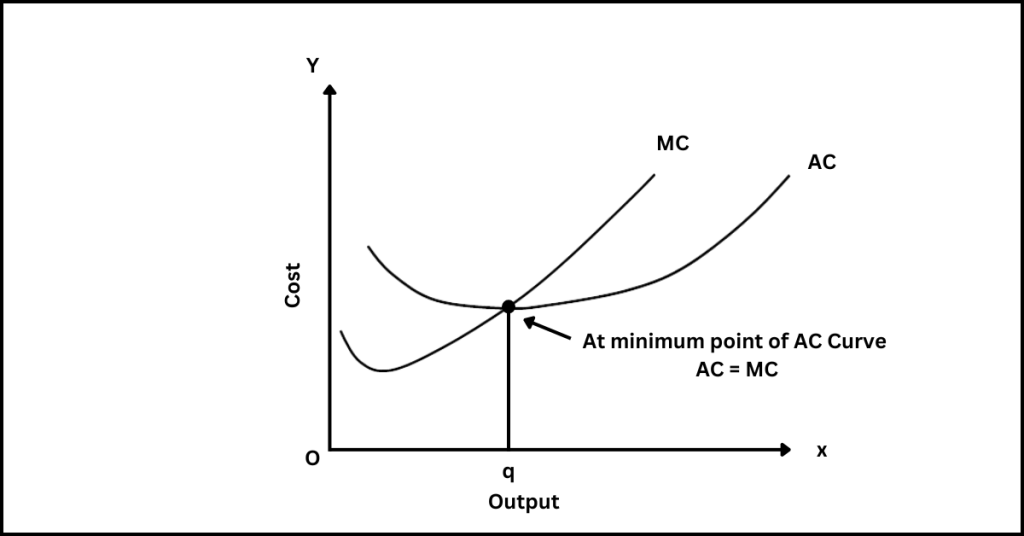
8. Discuss the relationship between average cost and marginal cost with the help of a diagram.
Answer: The relationship between average cost (AC) and marginal cost (MC) is such that when MC is less than AC, the average cost falls, and when MC is greater than AC, the average cost rises. At the minimum point of the average cost curve, MC equals AC. The marginal cost curve cuts the average cost curve at its lowest point.
9. Explain the relationship between average total cost curve, average variable cost curve and marginal cost curve. (Or) Do ATC and AVC curves intersect each other? Give reasons.
Answer: The average total cost (ATC) curve and average variable cost (AVC) curve are both U-shaped, reflecting the law of variable proportions. The marginal cost (MC) curve also follows a U-shape and intersects both the ATC and AVC curves at their minimum points. As output increases, the gap between the ATC and AVC narrows because the average fixed cost (AFC) diminishes. Therefore, the MC curve intersects the AVC curve before it intersects the ATC curve.
1. From the following data given below, calculate (i) Marginal cost and (ii) Average cost.
| Output | Total cost in ₹ |
| 1 | 10 |
| 2 | 20 |
| 3 | 28 |
| 4 | 34 |
| 5 | 38 |
| 6 | 42 |
| 7 | 48 |
| 8 | 56 |
Answer:
| Output | Total cost in ₹ | Marginal Cost (MC) | Average Cost (AC) |
| 1 | 10 | – | 10 |
| 2 | 20 | 10 | 10 |
| 3 | 28 | 8 | 9.3 |
| 4 | 34 | 6 | 8.5 |
| 5 | 38 | 4 | 7.6 |
| 6 | 42 | 4 | 7 |
| 7 | 48 | 6 | 6.8 |
| 8 | 56 | 8 | 7 |
(i) Marginal cost (MC)
(ii) Average cost (AC)
2. Find total fixed cost, average fixed cost, total variable cost, and marginal cost from the following data:
| Units of output | Total cost in ₹ |
| 1 | 75 |
| 2 | 95 |
| 3 | 110 |
Answer:
| Units of output | Total cost in ₹ | TFC | AFC | TVC | MC |
| 1 | 75 | 75 | – | 0 | – |
| 2 | 95 | 75 | 75 | 20 | 20 |
| 3 | 110 | 75 | 37.5 | 35 | 15 |
(i) Total Fixed Cost (TFC):
The total fixed cost is the same for all levels of output. From the given data, TFC = 75.
(ii) Average Fixed Cost (AFC):
AFC = TFC ÷ Output
For output 2: AFC = 75 ÷ 2 = 37.5
(iii) Total Variable Cost (TVC):
TVC = Total cost – Total fixed cost
For output 2: TVC = 95 – 75 = 20
For output 3: TVC = 110 – 75 = 35
(iv) Marginal Cost (MC):
MC = Total cost of current output – Total cost of previous output
For output 2: MC = 95 – 75 = 20
For output 3: MC = 110 – 95 = 15
3. From the following data on the cost of production of a firm, calculate: (i) AFC (ii) AVC and (iii) AC of producing 4 units
| Output | Total cost in ₹ |
| 4 | 112 |
Answer:
| Output | Total cost in ₹ | AFC | AVC | AC |
| 4 | 112 | 15 | 13 | 28 |
(i) Average Fixed Cost (AFC):
AFC = TFC ÷ Output
Assume TFC = 60
AFC = 60 ÷ 4 = 15
(ii) Average Variable Cost (AVC):
AVC = TVC ÷ Output
TVC = Total cost – TFC
TVC = 112 – 60 = 52
AVC = 52 ÷ 4 = 13
(iii) Average Cost (AC):
AC = AFC + AVC
AC = 15 + 13 = 28
4. Complete the following table:
| Output | Total Cost (₹) |
| 0 | 60 |
| 1 | 140 |
| 2 | 190 |
| 3 | 240 |
| 4 | 300 |
Answer:
| Output | Total Cost (₹) | Marginal Cost (MC) | Average Variable Cost (AVC) |
| 0 | 60 | – | – |
| 1 | 140 | 80 | 80 |
| 2 | 190 | 50 | 65 |
| 3 | 240 | 50 | 60 |
| 4 | 300 | 60 | 60 |
(i) Marginal Cost (MC):
MC = Total cost of current output – Total cost of previous output
For output 1: MC = 140 – 60 = 80
For output 2: MC = 190 – 140 = 50
For output 3: MC = 240 – 190 = 50
For output 4: MC = 300 – 240 = 60
(ii) Average Variable Cost (AVC):
AVC = TVC ÷ Output
TVC = Total cost – TFC
Assume TFC = 60
For output 1: TVC = 140 – 60 = 80
AVC = 80 ÷ 1 = 80
For output 2: TVC = 190 – 60 = 130
AVC = 130 ÷ 2 = 65
For output 3: TVC = 240 – 60 = 180
AVC = 180 ÷ 3 = 60
For output 4: TVC = 300 – 60 = 240
AVC = 240 ÷ 4 = 60
5. From the data given below, calculate (i) average fixed cost (ii) average variable cost and (iii) marginal cost of producing five units of output
| Output | Total cost in ₹ |
| 1 | 60 |
Answer:
| Output | Total cost in ₹ | AFC | AVC | MC |
| 1 | 60 | 8 | 30 | 40 |
(i) Average Fixed Cost (AFC):
AFC = TFC ÷ Output
Assume TFC = 40
For output 5: AFC = 40 ÷ 5 = 8
(ii) Average Variable Cost (AVC):
AVC = TVC ÷ Output
TVC = Total cost – TFC
TVC = 150
AVC = 150 ÷ 5 = 30
(iii) Marginal Cost (MC):
MC = Total cost of current output – Total cost of previous output
For output 5: MC = 40
6. Complete the following table:
| Output (units) | Total Cost (₹) |
| 0 | 30 |
| 1 | 45 |
| 2 | 55 |
Answer:
| Output (units) | Total Cost (₹) | TFC (₹) | TVC (₹) | MC (₹) |
| 0 | 30 | 30 | 0 | – |
| 1 | 45 | 30 | 15 | 15 |
| 2 | 55 | 30 | 25 | 10 |
Steps:
7. Calculate total variable cost and marginal cost from the following cost schedule of a firm whose total fixed costs are ₹12.
| Output Units | Total Cost (₹) |
| 1 | 20 |
| 2 | 26 |
| 3 | 31 |
| 4 | 38 |
Answer:
| Output Units | Total Cost (₹) | TVC (₹) | MC (₹) |
| 1 | 20 | 8 | 8 |
| 2 | 26 | 14 | 6 |
| 3 | 31 | 19 | 5 |
| 4 | 38 | 26 | 7 |
Steps:
8. Total fixed cost is ₹90, complete the following table:
| Units of Output | Marginal Cost (₹) | Total Cost (₹) | Average Total Cost (₹) |
| 1 | 10 | – | – |
| 2 | 20 | – | – |
| 3 | 15 | – | – |
| 4 | 25 | – | – |
Answer:
| Units of Output | Marginal Cost (₹) | Total Cost (₹) | Average Total Cost (₹) |
| 1 | 10 | 100 | 100 |
| 2 | 20 | 120 | 60 |
| 3 | 15 | 135 | 45 |
Steps:
9. Calculate total variable cost and marginal cost at each given level of output from the following table.
| Output Units | Total Cost (₹) |
| 1 | 60 |
| 2 | 78 |
| 3 | 97 |
| 4 | 124 |
Answer:
| Output Units | Total Cost (₹) | TVC (₹) | MC (₹) |
| 1 | 60 | 0 | – |
| 2 | 78 | 20 | 18 |
| 3 | 97 | 38 | 19 |
| 4 | 124 | 57 | 27 |
Steps:
10. Complete the following table:
| Output (units) | TC (₹) | AVC (₹) | MC (₹) |
| 0 | 80 | – | – |
| 1 | 180 | – | – |
| 2 | 270 | – | – |
| 3 | 350 | – | – |
| 4 | 440 | – | – |
Answer:
| Output (units) | TC (₹) | AVC (₹) | MC (₹) |
| 0 | 80 | – | – |
| 1 | 180 | 100 | 100 |
| 2 | 270 | 95 | 90 |
| 3 | 350 | 90 | 80 |
| 4 | 440 | 90 | 90 |
Steps:
11. Given that the total fixed cost is ₹60, complete the following table:
| Output Units | Average Variable Cost (₹) | Total Cost (₹) | Marginal Cost (₹) |
| 1 | 20 | – | – |
| 2 | 15 | – | – |
| 3 | 20 | – | – |
Answer:
| Output Units | Average Variable Cost (₹) | Total Cost (₹) | Marginal Cost (₹) |
| 1 | 20 | 80 | 80 |
| 2 | 15 | 90 | 10 |
| 3 | 20 | 120 | 30 |
Steps:
12. A firm is producing 20 units. At this level of output, the ATC and AVC are respectively equal to ₹40 and ₹37. Find out the total fixed cost of the firm.
Answer:
13. The total cost (TC) of a production unit is ₹70 and the level of output (Q) is 5. Find out the average cost (AC) and average variable cost (AVC) if the average fixed cost is ₹4.
Answer:
14. Given below is the cost schedule of a firm. Its total fixed cost is ₹100. Calculate average variable cost and marginal cost at each given level of output.
| Output Units | Total Cost (₹) |
| 1 | 350 |
| 2 | 450 |
| 3 | 610 |
| 4 | 820 |
Answer:
| Output Units | AVC (₹) | MC (₹) |
| 1 | 250 | 250 |
| 2 | 175 | 100 |
| 3 | 170 | 160 |
| 4 | 180 | 210 |
Steps:
15. The following table shows the total cost schedule of a firm. What is the total fixed cost schedule of this firm? Calculate the TVC, AFC, AVC, SAC, and SMC schedule of the firm.
| Q | TC (₹) |
| 0 | 10 |
| 1 | 30 |
| 2 | 45 |
| 3 | 55 |
| 4 | 70 |
| 5 | 90 |
| 6 | 120 |
Answer:
| Q | TFC (₹) | TVC (₹) | AFC (₹) | AVC (₹) | SAC (₹) | SMC (₹) |
| 0 | 10 | 0 | – | – | – | – |
| 1 | 10 | 20 | 10 | 20 | 30 | 20 |
| 2 | 10 | 35 | 5 | 17.5 | 22.5 | 15 |
| 3 | 10 | 45 | 3.33 | 15 | 18.33 | 10 |
| 4 | 10 | 60 | 2.5 | 15 | 17.5 | 15 |
| 5 | 10 | 80 | 2 | 16 | 18 | 20 |
| 6 | 10 | 110 | 1.67 | 18.33 | 20 | 30 |
Steps:
16. Complete the following table:
| Output (units) | AFC (₹) | MC (₹) | TC (₹) |
| 1 | – | 60 | – |
| 2 | 18 | – | 82 |
| 3 | – | – | – |
| 4 | 20 | 120 | 99 |
| 5 | 22 | – | – |
Answer:
| Output (units) | AFC (₹) | MC (₹) | TC (₹) |
| 1 | 60 | 60 | 72 |
| 2 | 30 | 12 | 82 |
| 3 | 18 | 9 | 90 |
| 4 | 15 | 120 | 99 |
| 5 | 12 | 9 | 109 |
Steps:
1. What do explicit costs include?
A. Payments for raw materials
B. Implicit costs
C. Normal profit
D. Rent of self-owned building
Answer: A. Payments for raw materials
Q. What is the sum of explicit and implicit costs called?
A. Total cost
B. Average cost
C. Economic cost
D. Marginal cost
Answer: C. Economic cost
Q. What type of costs are wages to casual workers?
A. Fixed costs
B. Implicit costs
C. Variable costs
D. Overhead costs
Answer: C. Variable costs
Q. Which of the following is an example of fixed cost?
A. Wages to temporary staff
B. Payments for raw materials
C. Rent on land
D. Fuel and power costs
Answer: C. Rent on land
Q. What is another term used for fixed costs?
A. Prime costs
B. Indirect costs
C. Variable costs
D. Direct costs
Answer: B. Indirect costs
Q. What happens to total variable cost when output increases?
A. It decreases
B. It remains the same
C. It increases
D. It fluctuates randomly
Answer: C. It increases
Q. What kind of costs are incurred when output is zero?
A. Total fixed costs
B. Total variable costs
C. Total costs
D. Marginal costs
Answer: A. Total fixed costs
Q. In the short run, which costs cannot be varied?
A. Variable costs
B. Average costs
C. Implicit costs
D. Fixed costs
Answer: D. Fixed costs
Q. What are short-run costs a combination of?
A. Implicit and explicit costs
B. Fixed and variable costs
C. Accounting and economic costs
D. Total and marginal costs
Answer: B. Fixed and variable costs
Q. What does TVC stand for in cost theory?
A. Total Variable Costs
B. Total Virtual Costs
C. Total Value Costs
D. Total Variance Costs
Answer: A. Total Variable Costs
Q. In the long run, what happens to costs?
A. All costs become fixed
B. All costs become variable
C. Only variable costs remain
D. Only fixed costs remain
Answer: B. All costs become variable
Q. What is the formula for economic cost?
A. Total cost + Marginal cost
B. Explicit costs + Implicit costs
C. Fixed costs + Variable costs
D. Average cost + Marginal cost
Answer: B. Explicit costs + Implicit costs
Q. What is another name for variable costs?
A. Overhead costs
B. Avoidable costs
C. Implicit costs
D. Accounting costs
Answer: B. Avoidable costs
Q. When does TVC start increasing at an increasing rate?
A. After a point of diminishing returns
B. After output is zero
C. At constant returns
D. At zero level of production
Answer: A. After a point of diminishing returns
Q. What happens to Average Fixed Cost (AFC) as output increases?
A. It increases
B. It remains constant
C. It decreases
D. It fluctuates
Answer: C. It decreases
Q. What is the shape of the Average Fixed Cost (AFC) curve?
A. U-shaped
B. Rectangular hyperbola
C. Linear
D. Constant
Answer: B. Rectangular hyperbola
Q. Which of the following costs is U-shaped due to the law of variable proportions?
A. AFC
B. AVC
C. TFC
D. TVC
Answer: B. AVC
Q. How is Average Total Cost (ATC) calculated?
A. AVC + AFC
B. TVC + TFC
C. MC + AFC
D. TFC / Output
Answer: A. AVC + AFC
Q. When does the Average Cost (AC) reach its minimum point?
A. At zero output
B. When marginal cost equals average cost
C. When marginal cost is greater than average cost
D. When total fixed cost is constant
Answer: B. When marginal cost equals average cost
Q. What is Marginal Cost (MC)?
A. Total cost divided by output
B. Fixed cost plus variable cost
C. Increase in total cost due to one extra unit of output
D. Average cost divided by variable cost
Answer: C. Increase in total cost due to one extra unit of output
Q. What is the relationship between Marginal Cost (MC) and Average Variable Cost (AVC) when AVC is at its lowest point?
A. MC > AVC
B. MC < AVC
C. MC = AVC
D. MC is undefined
Answer: C. MC = AVC
Q. Which cost remains constant as output increases in the short run?
A. Variable cost
B. Fixed cost
C. Marginal cost
D. Average cost
Answer: B. Fixed cost
Q. At what point does the Marginal Cost (MC) curve intersect the Average Cost (AC) curve?
A. At the maximum point of the AC curve
B. At the minimum point of the AC curve
C. At the origin
D. At the maximum output level
Answer: B. At the minimum point of the AC curve
Q. What does the area under the Marginal Cost (MC) curve represent?
A. Total fixed cost
B. Total variable cost
C. Total cost
D. Average total cost
Answer: B. Total variable cost
Q. What happens to Average Variable Cost (AVC) when the law of diminishing returns begins to operate?
A. AVC decreases
B. AVC remains constant
C. AVC increases
D. AVC becomes zero
Answer: C. AVC increases
Q. How is Marginal Cost (MC) calculated?
A. Change in total cost divided by change in output
B. Total fixed cost divided by output
C. Total cost divided by total output
D. Total variable cost plus total fixed cost
Answer: A. Change in total cost divided by change in output
Q. What happens to the difference between ATC and AVC as output increases?
A. It decreases
B. It remains constant
C. It increases
D. It becomes zero
Answer: A. It decreases
Q. When does Marginal Cost (MC) rise above Average Cost (AC)?
A. When output is zero
B. When AC is falling
C. When AC is rising
D. When AFC is zero
Answer: C. When AC is rising
Q. What does the Long-Run Average Cost (LAC) curve represent?
A. Minimum possible cost per unit of output over time
B. Maximum cost per unit of output over time
C. Constant cost per unit of output
D. The cost of producing one unit only
Answer: A. Minimum possible cost per unit of output over time
Q. What is the relationship between Long-Run Average Cost (LAC) and Long-Run Marginal Cost (LMC) when LAC is falling?
A. LAC is greater than LMC
B. LMC is greater than LAC
C. LAC is equal to LMC
D. LAC is constant
Answer: A. LAC is greater than LMC
Q. At what point does the Long-Run Marginal Cost (LMC) curve intersect the Long-Run Average Cost (LAC) curve?
A. At the maximum point of LAC
B. At the minimum point of LAC
C. At the zero output point
D. At the rising portion of LAC
Answer: B. At the minimum point of LAC
Q. What causes the U-shape of the Long-Run Average Cost (LAC) curve?
A. Law of variable proportions
B. Returns to scale
C. Constant returns to a factor
D. Fixed costs
Answer: B. Returns to scale
Q. When does the Long-Run Average Cost (LAC) curve begin to rise?
A. When increasing returns to scale operate
B. When diseconomies of scale start operating
C. When fixed costs decrease
D. When output is zero
Answer: B. When diseconomies of scale start operating
Q. Why does the LAC curve initially decline?
A. Due to the operation of fixed costs
B. Due to increasing returns to scale
C. Due to constant returns to scale
D. Due to rising variable costs
Answer: B. Due to increasing returns to scale
Q. What happens to Long-Run Marginal Cost (LMC) when Long-Run Average Cost (LAC) rises?
A. LMC remains below LAC
B. LMC equals LAC
C. LMC remains constant
D. LMC rises above LAC
Answer: D. LMC rises above LAC
Q. What is one of the reasons for the rise in LAC beyond a certain point?
A. Increasing returns to scale
B. Internal economies of scale
C. Communication gaps in large-scale production
D. Constant costs
Answer: C. Communication gaps in large-scale production
Q. What governs the U-shape of the LAC and LMC curves?
A. Law of variable proportions
B. Law of diminishing returns
C. Laws of returns to scale
D. Total fixed cost
Answer: C. Laws of returns to scale
19. When is Long-Run Average Cost (LAC) equal to Long-Run Marginal Cost (LMC)?
A. When LAC is rising
B. When LAC is falling
C. At the minimum point of the LAC curve
D. When output is zero
Answer: C. At the minimum point of the LAC curve
1. What is the link between a firm’s output, costs, and revenue?
Answer: The output of a commodity is linked to costs on one hand and revenue on the other. To produce output, a firm must employ inputs, and the payment for these inputs is called cost. The output produced is linked to total revenue in the product market. Production decisions of a firm are guided by its cost and revenue conditions.
Q. What is the cost function and how is it expressed?
Answer: The cost function refers to the functional relationship between cost and output. It shows total costs at each level of output. Average and marginal costs can be calculated from it. Cost functions can be constructed for the short run, where few inputs can vary, or for the long run, where all inputs can be varied. The cost function is expressed as: C=f(Q)C = f(Q)C=f(Q) Where C represents total cost and Q represents output. The cost function gives the least cost combination of inputs for different levels of output.
Q. What is meant by the cost of production?
Answer: The cost of production refers to the cost of purchasing inputs necessary for producing any given output. This includes wages for labour, prices for raw materials, fuel, power, rent for buildings, and interest on borrowed money. These are called explicit or actual costs. Economically, cost of production also includes implicit costs, which refer to the costs of self-owned resources like rent on the producer’s own building or interest on his own invested capital. Thus, the economic cost is the sum of explicit costs and implicit costs.
Economic Costs = Explicit Costs + Implicit Costs
Q. What are short-run costs and how are they categorized?
Answer: Short-run costs refer to the costs incurred over a period during which some inputs are fixed while others are variable. These costs are divided into:
Q. What are the characteristics of fixed and variable costs?
Answer:
Q. What is the behaviour of total fixed cost (TFC), total variable cost (TVC), and total cost (TC) curves in the short run?
Answer:
Q. What are some examples of fixed and variable costs?
Answer:
Q. What is Average Fixed Cost (AFC) and how does it behave with changes in output?
Answer: Average Fixed Cost (AFC) is the ratio of Total Fixed Cost (TFC) to output (q).
(i) When output is very close to zero, AFC is large and as output increases, AFC decreases.
(ii) The AFC curve is a rectangular hyperbola. If we multiply any value of output (q) with its corresponding AFC value, we get a constant value, which is TFC.
(iii) The AFC curve will never touch or cut the horizontal axis because AFC cannot be zero.
(iv) The AFC curve will also never touch the Y-axis because at zero output, TFC is positive, and dividing any value by zero results in an infinite value.
Q. What is Average Variable Cost (AVC) and how does it behave with changes in output?
Answer: Average Variable Cost (AVC) is the per unit variable cost of producing a commodity. It is obtained by dividing the total variable cost (TVC) by the output.
Initially, AVC decreases as output increases. However, after reaching the stage of minimum cost, AVC starts increasing. This is because, in the initial stage of production, the law of increasing returns to a factor operates, leading to decreasing costs. But after a point, the law of diminishing returns begins to operate, which leads to increasing costs. Therefore, the AVC curve is U-shaped.
Q. How is Average Total Cost (ATC) calculated, and what is its relationship with AFC and AVC?
Answer: Average Total Cost (ATC) is obtained by dividing the total cost (TC) by the output. ATC = TC/Output.
Since total cost is the sum of total variable cost (TVC) and total fixed cost (TFC), ATC is also the sum of average variable cost (AVC) and average fixed cost (AFC).
ATC = AVC + AFC.
The ATC curve is U-shaped, reflecting the law of variable proportions.
Q. What is Marginal Cost (MC) and why is the MC curve U-shaped?
Answer: Marginal Cost (MC) is the increase in total cost when one extra unit of output is produced. MC = Change in total cost / Change in output.
The MC curve is U-shaped because of the law of variable proportions. Initially, production is subject to the law of increasing returns, which leads to decreasing costs, and the MC falls. Then, the law of constant returns operates, making the cost constant. Finally, the law of diminishing returns operates, leading to increasing costs and the rise of MC.
The MC curve cuts the AVC and ATC curves at their minimum points.
Q. What are the interrelationships between ATC, AVC, AFC, and MC?
Answer:
(i) As output increases, AVC and ATC initially fall, but then rise.
(ii) The distance between the ATC and AVC curves decreases as output increases because AFC, which is the difference between ATC and AVC, continuously falls.
(iii) ATC and AVC curves never intersect because AFC can never be zero or negative.
(iv) The MC curve cuts the AVC and ATC curves at their minimum points.
(v) MC is less than AC when AC is falling and more than AC when AC is rising.
(vi) AVC reaches its lowest point before ATC, as AFC continues to fall even when AVC starts rising slowly.
Q. How are Average Cost (AC) and Marginal Cost (MC) related?
Answer:
(i) Both AC and MC are derived from total cost. AC = TC/Output and MC = Change in total cost / Change in output.
(ii) When AC falls, MC is lower than AC.
(iii) When AC rises, MC is higher than AC.
(iv) MC equals AC at the minimum point of AC, meaning that the MC curve cuts the AC curve at its lowest point.
Q. Explain how Average Cost (AC) behaves when Marginal Cost (MC) is rising.
Answer:
Although MC generally remains below AC when AC is falling, it does not always fall. MC may rise even when AC is falling. For instance, if Mahendra Singh Dhoni’s average score is 40 in 10 matches, and he scores 29 runs in the next match, his average falls to 39 despite his marginal score increasing. Similarly, AC may fall when MC is rising.
Q. What is the significance of Average Cost (AC) and Marginal Cost (MC) for a firm?
Answer: AC and MC are important concepts for a firm. A firm aims to maximize profit, which is the difference between total revenue and total cost. To calculate total cost, AC is multiplied by the number of units produced.
MC helps the firm determine whether producing an additional unit is beneficial. If the cost of producing one more unit is less than the revenue generated, the firm should continue production.
Q. What is Long-run Average Cost (LAC) and how is it derived?
Answer: Long-run average cost refers to the minimum possible per unit cost of producing different quantities of output of a good over the long period. In the long period, each firm can make use of different sizes of plants, and a given quantity of output can be produced from a plant most suitable to it. If such a plant is used, the cost of production would be the least possible. A rational producer, in the long run, will produce with the help of such a plant to minimize the average cost. The long-run average cost curve (LAC) is derived from the short-run average cost curves (SACs). When a firm can make use of multiple plants (small, medium, and large), the LAC is the locus of points that denote the least cost of producing the corresponding output levels. It is called an ‘envelope curve’ because it envelopes all the SAC curves, showing the minimum per unit cost of production at each level of output.
Q. How does the Long-run Marginal Cost (LMC) curve relate to the LAC curve, and how is it derived?
Answer: The Long-run Marginal Cost (LMC) curve is related to the Long-run Average Cost (LAC) curve in the same way as the Short-run Marginal Cost (SMC) is related to the Short-run Average Cost (SAC). The LMC curve is derived from the LAC curve. For example, if OM output is produced, it is produced at a tangency point between the SAC and LAC curves. The corresponding short-run marginal cost curve (SMC) will intersect at that tangency point, reflecting the long-run marginal cost. The LMC curve is drawn by connecting such points of tangency, and it shows the cost of producing additional units of output when all inputs are variable.
Q. What is the relationship between LAC and LMC curves?
Answer: The relationship between the LAC and LMC curves is similar to that between SAC and SMC curves:
(a) When the LAC curve falls, the LMC curve lies below the LAC curve.
(b) The LMC curve passes through the minimum point of the LAC curve, meaning LAC = LMC at the minimum point.
(c) When the LAC curve rises, the LMC curve lies above the LAC curve.
(d) Both the LAC and LMC curves are U-shaped, but this U-shape is due to the law of returns to scale rather than the law of variable proportions, which governs the U-shape of the short-run curves.
Q. Why is the Long-run Average Cost (LAC) curve U-shaped?
Answer: The LAC curve is U-shaped due to the operation of internal economies and diseconomies of scale. Initially, as the scale of production increases, the firm experiences increasing returns to scale, leading to a fall in average costs. This is due to factors such as greater division of labour, specialization, and the use of more efficient machinery. However, beyond a certain point, diseconomies of scale set in, causing the LAC to rise. These diseconomies may arise from issues like communication gaps and inefficiencies in managing large-scale operations.
Q. What are the assumptions behind the U-shaped Long-run Average Cost (LAC) curve?
Answer: The U-shaped LAC curve is based on the assumption that each plant is designed to produce optimally at a specific output level. Deviations from this optimal level result in increased costs. The LAC curve is drawn as a ‘planning curve’ to represent the least cost of production at each output level, assuming that the firm can build any desired scale of plant. It envelopes the short-run average cost (SAC) curves, representing the minimum cost at each level of output.
Q. How do internal economies and diseconomies of scale affect the LAC curve?
Answer: Internal economies of scale lead to a decrease in the LAC as production increases. These economies include better division of labour, specialization, and the use of more efficient machinery at a larger scale of production. However, when the firm expands beyond a certain point, internal diseconomies of scale set in, such as communication problems and inefficiencies, causing the LAC to rise. Hence, the LAC is U-shaped, falling initially and rising after reaching the minimum point.
Q. How is the Long-run Marginal Cost (LMC) curve derived from the Long-run Average Cost (LAC) curve?
Answer: The LMC curve is derived from the LAC curve by identifying points of tangency between the Short-run Average Cost (SAC) curves and the LAC curve. For example, if OM output is produced, the LAC curve is tangent to the SAC curve at point P. Corresponding to this tangency point, there is a point on the short-run marginal cost curve (SMC), and this point lies on the LMC curve. By connecting all such points of tangency, the LMC curve is derived, showing the marginal cost of producing additional units in the long run.
23. What is the relationship between Total Cost (TC) and Marginal Cost (MC)?
Answer:
MC is calculated from TC as follows:
MC = ΔTC / ΔQ
or
MC = TCᵢ – TCᵢ₋₁.

Only for registered users