Synonyms
More meanings
Tip: select a single word for meaning & synonyms.
Select multiple words normally to copy text.

Get notes, summary, questions and answers, MCQs, extras, and PDFs of Chapter 1 “Earth As a Planet” which is part of ICSE Class 9 Geography (Morning Star) textbook/workbook answers. However, the notes should only be treated as references and changes should be made according to the needs of the students.
Earth is our home, the third planet from the Sun. It is the only planet known to support life. Earth looks blue from space because water covers most of its surface. It is called the watery planet. The Solar System includes the Sun, Earth, other planets, moons, and smaller bodies.
Earth is not a perfect sphere. It is an oblate spheroid, meaning it bulges at the Equator and is flatter at the Poles. Ancient thinkers like Aryabhatta and Pythagoras believed Earth was round. This was different from older ideas that Earth was flat. Its specific shape is also called a Geoid, which means “earth-shaped.”
Many proofs show Earth is spherical. A ship’s mast appears first over the horizon. Experiments like the Bedford Level showed Earth’s surface is curved because a middle pole, set at the same height as others over a distance, looked higher. The Pole Star’s height changes as you travel north or south. Satellite images show a round Earth. Earth’s shadow on the Moon during an eclipse is always circular. The horizon, the line where the sky seems to meet the land or sea, is always a circle.
Earth supports life due to its ideal distance from the Sun, giving it a moderate temperature. Its atmosphere, a layer of air, has oxygen for breathing and an ozone layer that blocks harmful solar rays. The atmosphere also helps keep Earth warm.
Water is essential for life on Earth. It covers much of the planet and helps keep the climate stable by absorbing and releasing heat. Earth’s solid crust, the lithosphere, provides land and soil. Soil is needed for plants, which are the base of the food chain for many living things.
The biosphere is the zone on Earth where life exists. It includes parts of the air, water, and land. Ecosystems, like forests or ponds, are communities within the biosphere where living and non-living things interact.
Life-giving cycles recycle materials needed for life. The nutrition cycle shows how energy moves from the Sun to plants and then to animals. The carbon cycle describes how carbon, a basic element of life, moves between the air, living things, and the Earth. Plants use carbon dioxide, and it is released back through breathing and decay. The nitrogen and oxygen cycles are also important for maintaining life’s balance.
1. At the Bedford level canal area a famous experiment was carried out. How many poles were used and at what distance apart?
(a) 3 poles, 5km
(b) 2 poles, 10km
(c) 4 poles, 5km
(d) 3 poles, 10km
Answer: A. 3 poles, 5km
2. The view of the earth’s surface as seen from a height is
(a) square
(b) rectangular
(c) circular
(d) triangular
Answer: C. circular
3. At what angle can the Pole Star be seen at the Poles and at the Equator?
(a) 60°, 30°
(b) 90°, 0°
(c) 45°, 45°
(d) 0°, 90°
Answer: B. 90°, 0°
4. Magellan’s ship Victoria after completing a round-the-world voyage in 1522 returned to which country?
(a) France
(b) Spain
(c) London
(d) United States of America
Answer: B. Spain
5. Earth’s diameter at the Equator is _______ and at the poles is _______.
(a) 12,750 km, 12,715 km
(b) 12,752 km, 12,726 km
(c) 12,714 km, 12,755 km
(d) 12,756 km, 12,714 km
Answer: D. 12,756 km, 12,714 km
6. What is the shape of the earth?
(a) Sphere
(b) Oblate
(c) Geoid
(d) Spheroid
Answer: B. Oblate
7. What is the shape of earth called?
(a) Oblate
(b) Spherical
(c) Oval
(d) Oblate Spheroid
Answer: D. Oblate Spheroid
8. The atmosphere of Venus has maximum concentration of which gas?
(a) Oxygen
(b) Carbon dioxide
(c) Nitrogen
(d) Helium
Answer: B. Carbon dioxide
9. Name the gas that absorbs the harmful ultraviolet rays of the sun.
(a) Ozone
(b) Oxygen
(c) Carbon dioxide
(d) Nitrogen
Answer: A. Ozone
10. What is the thickness of the Biosphere?
(a) 20 km
(b) 19 km
(c) 15 km
(d) 25 km
Answer: C. 15 km
11. What term refers to a self-regulating and self-sustaining unit of the biosphere?
(a) Ecosystem
(b) Food cycle
(c) Biome
(d) Ecology
Answer: A. Ecosystem
12. Name the cycle through which solar energy moves from non-living to living organisms and back.
(a) Carbon cycle
(b) Nitrogen cycle
(c) Nutrition cycle
(d) Energy cycle
Answer: A. Carbon cycle
13. Name the basic raw material for life.
(a) Nitrogen
(b) Carbon
(c) Oxygen
(d) Solar energy
Answer: B. Carbon
14. Name the genius mathematician astronomer from the ancient world who was the first proponent of the round shape of the earth.
(a) Pythagoras
(b) Aryabhatta
(c) Brahmagupta
(d) Bhaskara
Answer: B. Aryabhatta
15. You are standing at a beach looking towards the horizon. You hear the horn of a ship. Which part of the ship will you see first?
(a) Hull
(b) Deck
(c) Mast
(d) All of them
Answer: C. Mast
16. Where was the Bedford Level Experiment carried out?
(a) England
(b) France
(c) India
(d) Canada
Answer: A. England
1. How can you prove that the earth is a sphere by looking at the horizon?
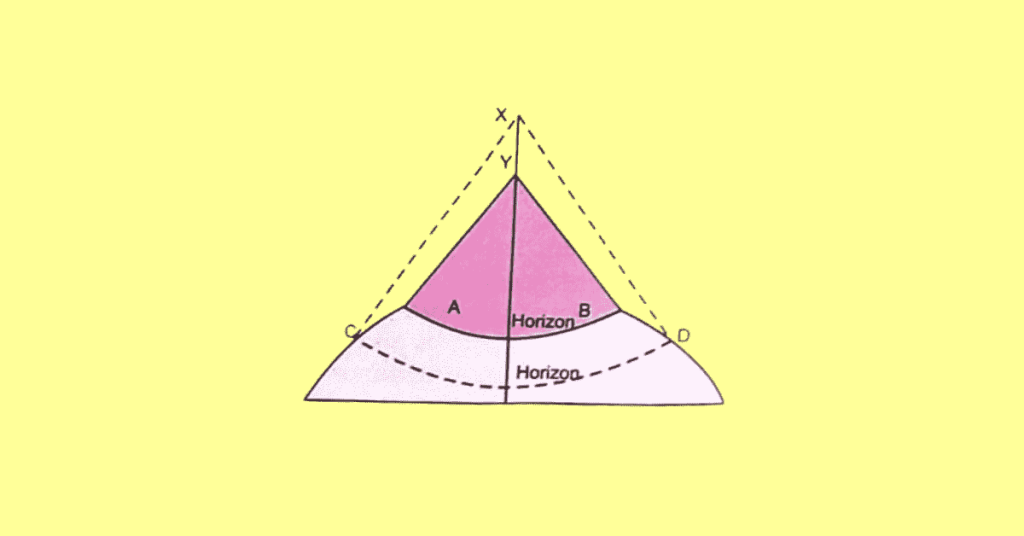
Answer: The view of the earth’s surface as seen from a height is circular. With increase in altitude, the circular horizon also widens. Had the earth’s surface been flat, the horizon would have been the same irrespective of altitude.
2. Briefly describe the shape of the earth.
Answer: The earth is said to be spherical; but it is not a perfect sphere. Its diameter varies at the Equator and at the Poles. This difference in diameter is due to the centrifugal force of the earth’s rotation at a great speed which forms a bulge at the Equator and a compression at the Poles. Thus, the earth is said to be an Oblate Spheroid. The shape of the earth is also described as Geoid, which means earth-shaped.
3. What is the earth’s mean temperature? State its one advantage.
Answer: The earth has an average temperature of 17°C which is suitable for life to exist.
4. Why is the earth called a watery planet?
Answer: Earth is called a watery planet because 70 per cent of its total area is covered by water.
5. What is ‘biosphere’?
Answer: Biosphere is the narrow realm of contact and interaction between the atmosphere, lithosphere, and hydrosphere. It provides all the necessities for all the species living on earth, i.e., light, heat, water, food and habitats. Biosphere is a thin layer of approximately 15 km from the deepest ocean trench to the highest mountain peak. It is the life zone of the earth.
6. Name the conditions necessary for life on earth.
Answer:
7. Give any two features of the earth that make it a ‘Unique Planet’.
Answer:
8. What would happen if the average temperature of the earth increased by half a degree?
Answer: If the average temperature on the earth’s surface changes by only a few degrees, many species would perish due to extreme heat or cold.
9. Trace the cyclical movement of carbon in the three realms of the earth.
Answer: Carbon is the basic raw material of all life. Atmospheric carbon dioxide is used by plants in the presence of sunlight and chlorophyll to make their own food by the process of photosynthesis. From the plants, carbon moves along the food chain through consumers at different levels. After the death of plants and animals, the carbon present in their bodies is decomposed and absorbed as food by saprophytic bacteria and fungi. When plants die and get buried in the soil, they undergo slow degradation and compaction. This results in the formation of fossil fuels containing huge amounts of carbon. During respiration, plants, animals, and humans use atmospheric oxygen and release carbon dioxide back into the atmosphere. The burning of carbon-containing fuels also results in the release of CO2 into the atmosphere. Thus, carbon from CO2 taken by green plants from the environment through photosynthesis is returned to the environment through respiration, decomposition, and through the burning of fuels.
1. (a) How does the sighting of a ship from the seashore prove that the earth is round in shape?
Answer: While standing at the seashore, watching an approaching ship, we first see only its mast. Then, as it comes closer, we can see the deck in the middle, then its funnel, and finally the hull comes into full view. This can happen only when the earth’s surface is curved. If the earth were flat, the entire ship would have been visible at once.
(b) Use a 1m long table to replicate the Bedford Level Experiment. Briefly mention how did you carry out the experiment to prove the shape of the earth.
Answer: Do it yourself.
The Bedford Level Experiment can be replicated by placing three poles of equal length at intervals of 5 cm on a 1m long table. These poles should be positioned such that they are of the same height above the table. When viewed from one end of the table, the middle pole will appear slightly higher than the others. This demonstrates that the surface is curved, similar to how the Bedford Level Experiment proved that the earth’s surface is curved.
(c) Give a geographical reason for each of the following:
(i) The sunrise and sunset occur at different times at different places.
Answer: Sunrise and sunset occur at different times at different places because the earth rotates from west to east. Therefore, people in the east can see the sun earlier than those in the west.
(ii) The earth is not a perfect sphere.
Answer: The earth is not a perfect sphere because it bulges slightly at the Equator and is flattened at the Poles due to the centrifugal force of the earth’s rotation.
(iii) Venus is hotter than Mercury.
Answer: Venus is hotter than Mercury because the atmosphere around Venus is mainly composed of carbon dioxide, which produces a greenhouse effect on the surface of Venus, causing its temperature to remain very high.
(d) Draw a well-labelled diagram to show that the horizon of the earth is circular in shape.
Answer: The higher the altitude, the wider the circular horizon. The circular horizon AB widens to CD as you move up from Y to X.
2. Describe the role of each of the following in making earth a habitable planet.
(a) Atmosphere
Answer: The earth’s atmosphere is made up of life-supporting gases like nitrogen, oxygen, and carbon dioxide. The ozone present in the atmosphere absorbs harmful ultraviolet rays of the sun and prevents loss of heat from the earth’s surface, helping to keep the earth warm.
(b) Water
Answer: Water plays a crucial role in making the earth habitable as 70 per cent of the earth’s surface is covered by water. Water bodies absorb a large amount of heat during the day and release it slowly at night, thus moderating temperature and making the climate conducive to life.
(c) Temperature
Answer: The earth has an average temperature of 17°C, which is suitable for life to exist. A slight change in temperature would result in extreme heat or cold, making it difficult for many species to survive.
(d) Distance from the Sun
Answer: The earth is at an optimum distance from the sun, making it neither too hot nor too cold. This distance allows life to thrive, as it ensures that the earth receives the right amount of heat and light from the sun.
3. (a) How does each of the following prove the circular shape of the earth:
(i) Lunar Eclipse
Answer: The shadow of the earth on the surface of the moon is clearly visible from the earth during a lunar eclipse. It appears as an arc of a circle, which can only happen if the earth is spherical.
(ii) Pole Star
Answer: The Pole Star can be seen at an angle of 90° at the North Pole and its angle decreases towards the Equator. At the Equator, the angle is 0°. This can happen only in an arc of a circle.
(b) What is an ecosystem? Give an example.
Answer: The self-regulating and self-sustaining structural and functional unit of the biosphere is called an ecosystem. This system depends upon the sun for its energy. A pond, a lake, a desert, grassland, meadow, and forests are common examples of ecosystems.
(c) Give a geographical reason for each of the following:
(i) Earth is a habitable planet.
Answer: Earth is a habitable planet because it has an atmosphere that supports life, moderate temperatures, water, and an optimal distance from the sun.
(ii) From space Earth looks blue.
Answer: From space, the earth looks blue because 70 per cent of its surface is covered by water.
(iii) Water bodies reduce the day-night temperature variations.
Answer: Water bodies absorb heat during the day and release it at night, thus moderating temperature variations between day and night.
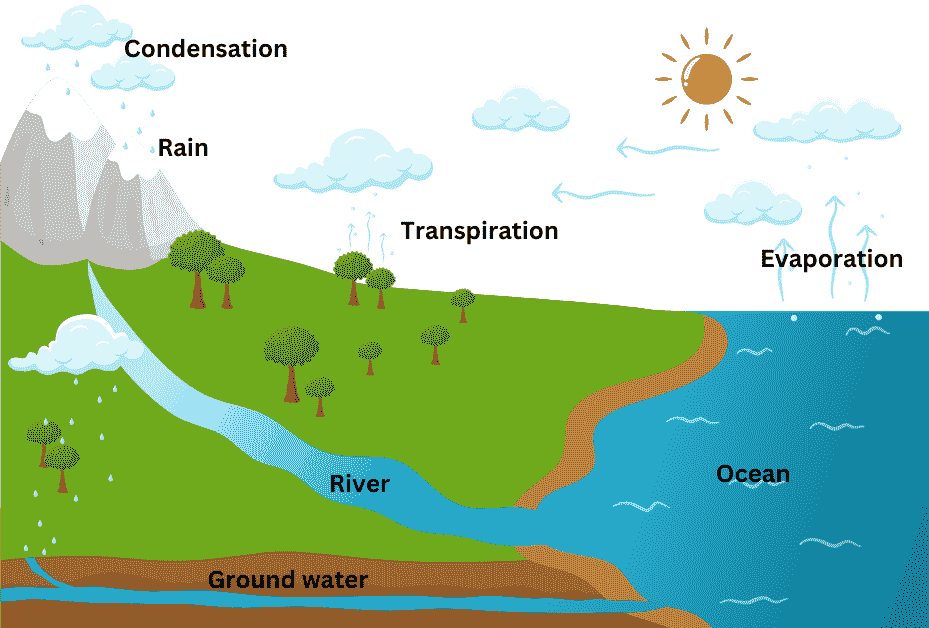
(d) Draw a well-labelled diagram to show the cyclic circulation of water between the three realms of the earth.
Answer:
1. You have gone from Delhi to Arunachal Pradesh on a study tour with your school during the winter vacation. As you woke up in the morning at 6 o’clock, you noticed the sun has risen whereas at Delhi sun rise is around 7.30 a.m. Similarly around 4.30 it was sunset while sunset is around 6 p.m. in Delhi. What do you think could be the reason for the sun rising and setting earlier than Delhi? Which feature of the earth can you relate to from this?
Answer: The reason for the sun rising and setting earlier in Arunachal Pradesh than in Delhi is due to the earth’s rotation from west to east. Arunachal Pradesh is located to the east of Delhi, and therefore, it experiences sunrise and sunset earlier. This is related to the rotation of the earth, which causes different places to experience sunrise and sunset at different times.
2. The earth depends upon the sun for its energy. Imagine a day, when the sun would not rise. Write down the consequences for the earth and its inhabitants.
Answer: If the sun would not rise, the earth would face several drastic consequences. There would be no sunlight, which would result in darkness. Plants would not be able to perform photosynthesis, leading to a collapse of the food chain. The temperature on earth would drop, making it extremely cold. Without the sun’s energy, life on earth would not be able to sustain, and eventually, all living organisms would perish due to lack of light and heat.
Prepare a project on Natural Creation and Destruction. State the conditions essential for the maintenance of life on our planet. Give a description of how new species have evolved and of how many species of plants and animals have become extinct. Look around your environment. Describe natural forces of creation and destruction that are active all the time.
Answer: Do it yourself. Here are the instructions:
1. What percentage of the Earth’s surface is covered by water?
A. 50%
B. 60%
C. 70%
D. 80%
Answer: C. 70%
Q. Who was the Indian astronomer who believed in the round shape of the Earth in the 5th century?
A. Pythagoras
B. Aryabhatta
C. Jean Baptiste Delambre
D. Magellan
Answer: B. Aryabhatta
Q. Which planet is the third from the Sun in the Solar System?
A. Venus
B. Mars
C. Earth
D. Jupiter
Answer: C. Earth
Q. What was the name of Magellan’s ship that completed the first circumnavigation of the Earth?
A. Santa Maria
B. Victoria
C. Mayflower
D. Beagle
Answer: B. Victoria
Q. What is the main reason Earth appears blue when viewed from space?
A. Atmospheric composition
B. Reflection of sunlight
C. Presence of oceans
D. Reflection of the sky
Answer: C. Presence of oceans
Q. Which planet is the fifth-largest in the Solar System?
A. Mars
B. Earth
C. Neptune
D. Uranus
Answer: B. Earth
Q. Which phenomenon is used as evidence of Earth’s spherical shape during a lunar eclipse?
A. Circular horizon
B. Pole Star observation
C. Arc-shaped shadow
D. Satellite pictures
Answer: C. Arc-shaped shadow
Q. Who discovered the flattening of the Earth at the poles?
A. Pythagoras
B. Aryabhatta
C. Jean Baptiste Delambre
D. Galileo Galilei
Answer: C. Jean Baptiste Delambre
Q. What causes sunrise and sunset to occur at different times in different places?
A. Earth’s tilt
B. Earth’s rotation
C. Earth’s orbit
D. Earth’s curvature
Answer: B. Earth’s rotation
Q. In which century did Pythagoras suggest that the Earth was spherical?
A. 4th century BC
B. 5th century
C. 6th century
D. 7th century
Answer: C. 6th century
Q. What effect does increased altitude have on the visible horizon on Earth?
A. It remains the same
B. It widens
C. It narrows
D. It disappears
Answer: B. It widens
Q. Which celestial body is aligned with the Earth’s axis, making it visible at an angle of 90° at the North Pole?
A. Sirius
B. North Star
C. Venus
D. Mars
Answer: B. North Star
Q. What is the main reason Earth is considered the only planet that supports life?
A. Its distance from the Sun
B. Presence of water
C. Its atmosphere
D. All of the above
Answer: D. All of the above
Q. Which of the following provides conclusive evidence of the Earth’s spherical shape in modern times?
A. Sighting of a ship
B. Lunar eclipse
C. Satellite pictures
D. Circular horizon
Answer: C. Satellite pictures
Q. What is the diameter of the Earth at the Equator?
A. 12,756 km
B. 12,714 km
C. 12,700 km
D. 13,000 km
Answer: A. 12,756 km
Q. What is the diameter of the Earth at the Poles?
A. 12,756 km
B. 12,700 km
C. 12,714 km
D. 12,740 km
Answer: C. 12,714 km
Q. What force is responsible for the Earth’s shape as an oblate spheroid?
A. Gravity
B. Magnetic force
C. Centripetal force
D. Centrifugal force
Answer: D. Centrifugal force
Q. What term is used to describe the Earth’s shape?
A. Sphere
B. Ellipsoid
C. Geoid
D. Spheroid
Answer: C. Geoid
Q. Which planet is hotter than Mercury despite being farther from the Sun?
A. Mars
B. Earth
C. Jupiter
D. Venus
Answer: D. Venus
Q. What is the average temperature of the Earth?
A. 10°C
B. 15°C
C. 17°C
D. 20°C
Answer: C. 17°C
Q. What percentage of Earth’s atmosphere is composed of nitrogen?
A. 78%
B. 21%
C. 1%
D. 70%
Answer: A. 78%
Q. What gas is primarily responsible for the greenhouse effect on Venus?
A. Oxygen
B. Nitrogen
C. Carbon dioxide
D. Methane
Answer: C. Carbon dioxide
Q. What percentage of the Earth’s surface is covered by water?
A. 50%
B. 60%
C. 70%
D. 80%
Answer: C. 70%
Q. Which process in the water cycle involves the conversion of water from plants into vapor?
A. Evaporation
B. Transpiration
C. Condensation
D. Precipitation
Answer: B. Transpiration
Q. What term refers to the life-supporting layer of air around the Earth?
A. Lithosphere
B. Hydrosphere
C. Atmosphere
D. Biosphere
Answer: C. Atmosphere
Q. What is the primary source of energy for ecosystems on Earth?
A. Moon
B. Water
C. Sun
D. Earth’s core
Answer: C. Sun
Q. Which planet in the Solar System has the lowest surface temperature?
A. Mercury
B. Venus
C. Mars
D. Neptune
Answer: D. Neptune
Q. What process balances evaporation, condensation, and precipitation on Earth?
A. Carbon cycle
B. Hydrological cycle
C. Nitrogen cycle
D. Oxygen cycle
Answer: B. Hydrological cycle
Q. What forms the solid crust of the Earth known as the lithosphere?
A. Soil
B. Rocks
C. Water
D. Atmosphere
Answer: B. Rocks
Q. What is the narrow realm of contact and interaction between the atmosphere, lithosphere, and hydrosphere called?
A. Biosphere
B. Lithosphere
C. Hydrosphere
D. Atmosphere
Answer: A. Biosphere
Q. How thick is the biosphere layer from the deepest ocean trench to the highest mountain peak?
A. 5 km
B. 10 km
C. 15 km
D. 20 km
Answer: C. 15 km
Q. What are the two primary forms of life within the biosphere?
A. Bacteria and viruses
B. Animals and fungi
C. Plants and animals
D. Algae and corals
Answer: C. Plants and animals
Q. Which process is responsible for plants producing their own food?
A. Transpiration
B. Respiration
C. Decomposition
D. Photosynthesis
Answer: D. Photosynthesis
Q. Which element is the basic raw material of all life on Earth?
A. Oxygen
B. Nitrogen
C. Carbon
D. Hydrogen
Answer: C. Carbon
Q. What percentage of the atmosphere is made up of free nitrogen?
A. 21%
B. 50%
C. 78%
D. 95%
Answer: C. 78%
Q. Which cycle involves the cyclic movement of carbon from the atmosphere to organisms and back?
A. Water cycle
B. Carbon cycle
C. Nitrogen cycle
D. Oxygen cycle
Answer: B. Carbon cycle
Q. What is the science of measuring and understanding Earth’s shape, orientation, and gravity field called?
A. Geology
B. Cartography
C. Geodesy
D. Topography
Answer: C. Geodesy
Q. What tool do geodesists use to monitor the movement of Earth’s surface continuously?
A. Barometer
B. Telescope
C. Global Positioning System (GPS)
D. Compass
Answer: C. Global Positioning System (GPS)
Q. What simple mathematical model do geodesists use as the most basic model of the Earth?
A. Sphere
B. Geoid
C. Ellipsoid
D. Cube
Answer: C. Ellipsoid
Q. Which process releases carbon dioxide back into the atmosphere during respiration?
A. Photosynthesis
B. Transpiration
C. Combustion
D. Respiration
Answer: D. Respiration
Q. What contributes to global warming by heating up the Earth due to an imbalance of carbon in the atmosphere?
A. Oxygen
B. Carbon dioxide
C. Nitrogen
D. Hydrogen
Answer: B. Carbon dioxide
52. What is released back into the atmosphere by green plants during photosynthesis?
A. Nitrogen
B. Hydrogen
C. Carbon dioxide
D. Oxygen
Answer: D. Oxygen
1. Assertion (A): The Earth is often referred to as the “watery planet.”
Reason (R): This is primarily because approximately 30 per cent of its total surface area is covered by water.
(a) Both A and R are true and R is the correct explanation of A.
(b) Both A and R are true but R does not explain A.
(c) A is true but R is false.
(d) A is false but R is true.
Answer: (c) A is true but R is false.
2. Assertion (A): When an approaching ship is sighted from the shore, its mast is typically seen before its hull.
Reason (R): This sequential appearance is a consequence of the Earth’s curved surface.
(a) Both A and R are true and R is the correct explanation of A.
(b) Both A and R are true but R does not explain A.
(c) A is true but R is false.
(d) A is false but R is true.
Answer: (a) Both A and R are true and R is the correct explanation of A.
3. Assertion (A): The Earth is a perfect sphere with an identical diameter at the Equator and the Poles.
Reason (R): The Earth’s diameter at the Equator is approximately 12,756 km, while its Polar diameter is approximately 12,714 km.
(a) Both A and R are true and R is the correct explanation of A.
(b) Both A and R are true but R does not explain A.
(c) A is true but R is false.
(d) A is false but R is true.
Answer: (d) A is false but R is true.
4. Assertion (A): The Pole Star appears at an angle of 90° when observed from the North Pole, and its observed angle decreases as an observer moves towards the Equator, where it is 0°.
Reason (R): This systematic change in the Pole Star’s apparent altitude can only occur if the Earth’s surface forms an arc of a circle.
(a) Both A and R are true and R is the correct explanation of A.
(b) Both A and R are true but R does not explain A.
(c) A is true but R is false.
(d) A is false but R is true.
Answer: (a) Both A and R are true and R is the correct explanation of A.
5. Assertion (A): Aryabhatta, a prominent 5th-century Indian scholar, was a proponent of the theory that the Earth was flat and immobile.
Reason (R): The Greek philosopher Pythagoras, in the 6th century, independently concluded that the Earth was spherical and rotated on its axis.
(a) Both A and R are true and R is the correct explanation of A.
(b) Both A and R are true but R does not explain A.
(c) A is true but R is false.
(d) A is false but R is true.
Answer: (d) A is false but R is true.
6. Assertion (A): The Earth’s atmosphere is largely constituted by gases essential for supporting life, notably nitrogen and oxygen.
Reason (R): Helium and Argon are the predominant gases in Earth’s atmosphere, together making up more than 90% of its total composition.
(a) Both A and R are true and R is the correct explanation of A.
(b) Both A and R are true but R does not explain A.
(c) A is true but R is false.
(d) A is false but R is true.
Answer: (c) A is true but R is false.
7. Assertion (A): During a lunar eclipse, the shadow cast by the Earth on the Moon’s surface consistently appears as an arc of a circle.
Reason (R): The Earth is considerably larger than the Moon, ensuring its shadow is always circular regardless of its orientation relative to the Moon.
(a) Both A and R are true and R is the correct explanation of A.
(b) Both A and R are true but R does not explain A.
(c) A is true but R is false.
(d) A is false but R is true.
Answer: (a) Both A and R are true and R is the correct explanation of A.
8. Assertion (A): Sunrise and sunset do not occur simultaneously at all locations on Earth.
Reason (R): This variation in the timing of sunrise and sunset is due to the Earth’s rotation on its axis from west to east.
(a) Both A and R are true and R is the correct explanation of A.
(b) Both A and R are true but R does not explain A.
(c) A is true but R is false.
(d) A is false but R is true.
Answer: (a) Both A and R are true and R is the correct explanation of A.
9. Assertion (A): The Earth exhibits a bulge at the Equator and a compression at the Poles.
Reason (R): This specific shape is attributed to the centrifugal force generated by the Earth’s rapid rotation.
(a) Both A and R are true and R is the correct explanation of A.
(b) Both A and R are true but R does not explain A.
(c) A is true but R is false.
(d) A is false but R is true.
Answer: (a) Both A and R are true and R is the correct explanation of A.
10. Assertion (A): Venus, despite being the second planet from the Sun, has a higher surface temperature than Mercury, the planet closest to the Sun.
Reason (R): The atmosphere of Venus is predominantly composed of carbon dioxide, leading to a significant greenhouse effect.
(a) Both A and R are true and R is the correct explanation of A.
(b) Both A and R are true but R does not explain A.
(c) A is true but R is false.
(d) A is false but R is true.
Answer: (a) Both A and R are true and R is the correct explanation of A.
11. Assertion (A): The presence of ozone in the Earth’s atmosphere plays a vital role in protecting life on the surface.
Reason (R): Ozone gas effectively absorbs harmful ultraviolet radiation emitted by the Sun.
(a) Both A and R are true and R is the correct explanation of A.
(b) Both A and R are true but R does not explain A.
(c) A is true but R is false.
(d) A is false but R is true.
Answer: (a) Both A and R are true and R is the correct explanation of A.
12. Assertion (A): Large expanses of water on Earth’s surface contribute to the moderation of global temperatures.
Reason (R): Water has the capacity to absorb substantial amounts of heat during daylight hours and release it during the night, thereby reducing extreme temperature fluctuations.
(a) Both A and R are true and R is the correct explanation of A.
(b) Both A and R are true but R does not explain A.
(c) A is true but R is false.
(d) A is false but R is true.
Answer: (a) Both A and R are true and R is the correct explanation of A.
13. Assertion (A): The lithosphere, Earth’s solid outer crust, is fundamental for the existence of plant life.
Reason (R): The process of rock weathering leads to the formation of soil, which supplies essential nutrients required for plant growth.
(a) Both A and R are true and R is the correct explanation of A.
(b) Both A and R are true but R does not explain A.
(c) A is true but R is false.
(d) A is false but R is true.
Answer: (a) Both A and R are true and R is the correct explanation of A.
14. Assertion (A): The biosphere is characterized as a relatively narrow zone where the atmosphere, lithosphere, and hydrosphere interact.
Reason (R): The biosphere is the sole provider of all essential requirements for life on Earth, including light, heat, water, food, and habitats.
(a) Both A and R are true and R is the correct explanation of A.
(b) Both A and R are true but R does not explain A.
(c) A is true but R is false.
(d) A is false but R is true.
Answer: (b) Both A and R are true but R does not explain A.
15. Assertion (A): Carbon, in the form of atmospheric carbon dioxide, is utilized by plants for photosynthesis.
Reason (R): All living organisms are primarily composed of nitrogen.
(a) Both A and R are true and R is the correct explanation of A.
(b) Both A and R are true but R does not explain A.
(c) A is true but R is false.
(d) A is false but R is true.
Answer: (c) A is true but R is false.
16. Assertion (A): For foundational measurements of the Earth, geodesists often employ the ellipsoid as the primary model.
Reason (R): The ellipsoid model simplifies Earth’s surface by assuming it is smooth, akin to an oceanic surface, and omits features like mountains and valleys.
(a) Both A and R are true and R is the correct explanation of A.
(b) Both A and R are true but R does not explain A.
(c) A is true but R is false.
(d) A is false but R is true.
Answer: (a) Both A and R are true and R is the correct explanation of A.
17. Assertion (A): The natural carbon cycle plays an indispensable role in maintaining a balance of carbon in Earth’s systems.
Reason (R): Any significant imbalance in atmospheric carbon levels can contribute to the phenomenon of global warming.
(a) Both A and R are true and R is the correct explanation of A.
(b) Both A and R are true but R does not explain A.
(c) A is true but R is false.
(d) A is false but R is true.
Answer: (a) Both A and R are true and R is the correct explanation of A.
18. Assertion (A): Plants absorb nitrogen predominantly from the soil in the chemical form of nitrates.
Reason (R): The Earth’s atmosphere contains a vast reserve of free nitrogen, accounting for about 78% of its composition.
(a) Both A and R are true and R is the correct explanation of A.
(b) Both A and R are true but R does not explain A.
(c) A is true but R is false.
(d) A is false but R is true.
Answer: (b) Both A and R are true but R does not explain A.
19. Assertion (A): The Bedford Level Experiment, involving poles in a canal, demonstrated that the Earth is perfectly flat.
Reason (R): In this experiment, when three poles of equal height fixed at intervals were viewed from one end, the middle pole appeared slightly higher, indicating the Earth’s curvature.
(a) Both A and R are true and R is the correct explanation of A.
(b) Both A and R are true but R does not explain A.
(c) A is true but R is false.
(d) A is false but R is true.
Answer: (d) A is false but R is true.
20. Assertion (A): Organisms utilize atmospheric oxygen to derive energy from the food they consume.
Reason (R): Green plants are the primary source for replenishing atmospheric oxygen through the process of photosynthesis.
(a) Both A and R are true and R is the correct explanation of A.
(b) Both A and R are true but R does not explain A.
(c) A is true but R is false.
(d) A is false but R is true.
Answer: (b) Both A and R are true but R does not explain A.
21. Assertion (A): Earth’s specific distance from the Sun is a critical factor for its habitability.
Reason (R): This orbital position ensures that surface temperatures on Earth are generally maintained within a range that is neither excessively hot nor prohibitively cold for life to flourish.
(a) Both A and R are true and R is the correct explanation of A.
(b) Both A and R are true but R does not explain A.
(c) A is true but R is false.
(d) A is false but R is true.
Answer: (a) Both A and R are true and R is the correct explanation of A.
22. Assertion (A): The visual horizon observed from any elevated position on Earth consistently forms a circular shape, and its apparent size increases with altitude.
Reason (R): If the Earth possessed a flat surface, the extent of the visible horizon would not change with variations in the observer’s altitude.
(a) Both A and R are true and R is the correct explanation of A.
(b) Both A and R are true but R does not explain A.
(c) A is true but R is false.
(d) A is false but R is true.
Answer: (a) Both A and R are true and R is the correct explanation of A.

Only for registered users