Synonyms
More meanings
Tip: select a single word for meaning & synonyms.
Select multiple words normally to copy text.


Get here the notes, questions, answers, textbook solutions, summary, additional/extras, and PDF of TBSE (Tripura Board) Class 10 Social Science (Political Science/Democratic Politics II) Chapter 2 “Federalism.” However, the provided notes should only be treated as references, and the students are encouraged to make changes to them as they feel appropriate.

Federalism is a form of government in which power is divided between a central authority and constituent units such as provinces or states. This system seeks to strike a balance between unity and diversity by allowing both the central and regional governments to have their own powers and responsibilities while remaining accountable to the people. Federal systems have dual objectives, which necessitate mutual trust and agreements among the various levels of government. Approximately 40% of the world’s population lives in 25 federal countries, the majority of which are large countries.
The balance of power between the central and state governments varies by country and is primarily determined by the historical context in which the federation was formed. There are two ways to form a federation: independent states joining together or a large country dividing its power. A federal country’s constitution specifies the jurisdiction of each level of government and the sources of revenue, and the highest court has the authority to interpret the constitution. India is a federal country with three levels of government: the Union of India, state governments, and panchayats and municipalities. The Indian Constitution establishes a two-tiered government system with the Union (Central) Government and State Governments, each with distinct responsibilities and powers.
The Union List includes subjects of national importance such as defence, foreign affairs, and banking, whereas the State List includes subjects of state and local importance such as police, agriculture, and commerce. The Concurrent List includes subjects of mutual interest to the Union and State Governments, with the Union Government having the authority to override any conflicting state laws. Union Territories, such as Chandigarh and Delhi, are governed by the Central Government and have limited powers. Some states, such as Jammu and Kashmir, have a special status with unique provisions and powers. The division of power between the Union and state governments is a fundamental aspect of the Constitution that can only be changed with a two-thirds majority vote in both Houses of Parliament and ratification by at least half of the state legislatures. The judiciary is critical in resolving disputes, and the Union and state governments have the authority to raise funds through taxation.
Federalism’s success is attributed to the democratic nature of Indian politics, which has resulted in shared ideals of respect for diversity, the spirit of federalism, and the desire for unity. The formation of linguistic states, language policy, and the restructuring of center-state relations are all important factors in the practise of federalism in India. The use of Hindi as the official language, as well as the recognition of 21 other languages, has allowed for greater inclusivity. The rise of regional political parties and the formation of coalition governments at the centre have bolstered center-state relations. Respecting the independence of state governments fosters a new culture of power sharing and appreciation for the concept of federalism.
The need for power decentralisation and the establishment of a third tier of local government. The Constitution was amended in 1992 to give local governments more power and effectiveness, and regular elections are now required. The basic idea behind decentralisation is that local people have a better understanding of local issues and can participate in decision making. Seats are reserved for underrepresented groups, and a new independent institution, the State Election Commission, has been established to oversee local elections. Panchayati raj is the name given to rural local government. The need for decentralisation was recognised by the Constitution, and several attempts have been made to decentralise power to the village and town level.
The village level is the lowest level of local government in India. The Gram Panchayat is the village’s decision-making body, and it is overseen by the Gram Sabha. The Zilla Parishad at the district level is mostly made up of elected members and is led by a chairperson. At the intermediate level, the Panchayat Samiti or Mandal is made up of several Gram Panchayats grouped together.
Municipalities for towns and municipal corporations for large cities are both run by elected bodies with a chairperson or mayor as the political head. The Prime Minister leads the country, the Chief Minister leads the state, and the chairperson of the Zilla Parishad leads the district.
1. Locate the following States on a blank outline political map of India: Manipur, Sikkim, Chhattisgarh and Goa.
Answer:
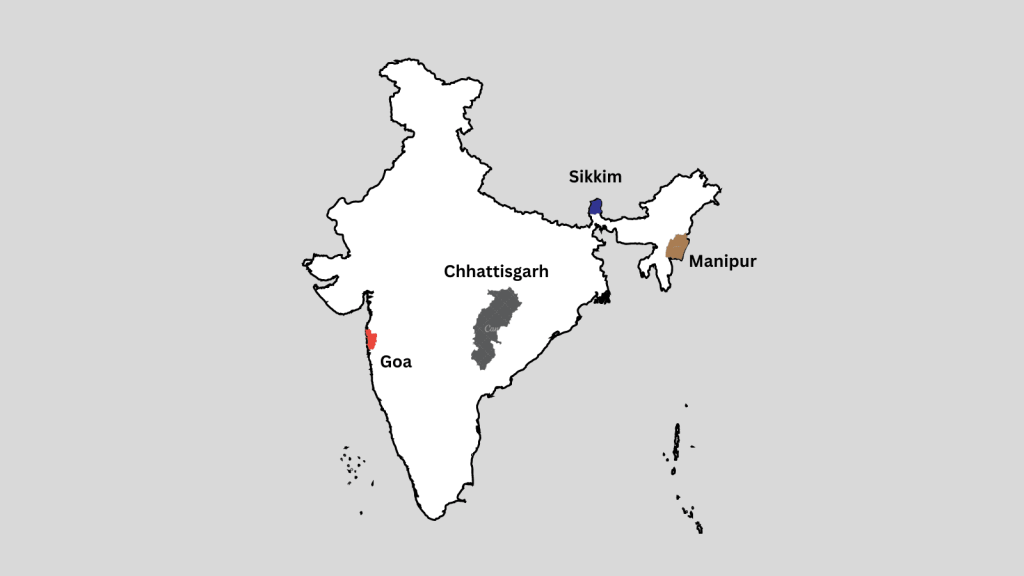
2. Identify and shade three federal countries (other than India) on a blank outline political map of the world.
Answer:
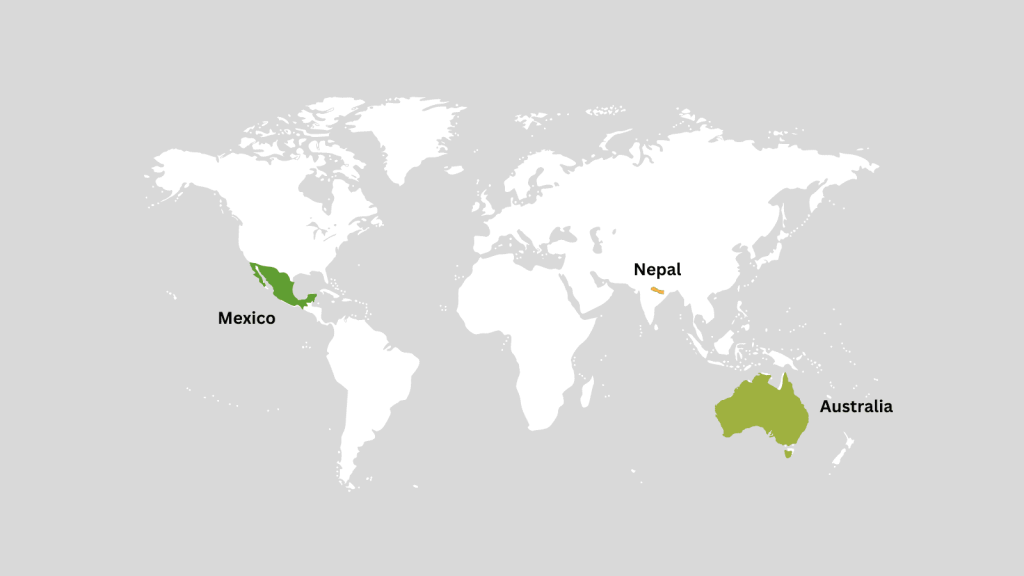
3. Point out one feature in the practice of federalism in India that is similar to and one feature that is different from that of Belgium.
Answer: In India, like in Belgium, the practice of federalism involves the sharing of power between the central and state governments. However, in India, the power sharing is not based on language communities, but rather on the states and union territories that make up the country.
4. What is the main difference between a federal form of government and a unitary one? Explain with an example.
Answer: The main difference between a federal form of government and a unitary one is that in a federal system, power is divided between the central government and the state governments, while in a unitary system, the power is held by the central government. For example, in the United States, power is divided between the federal government and the state governments, while in the United Kingdom, power is held by the central government.
5. State any two differences between the local government before and after the Constitutional amendment in 1992.
Answer: Before the Constitutional amendment in 1992, the local government was limited in its power and autonomy, with the central government having the ultimate authority. After the amendment, the local government was given more power and autonomy, with the central government having less control over the local government. Additionally, before the amendment, the local government was not allowed to raise taxes, but after the amendment, the local government was allowed to raise taxes.
6. Fill in the blanks:
Since the United States is a ___________________ type of federation, all the constituent States have equal powers and States are ______________vis-à-vis the federal government. But India is a _____________________ type of federation and some States have more power than others. In India, the ____________ government has more powers.
Answer: Since the United States is a (coming together) type of federation, all the constituent States have equal powers and States are (strong) vis-à-vis the federal government. But India is an (holding together) type of federation and some States have more power than others. In India, the (central) government has more powers.
7. Here are three reactions to the language policy followed in India.
Give an argument and an example to support any of these positions.
Sangeeta: The policy of accommodation has strengthened national unity.
Arman: Language-based States have divided us by making everyone conscious of their language.
Harish: This policy has only helped to consolidate the dominance of English over all other languages.
Answer: Sangeeta’s position can be supported by the fact that the policy of accommodation has allowed different languages to coexist peacefully in India, which has helped to strengthen national unity. For example, the 8th Schedule of the Indian Constitution recognizes 22 languages, allowing each language to be used in official documents, court proceedings, and government business. This has helped to foster a sense of unity among the people of India, regardless of their language.
8. The distinguishing feature of a federal government is:
(a) National government gives some powers to the provincial governments.
(b) Power is distributed among the legislature, executive and judiciary.
(c) Elected officials exercise supreme power in the government.
(d) Governmental power is divided between different levels of government.
Answer: (d) Governmental power is divided between different levels of government.
9. A few subjects in various Lists of the Indian Constitution are given here. Group them under the Union, State and Concurrent Lists as provided in the table below.
A. Defence; B. Police; C. Agriculture; D. Education; E. Banking; F. Forests; G. Communications; H. Trade; I. Marriages
Answer:
| Union List | defence, banking, communications. |
| State List | police, trade, agriculture. |
| Concurrent List | education, forests, trade, marriage |
1. What is federalism?
Answer: Federalism is a system of government in which power is divided between a central authority and various constituent units of the country, such as provinces or states.
2. How many countries have federal political systems?
Answer: Only 25 of the world’s 193 countries have federal political systems.
3. What is the goal of federalism?
Answer: Federalism aims to balance unity and diversity by allowing both the central and regional governments to have their own powers and responsibilities while still being accountable to the people.
4. What are the two crucial aspects of federalism?
Answer: The two crucial aspects of federalism are mutual trust and agreement to live together, which requires governments at different levels to agree on some rules of power-sharing.
5. What is the difference between federal and unitary systems?
Answer: In a federal system, the central government cannot order the state government to do something and both levels of government are separately accountable to the people. In a unitary system, either there is only one level of government or the sub-units are subordinate to the central government and the central government can pass on orders to the provincial or local government.
6. What is the population percentage that lives in federal countries?
Answer: Approximately 40% of the world’s population lives in 25 federal countries.
7. How is the balance of power between central and state government determined?
Answer: The balance of power between central and state government is determined by the historical context in which the federation was formed and can vary from one federation to another.
8. What is the role of the highest court in a federal system?
Answer: The highest court in a federal system acts as an umpire if disputes arise between different levels of government in the exercise of their respective powers.
9. What are the two routes through which federations have been formed?
Answer: The two routes through which federations have been formed are independent states coming together on their own, and a large country dividing its power between constituent states and the national government.
10. What are the subjects included in the Union List?
Answer: The Union List includes subjects of national importance such as defense, foreign affairs, banking, communications, and currency.
11. What are the subjects included in the State List?
Answer: The State List contains subjects of state and local importance such as police, trade, commerce, agriculture, and irrigation.
12. What are the subjects included in the Concurrent List?
Answer: The Concurrent List includes subjects of common interest to both the Union and State Governments such as education, forest, trade unions, marriage, adoption, and succession.
13. What are Union Territories?
Answer: Union Territories are areas that are too small to become an independent state but cannot be merged with any existing state, with the Central Government having special powers in running them.
14. What was the special status of Jammu and Kashmir?
Answer: Jammu and Kashmir had its own constitution, and many provisions of the Indian Constitution were not applicable without the approval of the state assembly. Indians who were not permanent residents there were also unable to buy land or houses there.
15. What is the process for changing the power sharing arrangement between the Union and state governments?
Answer: Any change to the power sharing arrangement between the Union and State Governments requires a two-thirds majority in both Houses of Parliament and ratification by the legislatures of at least half of the total states.
16. What is the role of the judiciary in overseeing constitutional provisions and procedures?
Answer: The judiciary plays an important role in overseeing the implementation of constitutional provisions and procedures, with the power to make a decision in case of disputes about the division of powers.
17. What are the key factors in the practice of federalism in India?
Answer: The key factors in the practice of federalism in India are the creation of linguistic states, the language policy, and restructuring of Centre-State relations.
18. What is the significance of decentralization of power in India?
Answer: Decentralization of power to local government is necessary in India due to the vast size and diversity of the country. It allows for local problems to be resolved and for direct democratic participation.
19. What was the purpose of the amendment made to the Constitution in 1992?
Answer: The amendment made to the Constitution in 1992 was to make the third tier of democracy (local government) more powerful and effective.
20. Why is local self-government considered an important principle of democracy?
Answer: Local self-government is considered an important principle of democracy because it allows for direct participation in decision making and helps inculcate a habit of democratic participation.
21. What is the role of the State Election Commission in India’s decentralization?
Answer: The State Election Commission in each State is responsible for conducting panchayat and municipal elections and ensuring the sharing of powers and revenue between state and local governments.
22. What is the significance of reserved seats for certain groups in local government bodies?
Answer: Reserved seats for Scheduled Castes, Scheduled Tribes, and Other Backward Classes in local government bodies help ensure representation of these groups in decision making processes.
23. What is the decision-making body for the entire village?
Answer: The Panchayat.
24. What is constituted by a few gram panchayats?
Answer: Panchayat Samiti.
25. Who is the political head of the municipality?
Answer: Municipal Chairperson.
26. Who is the political head of the Zilla Parishad?
Answer: Zilla Parishad Chairperson.
1. How many countries have federal political systems?
A. 25
B. 193
C. 40%
D. Large countries
Answer: A. 25
2. What is the role of the highest court in a federation?
A. Interpreter
B. Mediator
C. Enforcer
D. Decider
Answer: A. Interpreter
3. Who makes laws for subjects in Union List?
A. Union Government
B. State Government
C. Both
D. None
Answer: A. Union Government
4. Who makes laws for subjects in State List?
A. Union Government
B. State Government
C. Both
D. None
Answer: B. State Government
5. Who makes laws for subjects in Concurrent List?
A. Union Government
B. State Government
C. Both
D. None
Answer: C. Both
6. Who has special powers in running Union Territories?
A. Union Government
B. State Government
C. Both|
D. None
Answer: A. Union Government
7. Who has power to legislate on residuary subjects?
A. Union Government
B. State Government
C. Both
D. None
Answer: A. Union Government
8. What is the third tier of government in India?
A: Local government
B: State government
C: Centre government
D: Federal government
Answer: A. Local government
9. When was a major step towards decentralisation taken in India?
A: 1947
B: 1992
C: 1974
D: 2002
Answer: B. 1992
10. What is rural local government in India popularly known as?
A: Centre-State relations
B: Local self-government
C: Panchayati raj
D: State Election Commission
Answer: C. Panchayati raj
11. What is the role of State Election Commission in India?
A: Share revenue
B: Conduct elections
C: Reserve positions
D: Amend Constitution
Answer: B. Conduct elections
12. What is the percentage of positions reserved for women in local government bodies in India?
A: 30%
B: 33%
C: 50%
D: 66%
Answer: 33%
13. Who runs the country (like India)?
A. Prime Minister
B. Chief Minister
C. Chairperson
D. Mayor
Answer: A. Prime Minister
14. Who runs the state?
A. Prime Minister
B. Chief Minister
C. Chairperson
D. Mayor
Answer: B. Chief Minister
16. Who is the political head of a municipality?
A. Mayor
B. Prime Minister
C. Chairperson
D. Municipal chairperson
Answer: D. Municipal chairperson
17. Who is the political head of a Zilla Parishad?
A. Mayor
B. Prime Minister
C. Chairperson
D. Zilla Parishad chairperson
Answer: D. Zilla Parishad chairperson
18. Who approves the annual budget of the gram panchayat?
A. Zilla Parishad
B. Gram Sabha
C. Panchayat
D. Municipal corporation
Answer: C. Panchayat

Only for registered users