Synonyms
More meanings
Tip: select a single word for meaning & synonyms.
Select multiple words normally to copy text.

Get summaries, questions, answers, solutions, notes, extras, PDF and guides for Chapter 10 Human Eye and Colorful World: Class 10 Science textbook, which is part of the syllabus for students studying under SEBA (Assam Board), NBSE (Nagaland Board), TBSE (Tripura Board), CBSE (Central Board), MBOSE (Meghalaya Board), BSEM (Manipur Board), WBBSE (West Bengal Board), and all other boards following the NCERT books. These solutions, however, should only be treated as references and can be modified/changed.
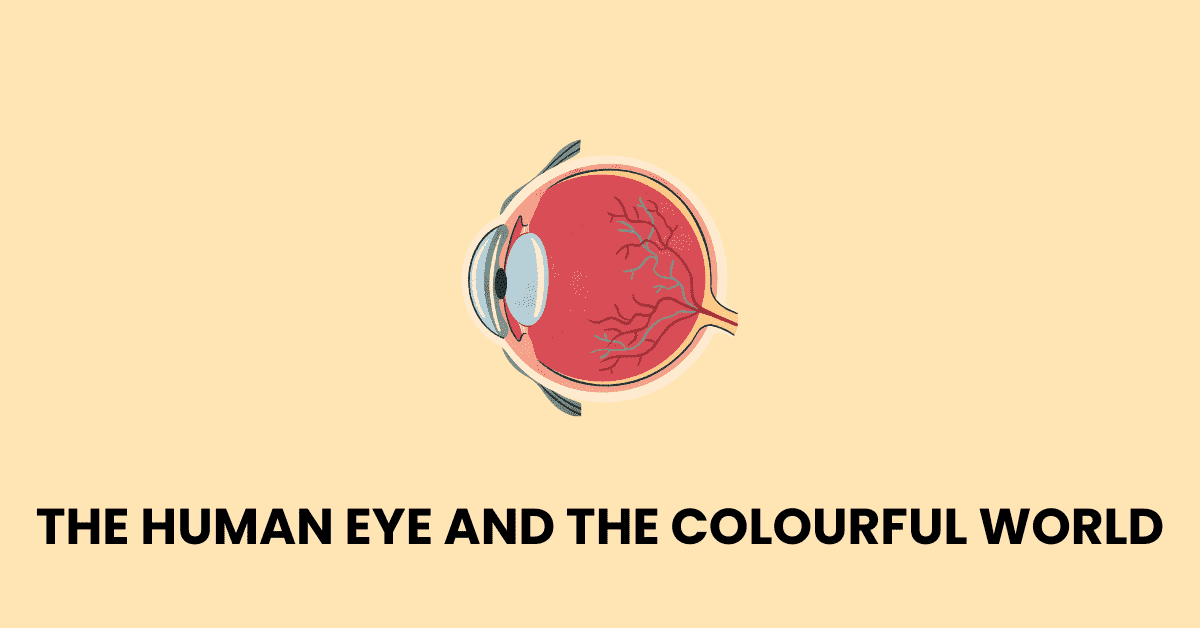
The human eye allows us to see the world. It uses light to form images of objects around us. The eye works much like a camera. A camera has a lens to focus light and create a picture on film or a sensor. Similarly, our eye has a lens. Light first enters through the cornea, which is the clear, curved front surface of the eye. The iris, the colored part of the eye, controls the size of the pupil. The pupil is the small dark opening in the center of the iris that lets light pass through. The lens is located behind the pupil and focuses this light onto the retina. The retina is a light-sensitive layer at the back of the eye, acting like the camera’s film. Special cells in the retina, called light-sensitive cells, detect the light and send signals through the optic nerve to the brain. The brain then interprets these signals as the images we see. The eyeball is roughly spherical and about 2.3 cm in diameter.
Our eyes have a remarkable ability to adjust their focus to see objects clearly, whether they are near or far away. This ability is called accommodation. Muscles called ciliary muscles change the shape of the eye lens. When these muscles are relaxed, the lens becomes thinner, allowing us to see distant objects clearly. When the muscles contract, the lens becomes thicker, which helps us focus on nearby objects. For a young adult with normal vision, the closest distance at which objects can be seen clearly without strain is about 25 cm. This is known as the near point. The farthest point the eye can see clearly is called the far point, which is infinity for a normal eye. Sometimes, especially as people get older, the eye lens can become cloudy. This condition is called a cataract, and it can cause blurry vision or loss of sight. Cataracts can often be treated with surgery.
Sometimes, the eye cannot focus light correctly on the retina, leading to vision defects. Myopia, also known as near-sightedness, is a condition where a person can see nearby objects clearly, but distant objects appear blurry. This happens because the image is formed in front of the retina. It can be corrected by using a concave lens. Hypermetropia, or far-sightedness, is when a person can see distant objects clearly, but has difficulty seeing nearby objects. In this case, the image is formed behind the retina. This defect can be corrected using a convex lens. Presbyopia is an age-related condition where the eye gradually loses its power of accommodation, making it difficult to focus on near objects. This occurs because the ciliary muscles weaken and the eye lens becomes less flexible. Bifocal lenses, which combine both concave and convex parts, are often used to correct presbyopia. It is also possible for people to donate their eyes after death, which can give the gift of sight to someone who is blind.
Light behaves in interesting ways when it interacts with different materials. When a beam of white light passes through a triangular piece of glass called a prism, it bends. More than that, the white light splits into a band of seven colors: Violet, Indigo, Blue, Green, Yellow, Orange, and Red (often remembered by the acronym VIBGYOR). This splitting of white light into its component colors is called dispersion. The band of colors produced is called a spectrum. A rainbow is a beautiful natural example of dispersion. It is formed when sunlight passes through tiny raindrops suspended in the atmosphere after a rain shower. These raindrops act like tiny prisms, dispersing the sunlight into its spectrum of colors.
The Earth’s atmosphere can also bend light. This phenomenon is known as atmospheric refraction. It is the reason why stars appear to twinkle. Stars are very far away, so they appear as point sources of light. As starlight enters the Earth’s atmosphere, it passes through layers of air that have different temperatures and densities. These layers are constantly moving, causing the light from the star to bend randomly as it travels towards our eyes. This makes the star appear to flicker or twinkle. Planets, on the other hand, do not usually twinkle. This is because they are much closer to Earth and appear as extended sources of light (like tiny discs rather than points). The light from different parts of the planet also bends, but these effects average out, so the twinkling is not noticeable. Atmospheric refraction also causes the Sun to appear to rise about two minutes before it actually crosses the horizon and to set about two minutes after it has actually gone below the horizon.
Light can also be scattered by very small particles in its path. The Tyndall effect is the scattering of a beam of light as it passes through a colloid (a mixture where tiny particles are suspended). This scattering makes the path of the light beam visible. The blue color of the clear sky is also due to the scattering of sunlight. The molecules of air and other fine particles in the atmosphere are smaller than the wavelength of visible light. They are more effective at scattering light of shorter wavelengths (like blue and violet) than light of longer wavelengths (like red). When sunlight passes through the atmosphere, the blue light is scattered in all directions. This scattered blue light enters our eyes, making the sky appear blue. Danger signal lights are often red. This is because red light has a longer wavelength and is scattered the least by fog, smoke, or atmospheric particles. Therefore, red light can be seen from a greater distance, making it suitable for signals. Astronauts in space, high above the Earth’s atmosphere, see the sky as dark instead of blue because there are no atmospheric particles to scatter the sunlight.
1. What is meant by power of accommodation of the eye?
Answer: The power of accommodation of the eye is the ability of the eye to focus on both near and distant objects, by adjusting its focal length.
2. A person with a myopic eye cannot see objects beyond 1.2 m distinctly. What should be the type of the corrective lens used to restore proper vision?
Answer: A person with a myopic eye cannot see distant objects distinctly. This defect can be corrected by using a concave lens of suitable power. Therefore, a concave lens should be used to restore proper vision for the person who cannot see objects beyond 1.2 m distinctly.
3. What is the far point and near point of the human eye with normal vision?
Answer: For a human eye with normal vision, the near point, which is the smallest distance at which the eye can see objects clearly without strain, is about 25 cm. The far point, which is the farthest point upto which the eye can see objects clearly, is infinity for a normal eye.
4. A student has difficulty reading the blackboard while sitting in the last row. What could be the defect the child is suffering from? How can it be corrected?
Answer: The student is likely suffering from myopia, also known as near-sightedness, as a person with myopia cannot see distant objects distinctly. This defect can be corrected by using a concave lens of suitable power.
1. The human eye can focus on objects at different distances by adjusting the focal length of the eye lens. This is due to
(a) presbyopia.
(b) accommodation.
(c) near-sightedness.
(d) far-sightedness.
Answer: The human eye can focus on objects at different distances by adjusting the focal length of the eye lens. This is due to (b) accommodation.
2. The human eye forms the image of an object at its
(a) cornea.
(b) iris.
(c) pupil.
(d) retina.
Answer: The human eye forms the image of an object at its (d) retina.
3. The least distance of distinct vision for a young adult with normal vision is about
(a) 25 m.
(b) 2.5 cm.
(c) 25 cm.
(d) 2.5 m.
Answer: The least distance of distinct vision for a young adult with normal vision is about (c) 25 cm.
4. The change in focal length of an eye lens is caused by the action of the
(a) pupil.
(b) retina.
(c) ciliary muscles.
(d) iris.
Answer: The change in focal length of an eye lens is caused by the action of the (c) ciliary muscles.
5. A person needs a lens of power -5.5 dioptres for correcting his distant vision. For correcting his near vision he needs a lens of power +1.5 dioptre. What is the focal length of the lens required for correcting (i) distant vision, and (ii) near vision?
Answer: For correcting distant vision (myopia), a concave lens is used, and for correcting near vision (hypermetropia), a convex lens is used. The document explains that myopia is corrected by using a concave lens of suitable power, and hypermetropia is corrected by using a convex lens of suitable power. The specific focal lengths for a lens of power -5.5 dioptres for distant vision and a lens of power +1.5 dioptre for near vision are not calculated in the document.
6. The far point of a myopic person is 80 cm in front of the eye. What is the nature and power of the lens required to correct the problem?
Answer: The nature of the lens required to correct the problem of myopia is a concave lens. The document states that myopia “can be corrected by using a concave lens of suitable power.” The specific power of the lens required for a myopic person whose far point is 80 cm in front of the eye is not calculated in the document.
7. Make a diagram to show how hypermetropia is corrected. The near point of a hypermetropic eye is 1 m. What is the power of the lens required to correct this defect? Assume that the near point of the normal eye is 25 cm.
Answer: Given,
u = -25 cm
v = -1 m = -100 cm
Putting these values in the lens formula,
1/v – 1/u = 1/f
⇒ 1/f = 1/-100 – 1/-25
⇒ 1/f = -1/100 + 1/25 = 3/100
⇒ f = 100/3 cm
We know, power of lens can be calculated as, P = 1/f (in meters) or P = 100/f (in centimeters)
⇒ P = 100/(100/3)
⇒ P = 3 D
A convex lens of power + 3.0D is required to correct the defect.

8. Why is a normal eye not able to see clearly the objects placed closer than 25 cm?
Answer: A normal eye is not able to see clearly objects placed closer than 25 cm because the focal length of the eye lens cannot be decreased below a certain minimum limit. If you try to read a printed page by holding it very close to your eyes, you may see the image being blurred or feel strain in the eye. To see an object comfortably and distinctly, you must hold it at about 25 cm from the eyes.
9. What happens to the image distance in the eye when we increase the distance of an object from the eye?
Answer: When the distance of an object from the eye is increased, the crystalline lens adjusts its focal length to ensure the image is formed on the retina. The human eye forms the image of an object at its retina, so the image distance, which is the distance from the lens to the retina, remains the location where the image is focused for clear vision.
10. Why do stars twinkle?
Answer: Stars twinkle due to atmospheric refraction of starlight. As starlight enters the earth’s atmosphere, it undergoes refraction continuously before it reaches the earth, in a medium of gradually changing refractive index. Since the atmosphere bends starlight towards the normal, the apparent position of the star is slightly different from its actual position. Furthermore, this apparent position of the star is not stationary but keeps on changing slightly because the physical conditions of the earth’s atmosphere are not stationary. Since stars are very distant, they approximate point-sized sources of light. As the path of rays of light coming from the star goes on varying slightly, the apparent position of the star fluctuates and the amount of starlight entering the eye flickers – the star sometimes appears brighter, and at some other time, fainter, which is the twinkling effect.
11. Explain why the planets do not twinkle.
Answer: Planets do not twinkle because they are much closer to the earth and are thus seen as extended sources. If we consider a planet as a collection of a large number of point-sized sources of light, the total variation in the amount of light entering our eye from all the individual point-sized sources will average out to zero, thereby nullifying the twinkling effect.
12. Why does the sky appear dark instead of blue to an astronaut?
Answer: The sky appears dark instead of blue to an astronaut because if the earth had no atmosphere, there would not have been any scattering, and then the sky would have looked dark. The sky appears dark to passengers flying at very high altitudes, such as an astronaut, as scattering is not prominent at such heights.
1. What is the approximate diameter of the human eyeball?
A. 1.3 cm
B. 2.3 cm
C. 3.3 cm
D. 4.3 cm
Answer: B. 2.3 cm
2. The ability of the eye lens to adjust its focal length is called what?
A. Refraction
B. Reflection
C. Accommodation
D. Dispersion
Answer: C. Accommodation
3. Myopia : Concave Lens :: Hypermetropia : ____________.
A. Cylindrical Lens
B. Bifocal Lens
C. Convex Lens
D. No Lens
Answer: C. Convex Lens
4. What condition of the eye lens, often occurring in old age, causes it to become milky and cloudy?
A. Glaucoma
B. Cataract
C. Myopia
D. Astigmatism
Answer: B. Cataract
5. Identify the part of the human eye that controls the size of the pupil.
A. Cornea
B. Retina
C. Iris
D. Optic nerve
Answer: C. Iris
6. A person can see nearby objects clearly but distant objects appear blurry. Which defect of vision are they likely suffering from?
A. Hypermetropia
B. Presbyopia
C. Myopia
D. Cataract
Answer: C. Myopia
7. Identify the characteristics of the image formed on the retina of a human eye:
P. Inverted
Q. Virtual
R. Real
S. Erect
A. P and Q
B. Q and S
C. P and R
D. R and S
Answer: C. P and R
8. Which of the following is NOT a common refractive defect of vision?
A. Myopia
B. Hypermetropia
C. Presbyopia
D. Glaucoma
Answer: D. Glaucoma
9. Where is the image of an object formed in the human eye?
A. Cornea
B. Pupil
C. Iris
D. Retina
Answer: D. Retina
10. What is the far point of a human eye with normal vision?
A. 25 cm
B. 1 m
C. 10 m
D. Infinity
Answer: D. Infinity
11. Which phenomenon is responsible for the blue colour of the sky?
A. Reflection
B. Refraction
C. Dispersion
D. Scattering
Answer: D. Scattering
12. Select the condition under which a person CANNOT donate their eyes.
A. Uses spectacles
B. Has diabetes
C. Had cataract surgery
D. Died of rabies
Answer: D. Died of rabies
13. Twinkling of Stars : Atmospheric Refraction :: Blue Colour of Sky : ____________.
A. Dispersion
B. Reflection
C. Scattering
D. Interference
Answer: C. Scattering
14. Which colour of light bends the least when white light passes through a prism?
A. Violet
B. Blue
C. Green
D. Red
Answer: D. Red
15. He was the first to use a glass prism to obtain the spectrum of sunlight and demonstrate that sunlight is made of seven colours. Identify the scientist.
A. Albert Einstein
B. Isaac Newton
C. Galileo Galilei
D. Thomas Edison
Answer: B. Isaac Newton
16. Identify the odd one out concerning the causes of myopia.
A. Excessive curvature
B. Elongation of eyeball
C. Lens becomes thin
D. Image before retina
Answer: C. Lens becomes thin (This is a characteristic of relaxed lens for distant vision, not a cause of myopia)
17. Identify the phenomena involved in the formation of a rainbow:
P. Dispersion
Q. Internal Reflection
R. Diffraction
S. Refraction
A. P, Q, and R
B. P, R, and S
C. Q, R, and S
D. P, Q, and S
Answer: D. P, Q, and S
18. Which of the following is NOT a component colour in the spectrum of white light (VIBGYOR)?
A. Indigo
B. Green
C. Magenta
D. Orange
Answer: C. Magenta
19. What is the term for the splitting of white light into its component colours?
A. Refraction
B. Reflection
C. Dispersion
D. Scattering
Answer: C. Dispersion
20. What is the near point for a young adult with normal vision?
A. 10 cm
B. 25 cm
C. 50 cm
D. 100 cm
Answer: B. 25 cm
21. What is the approximate time frame after death within which eyes must be removed for donation?
A. 1-2 hours
B. 4-6 hours
C. 10-12 hours
D. 24 hours
Answer: B. 4-6 hours
22. What is the acronym used to remember the sequence of colours in a spectrum?
A. ROYGBIV
B. VIBGYOR
C. GRBIYVO
D. BIVROYG
Answer: B. VIBGYOR
23. The sun appears visible for approximately how many minutes before actual sunrise due to atmospheric refraction?
A. 1 minute
B. 2 minutes
C. 5 minutes
D. 10 minutes
Answer: B. 2 minutes
24. Which effect describes the scattering of light by colloidal particles, making the path of light visible?
A. Raman Effect
B. Photoelectric Effect
C. Tyndall Effect
D. Doppler Effect
Answer: C. Tyndall Effect
25. What colour are danger signal lights typically?
A. Blue
B. Green
C. Yellow
D. Red
Answer: D. Red
26. The transparent bulge on the front surface of the eyeball is called the?
A. Lens
B. Iris
C. Cornea
D. Sclera
Answer: C. Cornea
27. Which part of the eye is a dark muscular diaphragm?
A. Pupil
B. Iris
C. Retina
D. Ciliary muscle
Answer: B. Iris
28. The light-sensitive cells in the retina generate what type of signals?
A. Magnetic
B. Chemical
C. Electrical
D. Mechanical
Answer: C. Electrical
29. What is a common cause for the eyeball to elongate, leading to myopia?
A. Old age
B. Genetic factors
C. Excessive reading
D. Nutritional deficiency
Answer: B. Genetic factors (Elongation is listed as a cause, the reason for elongation itself isn’t detailed beyond being a structural change)
30. What type of lens is used in the lower part of bifocal lenses for near vision?
A. Concave
B. Convex
C. Cylindrical
D. Plano-concave
Answer: B. Convex
31. The angle between the two lateral faces of a prism is called the angle of the?
A. Refraction
B. Incidence
C. Emergence
D. Prism
Answer: D. Prism
32. Which colour of light bends the most when white light passes through a prism?
A. Red
B. Yellow
C. Green
D. Violet
Answer: D. Violet
33. Why do planets not twinkle?
A. They emit own light
B. Closer to Earth
C. No atmosphere
D. Reflect less light
Answer: B. Closer to Earth (and are seen as extended sources)
34. What would be the appearance of the sky if the Earth had no atmosphere?
A. Blue
B. White
C. Red
D. Dark
Answer: D. Dark
35. The human eye is most significant because it enables us to see the?
A. Future
B. Microscopic organisms
C. Colourful world
D. Thoughts of others
Answer: C. Colourful world
36. Most of the refraction for light rays entering the eye occurs at the outer surface of the?
A. Lens
B. Retina
C. Cornea
D. Vitreous humour
Answer: C. Cornea
37. The ciliary muscles, when contracted, cause the eye lens to become?
A. Thinner
B. Flatter
C. Thicker
D. Opaque
Answer: C. Thicker
38. A person with hypermetropia has a near point that is?
A. Closer than 25cm
B. Exactly 25cm
C. Farther than 25cm
D. At infinity
Answer: C. Farther than 25cm
39. How many corneal blind people can potentially receive vision from one pair of donated eyes?
A. One
B. Two
C. Three
D. Four
Answer: D. Four
40. In a rainbow, water droplets act like small?
A. Mirrors
B. Lenses
C. Prisms
D. Filters
Answer: C. Prisms
41. The apparent flattening of the Sun’s disc at sunrise and sunset is due to?
A. Dispersion
B. Scattering
C. Atmospheric refraction
D. Internal reflection
Answer: C. Atmospheric refraction
42. Very fine particles in the atmosphere scatter mainly which colour of light?
A. Red
B. Yellow
C. Green
D. Blue
Answer: D. Blue
43. Identify the phenomenon NOT primarily caused by atmospheric refraction.
A. Twinkling of stars
B. Advance sunrise
C. Blue colour of sky
D. Delayed sunset
Answer: C. Blue colour of sky
1. Assertion (A): A person with hypermetropia requires a convex lens to correct their vision.
Reason (R): In a hypermetropic eye, the light rays from a nearby object are focused at a point behind the retina.
(a) Both A and R are true and R is the correct explanation of A.
(b) Both A and R are true but R does not explain A.
(c) A is true but R is false.
(d) A is false but R is true.
Answer: (a) Both A and R are true and R is the correct explanation of A.
2. An individual notices that they can see distant trees clearly, but struggle to read a newspaper unless they hold it further away than usual. This difficulty in seeing nearby objects distinctly suggests a common vision defect.
What is the most likely vision defect this individual is experiencing?
(a) Myopia
(b) Presbyopia
(c) Hypermetropia
(d) Cataract
Answer: (c) Hypermetropia
3. Match the optical phenomenon in Column A with its primary cause in Column B.
| Column A (Phenomenon) | Column B (Primary Cause) |
| (i) Twinkling of stars | 1. Scattering of light by atmospheric particles |
| (ii) Blue colour of the sky | 2. Dispersion of sunlight by water droplets |
| (iii) Rainbow formation | 3. Atmospheric refraction of starlight |
| (iv) Advanced sunrise | 4. Atmospheric refraction of sunlight near the horizon |
Select the correct code:
(a) (i)–3, (ii)–1, (iii)–2, (iv)–4
(b) (i)–4, (ii)–2, (iii)–1, (iv)–3
(c) (i)–3, (ii)–1, (iii)–4, (iv)–2
(d) (i)–1, (ii)–3, (iii)–2, (iv)–4
Answer: (a) (i)–3, (ii)–1, (iii)–2, (iv)–4
4. For an individual with normal vision, the ability to see objects clearly without strain is limited by a minimum distance.
What is this minimum distance, often referred to as the near point, for a young adult with normal vision?
(a) 2.3 cm
(b) 25 cm
(c) 1.2 m
(d) Infinity
Answer: (b) 25 cm
5. Arrange the following events in the correct sequence that leads to the perception of an image by the human eye:
(i) Electrical signals are generated by light-sensitive cells.
(ii) Light enters through the cornea.
(iii) The eye lens focuses light to form an image on the retina.
(iv) Signals are sent to the brain via optic nerves.
(a) (ii) → (iii) → (i) → (iv)
(b) (ii) → (i) → (iii) → (iv)
(c) (i) → (ii) → (iv) → (iii)
(d) (iii) → (ii) → (i) → (iv)
Answer: (a) (ii) → (iii) → (i) → (iv)
6. Consider the statement: “The crystalline lens of people at old age sometimes becomes milky and cloudy. This condition is called cataract. This causes partial or complete loss of vision.”
Based on this information, which of the following is true about cataract?
(a) It is primarily caused by the elongation of the eyeball.
(b) It can be corrected using a concave lens.
(c) It involves the clouding of the cornea.
(d) It is a condition affecting the crystalline lens, often associated with ageing.
Answer: (d) It is a condition affecting the crystalline lens, often associated with ageing.
7. Assertion (A): The phenomenon of Tyndall effect can be observed when a fine beam of sunlight enters a smoke-filled room.
Reason (R): The smoke particles in the room are large enough to scatter the light, making its path visible.
(a) Both A and R are true and R is the correct explanation of A.
(b) Both A and R are true but R does not explain A.
(c) A is true but R is false.
(d) A is false but R is true.
Answer: (a) Both A and R are true and R is the correct explanation of A.
8. A student sitting in the last row of a classroom has difficulty reading the blackboard clearly, but can easily read their textbook. Their ophthalmologist diagnoses them with a refractive error where the image of distant objects is formed in front of the retina.
Which type of corrective lens would be prescribed for this student?
(a) Convex lens
(b) Bifocal lens
(c) Cylindrical lens
(d) Concave lens
Answer: (d) Concave lens
9. Match the part of the human eye in Column A with its primary function in Column B.
| Column A (Eye Part) | Column B (Primary Function) |
| (i) Iris | 1. Forms an image on a light-sensitive screen |
| (ii) Crystalline Lens | 2. Controls the size of the pupil |
| (iii) Retina | 3. Enables finer adjustment of focal length |
| (iv) Ciliary Muscles | 4. Modify the curvature of the eye lens |
Select the correct code:
(a) (i)–2, (ii)–3, (iii)–1, (iv)–4
(b) (i)–3, (ii)–2, (iii)–4, (iv)–1
(c) (i)–2, (ii)–1, (iii)–3, (iv)–4
(d) (i)–4, (ii)–3, (iii)–1, (iv)–2
Answer: (a) (i)–2, (ii)–3, (iii)–1, (iv)–4
10. The wavelength of red light is approximately 1.8 times greater than that of blue light. This difference in wavelength is a key factor in how these colours are scattered by fine particles in the atmosphere.
Based on this information, which statement accurately describes the scattering?
(a) Red light is scattered more strongly than blue light.
(b) Blue light is scattered more strongly than red light.
(c) Both red and blue light are scattered equally.
(d) Neither red nor blue light is significantly scattered.
Answer: (b) Blue light is scattered more strongly than red light.
11. The formation of a rainbow involves several interactions of sunlight with water droplets. Arrange these steps in the correct order as they occur:
(i) Internal reflection of light within the water droplet.
(ii) Refraction and dispersion of sunlight as it enters the water droplet.
(iii) Refraction of light as it exits the water droplet.
(iv) Different colours of light reaching the observer’s eye.
(a) (ii) → (i) → (iii) → (iv)
(b) (i) → (ii) → (iii) → (iv)
(c) (ii) → (iii) → (i) → (iv)
(d) (iii) → (i) → (ii) → (iv)
Answer: (a) (ii) → (i) → (iii) → (iv)
12. “One pair of donated eyes gives vision to up to FOUR CORNEAL BLIND PEOPLE.”
What does this statement imply about eye donation?
(a) Each donated eye can only help one person.
(b) Corneal blindness is an incurable condition.
(c) A single donor can potentially restore sight to multiple individuals with corneal blindness.
(d) Eye donation is only beneficial for those with complete blindness.
Answer: (c) A single donor can potentially restore sight to multiple individuals with corneal blindness.
13. Assertion (A): Planets do not appear to twinkle when viewed from Earth.
Reason (R): Planets are much closer to Earth than stars and are considered extended sources of light, so the variations in light intensity average out.
(a) Both A and R are true and R is the correct explanation of A.
(b) Both A and R are true but R does not explain A.
(c) A is true but R is false.
(d) A is false but R is true.
Answer: (a) Both A and R are true and R is the correct explanation of A.
14. An elderly individual finds that their ability to focus on both near and distant objects has diminished. They require glasses where the upper part helps with distant vision and the lower part helps with reading.
What type of lens is most likely incorporated into their spectacles?
(a) Simple concave lens
(b) Simple convex lens
(c) Bi-focal lens
(d) Cylindrical lens
Answer: (c) Bi-focal lens
15. Atmospheric refraction causes the Sun to be visible for a short period even when it is slightly below the horizon.
Approximately how much earlier is the Sun visible before actual sunrise due to this phenomenon?
(a) 30 seconds
(b) 1 minute
(c) 2 minutes
(d) 5 minutes
Answer: (c) 2 minutes
16. Assertion (A): The splitting of white light into its component colours when passed through a prism is called dispersion.
Reason (R): Different colours of light travel at the same speed in a glass prism.
(a) Both A and R are true and R is the correct explanation of A.
(b) Both A and R are true but R does not explain A.
(c) A is true but R is false.
(d) A is false but R is true.
Answer: (c) A is true but R is false.
17. “The human eye is like a camera. Its lens system forms an image on a light-sensitive screen called the retina. Light enters the eye through a thin membrane called the cornea.”
According to this description, what is the primary role of the retina?
(a) To control the amount of light entering the eye.
(b) To act as the main refracting surface for light.
(c) To serve as the light-sensitive screen where the image is formed.
(d) To adjust the focal length of the eye lens.
Answer: (c) To serve as the light-sensitive screen where the image is formed.
18. Match the vision defect in Column A with its characteristic symptom or cause in Column B.
| Column A (Vision Defect) | Column B (Characteristic) |
| (i) Myopia | 1. Image formed behind the retina |
| (ii) Hypermetropia | 2. Clouding of the crystalline lens |
| (iii) Presbyopia | 3. Image formed in front of the retina |
| (iv) Cataract | 4. Decreased power of accommodation with age |
Select the correct code:
(a) (i)–3, (ii)–1, (iii)–4, (iv)–2
(b) (i)–1, (ii)–3, (iii)–2, (iv)–4
(c) (i)–3, (ii)–4, (iii)–1, (iv)–2
(d) (i)–4, (ii)–1, (iii)–3, (iv)–2
Answer: (a) (i)–3, (ii)–1, (iii)–4, (iv)–2
19. During a science experiment, a narrow beam of white light is passed through a triangular glass prism. A band of seven colours is observed on a screen placed on the other side.
What is the term for this phenomenon of splitting white light into its constituent colours?
(a) Refraction
(b) Reflection
(c) Dispersion
(d) Scattering
Answer: (c) Dispersion
20. For eye donation to be successful, the eyes must be removed promptly after death.
What is the recommended timeframe within which eyes should be removed after death for a successful donation?
(a) Within 1-2 hours
(b) Within 4-6 hours
(c) Within 12-24 hours
(d) Within 48 hours
Answer: (b) Within 4-6 hours
21. Assertion (A): Danger signal lights are generally red in colour.
Reason (R): Red light is scattered the least by atmospheric particles like fog or smoke, making it visible from a greater distance.
(a) Both A and R are true and R is the correct explanation of A.
(b) Both A and R are true but R does not explain A.
(c) A is true but R is false.
(d) A is false but R is true.
Answer: (a) Both A and R are true and R is the correct explanation of A.
22. Consider the process of accommodation by the human eye when shifting focus from a distant object to a nearby object. Arrange the following physiological changes in the correct sequence:
(i) The eye lens becomes thicker.
(ii) The ciliary muscles contract.
(iii) The focal length of the eye lens decreases.
(a) (i) → (ii) → (iii)
(b) (ii) → (i) → (iii)
(c) (iii) → (i) → (ii)
(d) (ii) → (iii) → (i)
Answer: (b) (ii) → (i) → (iii)
23. “The iris is a dark muscular diaphragm that controls the size of the pupil. The pupil regulates and controls the amount of light entering the eye.”
Based on this, what happens to the pupil when you move from a brightly lit area to a dimly lit room?
(a) The pupil constricts to reduce light entry.
(b) The pupil dilates to allow more light to enter.
(c) The pupil’s size remains unchanged.
(d) The iris changes colour to adapt to light.
Answer: (b) The pupil dilates to allow more light to enter.
24. Match the term related to vision in Column A with its definition or characteristic in Column B.
| Column A (Term) | Column B (Definition/Characteristic) |
| (i) Power of Accommodation | 1. The farthest point up to which the eye can see objects clearly |
| (ii) Near Point | 2. The ability of the eye lens to adjust its focal length |
| (iii) Far Point | 3. The minimum distance for distinct vision (approx. 25 cm) |
| (iv) Spectrum | 4. Band of coloured components of a light beam |
Select the correct code:
(a) (i)–2, (ii)–3, (iii)–1, (iv)–4
(b) (i)–1, (ii)–4, (iii)–2, (iv)–3
(c) (i)–2, (ii)–1, (iii)–3, (iv)–4
(d) (i)–3, (ii)–2, (iii)–4, (iv)–1
Answer: (a) (i)–2, (ii)–3, (iii)–1, (iv)–4
1. What is the function of the cornea in the human eye?
Answer: Light enters the eye through a thin membrane called the cornea. It forms the transparent bulge on the front surface of the eyeball. Most of the refraction for the light rays entering the eye occurs at the outer surface of the cornea.
2. Which eye component controls the amount of light entering the eye?
Answer: The pupil regulates and controls the amount of light entering the eye.
3. What role does the crystalline lens play in image formation?
Answer: The crystalline lens merely provides the finer adjustment of focal length required to focus objects at different distances on the retina. The eye lens forms an inverted real image of the object on the retina.
4. Where are the light-sensitive cells located in the eye?
Answer: The light-sensitive cells are located in the retina, which is a delicate membrane having an enormous number of these cells.
5. What is the name given to the least distance of distinct vision?
Answer: The minimum distance at which objects can be seen most distinctly without strain is called the least distance of distinct vision. It is also called the near point of the eye.
6. At approximately what distance is the near point of a normal young adult’s eye?
Answer: For a young adult with normal vision, the near point is about 25 cm.
7. What condition involves the clouding of the eye lens leading to vision loss?
Answer: The condition where the crystalline lens of people at old age becomes milky and cloudy is called cataract. This causes partial or complete loss of vision.
8. Which type of lens is used to correct vision in a near-sighted (myopic) eye?
Answer: Myopia, or near-sightedness, can be corrected by using a concave lens of suitable power.
9. Which type of lens is suitable for a far-sighted (hypermetropic) eye?
Answer: Hypermetropia, or far-sightedness, can be corrected by using a convex lens of appropriate power.
10. What is the purpose of bifocal lenses?
Answer: Bifocal lenses are often required by people who suffer from both myopia and hypermetropia. A common type of bi-focal lens consists of both concave and convex lenses; the upper portion consists of a concave lens which facilitates distant vision, and the lower part is a convex lens which facilitates near vision.
11. What phenomenon occurs when white light is split into its constituent colours?
Answer: The splitting of white light into its component colours is called dispersion.
12. Name the sequence of colours produced by dispersion of white light, using the acronym VIBGYOR.
Answer: The various colours seen are Violet, Indigo, Blue, Green, Yellow, Orange and Red. The acronym VIBGYOR helps to remember this sequence of colours.
13. What is the angle of a prism, i.e. the angle between its two inclined surfaces?
Answer: The angle between a prism’s two lateral faces is called the angle of the prism.
14. What is the name of the effect observed when light is scattered by colloidal particles, making its path visible?
Answer: The phenomenon of scattering of light by the colloidal particles, which makes the path of a beam of light visible, gives rise to the Tyndall effect.
15. Why does the sky appear blue?
Answer: The sky appears blue because the molecules of air and other fine particles in the atmosphere, which have a size smaller than the wavelength of visible light, are more effective in scattering light of shorter wavelengths at the blue end than light of longer wavelengths at the red end. Thus, when sunlight passes through the atmosphere, the fine particles in air scatter the blue colour (shorter wavelengths) more strongly than red, and this scattered blue light enters our eyes.
16. Describe the structural components of the human eye and their functions in vision.
Answer: The human eye is like a camera. Its lens system forms an image on a light-sensitive screen called the retina. Light enters the eye through a thin membrane called the cornea. It forms the transparent bulge on the front surface of the eyeball. Most of the refraction for the light rays entering the eye occurs at the outer surface of the cornea. Behind the cornea, we find a structure called iris, which is a dark muscular diaphragm that controls the size of the pupil. The pupil regulates and controls the amount of light entering the eye. The crystalline lens merely provides the finer adjustment of focal length required to focus objects at different distances on the retina. The curvature of the eye lens can be modified to some extent by the ciliary muscles, which changes its focal length. The eye lens forms an inverted real image of the object on the retina. The retina is a delicate membrane having an enormous number of light-sensitive cells. These light-sensitive cells get activated upon illumination and generate electrical signals. These signals are sent to the brain via the optic nerves. The brain interprets these signals, and finally, processes the information so that we perceive objects as they are. Other structural components include the aqueous humour and vitreous humour.
17. Explain the mechanism of accommodation in the human eye, defining both its near point and far point.
Answer: The ability of the eye lens to adjust its focal length is called accommodation. The eye lens is composed of a fibrous, jelly-like material. Its curvature can be modified to some extent by the ciliary muscles. The change in the curvature of the eye lens can thus change its focal length. When the ciliary muscles are relaxed, the lens becomes thin. Thus, its focal length increases. This enables us to see distant objects clearly. When you are looking at objects closer to the eye, the ciliary muscles contract. This increases the curvature of the eye lens. The eye lens then becomes thicker. Consequently, the focal length of the eye lens decreases. This enables us to see nearby objects clearly.
The minimum distance, at which objects can be seen most distinctly without strain, is called the least distance of distinct vision. It is also called the near point of the eye. For a young adult with normal vision, the near point is about 25 cm. The farthest point upto which the eye can see objects clearly is called the far point of the eye. It is infinity for a normal eye.
18. Discuss the causes of common refractive defects (myopia, hypermetropia and presbyopia) and how each is corrected using lenses.
Answer: There are mainly three common refractive defects of vision. These are (i) myopia or near-sightedness, (ii) Hypermetropia or far-sightedness, and (iii) Presbyopia. These defects can be corrected by the use of suitable spherical lenses.
(a) Myopia, also known as near-sightedness, is a defect where a person can see nearby objects clearly but cannot see distant objects distinctly. In a myopic eye, the image of a distant object is formed in front of the retina. This defect may arise due to (i) excessive curvature of the eye lens, or (ii) elongation of the eyeball. This defect can be corrected by using a concave lens of suitable power. A concave lens of suitable power will bring the image back on to the retina and thus the defect is corrected.
(b) Hypermetropia, also known as far-sightedness, is a defect where a person can see distant objects clearly but cannot see nearby objects distinctly. The near point, for the person, is farther away from the normal near point (25 cm). This is because the light rays from a closeby object are focussed at a point behind the retina. This defect arises either because (i) the focal length of the eye lens is too long, or (ii) the eyeball has become too small. This defect can be corrected by using a convex lens of appropriate power. Eye-glasses with converging lenses provide the additional focussing power required for forming the image on the retina.
(c) Presbyopia is a defect where the power of accommodation of the eye usually decreases with ageing. For most people, the near point gradually recedes away, and they find it difficult to see nearby objects comfortably and distinctly without corrective eye-glasses. This defect arises due to the gradual weakening of the ciliary muscles and diminishing flexibility of the eye lens. Sometimes, a person may suffer from both myopia and hypermetropia. Such people often require bi-focal lenses. A common type of bi-focal lenses consists of both concave and convex lenses. The upper portion consists of a concave lens, which facilitates distant vision. The lower part is a convex lens, which facilitates near vision. These days, it is possible to correct refractive defects with contact lenses or through surgical interventions.
19. Explain the principle of dispersion of white light by a prism and outline Newton’s experiment demonstrating recombination of colours.
Answer: The splitting of light into its component colours is called dispersion. The prism has probably split the incident white light into a band of colours. Different colours of light bend through different angles with respect to the incident ray, as they pass through a prism. The red light bends the least while the violet the most. Thus the rays of each colour emerge along different paths and thus become distinct. It is the band of distinct colours that we see in a spectrum.
Isaac Newton was the first to use a glass prism to obtain the spectrum of sunlight. He tried to split the colours of the spectrum of white light further by using another similar prism. However, he could not get any more colours. He then placed a second identical prism in an inverted position with respect to the first prism. This allowed all the colours of the spectrum to pass through the second prism. He found a beam of white light emerging from the other side of the second prism. This observation gave Newton the idea that the sunlight is made up of seven colours.
20. Describe the formation of a rainbow.
Answer: A rainbow is a natural spectrum appearing in the sky after a rain shower. It is caused by dispersion of sunlight by tiny water droplets, present in the atmosphere. The water droplets act like small prisms. They refract and disperse the incident sunlight, then reflect it internally, and finally refract it again when it comes out of the raindrop. Due to the dispersion of light and internal reflection, different colours reach the observer’s eye. A rainbow is always formed in a direction opposite to that of the Sun.
21. Explain the phenomenon of scattering of light in the atmosphere (Tyndall effect) and how it leads to the blue colour of the sky.
Answer: The phenomenon of scattering of light by colloidal particles gives rise to Tyndall effect. The earth’s atmosphere is a heterogeneous mixture of minute particles, including smoke, tiny water droplets, suspended particles of dust and molecules of air. When a beam of light strikes such fine particles, the path of the beam becomes visible. The light reaches us, after being reflected diffusely by these particles. Thus, scattering of light makes the particles visible.
The blue colour of the clear sky is due to the scattering of light. The molecules of air and other fine particles in the atmosphere have size smaller than the wavelength of visible light. These are more effective in scattering light of shorter wavelengths at the blue end than light of longer wavelengths at the red end. The red light has a wavelength about 1.8 times greater than blue light. Thus, when sunlight passes through the atmosphere, the fine particles in air scatter the blue colour (shorter wavelengths) more strongly than red. The scattered blue light enters our eyes.
22. Describe atmospheric refraction and its effects on (a) the apparent position and twinkling of stars, and (b) the timing of sunrise and sunset.
Answer: Atmospheric refraction is the refraction of light by the earth’s atmosphere. The starlight, on entering the earth’s atmosphere, undergoes refraction continuously before it reaches the earth. The atmospheric refraction occurs in a medium of gradually changing refractive index.
(a) The twinkling of a star is due to atmospheric refraction of starlight. Since the atmosphere bends starlight towards the normal, the apparent position of the star is slightly different from its actual position. The star appears slightly higher (above) than its actual position when viewed near the horizon. Further, this apparent position of the star is not stationary, but keeps on changing slightly, since the physical conditions of the earth’s atmosphere are not stationary. Since the stars are very distant, they approximate point-sized sources of light. As the path of rays of light coming from the star goes on varying slightly, the apparent position of the star fluctuates and the amount of starlight entering the eye flickers – the star sometimes appears brighter, and at some other time, fainter, which is the twinkling effect.
(b) Atmospheric refraction causes advance sunrise and delayed sunset. The Sun is visible to us about 2 minutes before the actual sunrise, and about 2 minutes after the actual sunset because of atmospheric refraction. By actual sunrise, we mean the actual crossing of the horizon by the Sun. The time difference between actual sunset and the apparent sunset is about 2 minutes.
23. Discuss age-related vision defects such as presbyopia and cataract, and the corrective measures available.
Answer: Presbyopia is an age-related vision defect where the power of accommodation of the eye usually decreases with ageing. For most people, the near point gradually recedes away, and they find it difficult to see nearby objects comfortably and distinctly without corrective eye-glasses. This defect arises due to the gradual weakening of the ciliary muscles and diminishing flexibility of the eye lens. Corrective measures include the use of corrective eye-glasses. Sometimes, a person may suffer from both myopia and hypermetropia along with presbyopia, and such people often require bi-focal lenses. A common type of bi-focal lenses consists of both concave and convex lenses; the lower part is a convex lens, which facilitates near vision. These days, it is also possible to correct refractive defects like presbyopia with contact lenses or through surgical interventions.
Cataract is another age-related vision defect where, sometimes, the crystalline lens of people at old age becomes milky and cloudy. This condition is called cataract and it causes partial or complete loss of vision. It is possible to restore vision through a cataract surgery.

Only for registered users