Synonyms
More meanings
Tip: select a single word for meaning & synonyms.
Select multiple words normally to copy text.

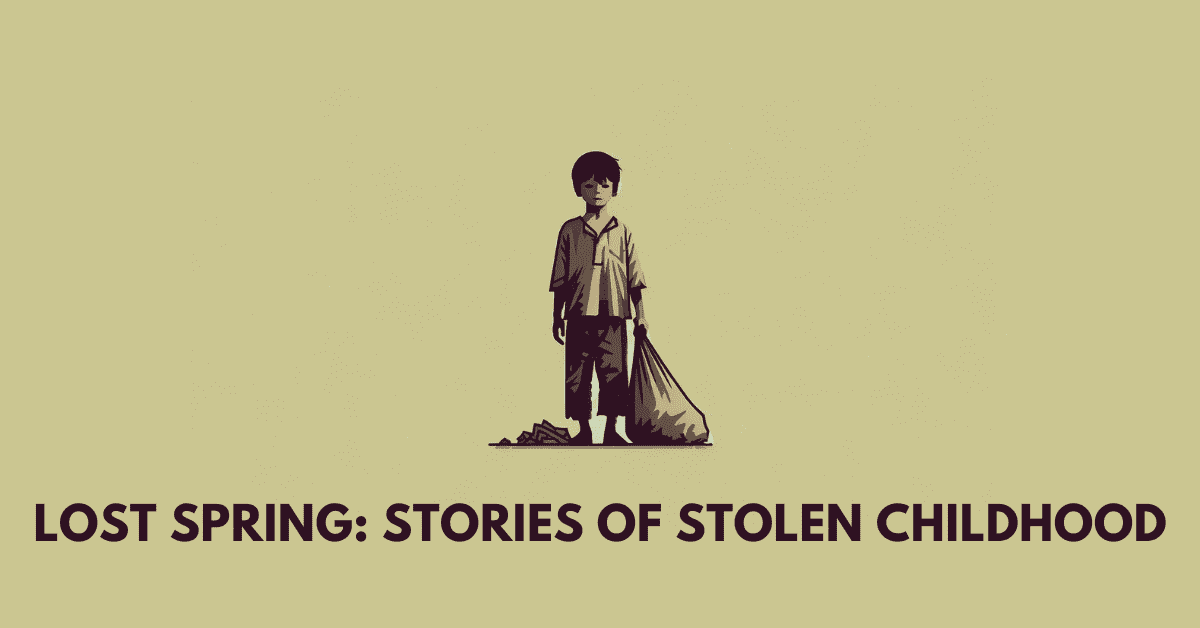
Get summaries, questions, answers, solutions, notes, extras, PDF of Class 12 English Core textbook (Resonance), Lost Spring: Stories of Stolen Childhood by Anees Jung, which is part of the syllabus of students studying under MBOSE (Meghalaya Board). These solutions, however, should only be treated as references and can be modified/changed.
| Select version notes |
| AHSEC/ASSEB Class 12 notes version |
| MBOSE Class 12 notes version |
.Anees Jung encounters Saheb every morning, searching for valuables in the garbage dumps of her neighborhood. Saheb, whose full name is Saheb-e-Alam, meaning “Lord of the Universe,” left his home in Dhaka with his family due to storms that destroyed their fields and homes. Now living in the big city, Saheb and his family seek gold in the garbage. When asked why he doesn’t go to school, Saheb explains there is no school in his neighborhood and promises to attend if one is built. He spends his days with other barefoot boys, wandering the streets, all of whom are familiar to Jung.
The lack of footwear among these boys is notable. Some children explain they don’t have shoes because their mothers didn’t bring them down from the shelf, while others are seen wearing mismatched or worn-out shoes. This widespread barefoot condition is sometimes attributed to tradition, but Jung believes it is more a reflection of persistent poverty.
Jung recounts a story from Udipi, where a boy used to pray for shoes at a temple. Decades later, shoes became commonplace for children in that town, but many like the ragpickers in her neighborhood remain shoeless. This narrative highlights the enduring poverty and lack of basic necessities for children like Saheb.
Saheb’s family lives in Seemapuri, on the outskirts of Delhi, a place filled with squatters who migrated from Bangladesh in 1971. Living in mud structures with tin roofs, devoid of basic amenities, they have survived without official identities but with ration cards that allow them to vote and buy food. For these families, food is a priority over identity.
Rag-picking has become a survival skill for Seemapuri’s residents. Garbage is their lifeline, providing them with daily sustenance and shelter, despite its precarious nature. For children like Saheb, finding a coin in the garbage offers a glimmer of hope, turning trash into treasure.
One winter morning, Jung observes Saheb watching men play tennis. Saheb enjoys watching the game and even uses the swing when allowed by the gatekeeper. He wears tennis shoes, a gift from someone, despite the shoes being old and damaged. For Saheb, even worn-out shoes are a luxury.
Saheb eventually starts working at a tea stall, earning 800 rupees and meals. However, he loses the carefree look he had as a ragpicker, now burdened by the responsibility of his new job.
Mukesh, another boy Jung meets, dreams of becoming a motor mechanic. Living in Firozabad, a town famous for its bangle industry, Mukesh’s family has been involved in bangle-making for generations. Despite the hazardous working conditions, including high temperatures and poor lighting, Mukesh is determined to break free from this cycle.
Mukesh’s family lives in a half-built house, amidst stinking lanes filled with garbage. His brother’s wife, although young, commands respect as the daughter-in-law and takes care of the family. Mukesh’s father, despite years of hard work, remains impoverished, unable to send his sons to school or improve their living conditions.
Mukesh’s grandmother believes in destiny, feeling that their lineage as bangle makers cannot be broken. The town of Firozabad is filled with bangle-making families, their homes and streets cluttered with bangles of various colors. Boys and girls work alongside their parents, often losing their eyesight due to the harsh working environment.
Savita, a young girl, helps in making bangles, unaware of their significance in Indian marriages. She will eventually understand their importance when she becomes a bride. However, many like her live in perpetual poverty, unable to escape their fate.
Jung suggests organizing a cooperative to the young men in Firozabad, but they are hesitant, fearing police harassment and legal issues. The community is trapped in a cycle of poverty, apathy, greed, and injustice, with no leader to guide them towards change.
Jung observes two distinct worlds: one of the impoverished families burdened by caste and poverty, and the other of the middlemen, policemen, bureaucrats, and politicians who exploit them. Children like Mukesh grow up accepting this burden, with little hope for change.
Mukesh, however, remains determined to become a mechanic. Despite the challenges, he plans to walk to a garage to learn the trade. While dreaming of driving cars, he hesitates to dream of flying planes, showing his realistic approach to his aspirations.
The story “Lost Spring” portrays the harsh realities of underprivileged children in India, like Saheb and Mukesh, who struggle for a better life amidst poverty. Their dreams, however small, provide a glimmer of hope in an otherwise bleak existence. The narrative highlights the need for systemic change to break the cycle of poverty and exploitation that traps these children and their families.
1. The author planned on building a school for the rag pickers.
Answer: False
2. One of the boys had no chappals on because his mother had put them on a shelf out of his reach.
Answer: True
3. It is a tradition for rag pickers to stay barefoot.
Answer: False
4. The bangle sellers have no permits but they have ration cards because this gets their names on voters’ lists.
Answer: True
5. A rich boy presented Saheb with a new pair of shoes.
Answer: False
6. Mukesh is proud of his home in Firozabad.
Answer: False
7. The bangle makers are aware that child labour is illegal.
Answer: True
8. The young men were excited at the idea of starting a cooperative.
Answer: False
1. a. Name the two boys that represent ‘stolen childhood’ in the text.
Answer: Saheb and Mukesh.
1. b. State the family background of each boy.
Answer: Saheb’s family is from Dhaka and they moved to Seemapuri after their fields and homes were destroyed by storms. Mukesh’s family is from Firozabad and they are bangle makers.
2. The two boys have much in common and yet they view life very differently. What is the main difference between them?
Answer: The main difference is that Saheb has accepted his fate and works in a tea stall, while Mukesh is determined to be his own master and dreams of becoming a motor mechanic.
3. Do you think Saheb is happy working in the tea stall? Give a reason for your answer.
Answer: No, Saheb is not happy working in the tea stall because his face has lost the carefree look and he is no longer his own master.
4. How do you know that the women of Seemapuri are practical people?
Answer: The women of Seemapuri are practical because they prioritize feeding their families over other needs, indicating their focus on survival.
5. a. Who is Mukesh?
Answer: Mukesh is a boy from Firozabad who works in the glass bangle industry.
5. b. How is he different from all the other children?
Answer: Mukesh is different because he dreams of a better future and is determined to be his own master.
5. c. What is his dream?
Answer: His dream is to become a motor mechanic.
5. d. He has a plan to make his dream a reality. What is it?
Answer: His plan is to go to a garage and learn to be a mechanic.
5. e. Why is the author pleased with Mukesh?
Answer: The author is pleased with Mukesh because he dares to dream and is determined to change his destiny.
6. List the hazards of working in the glass bangles industry.
Answer: The hazards include working in high temperatures, dingy cells without air and light, and the risk of losing eyesight.
7. a. What is the new idea put to the bangle makers by the author?
Answer: The new idea is to organise themselves into a cooperative.
7. b. How do they react?
Answer: They react with skepticism and fear of being punished by the police.
7. c. Why do they react in this manner?
Answer: They react this way because they are afraid of the police and the middlemen who exploit them. They have lost hope and feel powerless to change their situation.
8. a. If he knew its meaning-lord of the universe—he would have a hard time believing it.
Answer: Saheb does not know the meaning of his name, which is ‘lord of the universe’. If he did, he would find it unbelievable because his life as a ragpicker is far from that of a lord.
8. b. Garbage to them is gold.
Answer: For the ragpickers, garbage represents a source of livelihood, as they can find items of value in it.
8. c. For the children it is wrapped in wonder, for the elders it is a means of survival.
Answer: For the children, garbage holds the excitement of potential discoveries, whereas for the adults, it is a necessary means of providing for their families.
8. d. Saheb is no longer his own master!
Answer: Saheb has lost his freedom and independence after starting work at the tea stall, where he is now bound by his employer’s rules.
8. e. ‘Can a god-given lineage ever be broken?’
Answer: Mukesh’s grandmother believes that their family’s occupation of bangle making is destined by their caste and cannot be changed.
9. a. drowned in an air of desolation
Answer: This phrase describes the temple town which has become bleak and desolate over the years.
9. b. his eyes lighting up
Answer: This describes Saheb’s excitement and hope when he finds something valuable in the garbage.
9. c. his dream looms like a mirage amidst the dust of streets
Answer: This refers to Mukesh’s dream of becoming a motor mechanic. It seems distant and almost unattainable in the harsh realities of his life.
9. d. but no light in her eyes
Answer: This phrase indicates the loss of hope and vitality in the old woman who has endured a lifetime of hardships.
9. e. the young men echo the lament of their elders
Answer: The young men in Firozabad express the same feelings of helplessness and despair as their elders, showing that little has changed over the generations.
1. From the text, discuss all the reasons why a street child has no childhood.
Answer: A street child has no childhood because they are forced to scrounge for gold in garbage dumps to survive, lack access to education, live in poverty without basic amenities like proper housing, and must work from a young age to support their families, as seen in Saheb and Mukesh’s stories.
2. What are all the mental and social blocks that stop the bangle-seller family from progressing?
Answer: The mental and social blocks include their acceptance of their fate as bangle makers, the stigma of their caste, lack of awareness about the illegality of child labour, fear of police and legal repercussions if they try to organize, and generational poverty that kills initiative and the ability to dream.
3. Define each of the words given below. Name a person/persons from the text that symbolises each of these words.
Answer: a. Poverty: Saheb’s family, who scrounge in garbage for survival. b. Apathy: The young men in Firozabad, who feel organizing into a cooperative will only lead to trouble. c. Greed: The middlemen who exploit the bangle makers. d. Injustice: The systemic exploitation faced by the bangle makers and ragpickers, perpetuated by sahukars, policemen, bureaucrats, and politicians.
4. ‘Together they have imposed the baggage on the child that he cannot put down.’ Do you think this statement sums up the predicament of all street children who are forced to work for a living? Discuss using instances from the text.
Answer: Yes, this statement sums up the predicament of all street children who are forced to work for a living. Saheb and Mukesh, despite their dreams, are burdened by the responsibilities and limitations imposed by their socio-economic conditions. Saheb’s job at the tea stall and Mukesh’s inherited trade of bangle making illustrate how these children cannot escape the cycles of poverty and labour.
5. ‘He is content to dream of cars that he sees hurtling down the streets of his town.’ Lost Spring is a story about the underprivileged children of India who live in abject poverty and yet cling to their dreams for a better life. Do you agree?
Answer: Yes, Lost Spring is a story about underprivileged children like Saheb and Mukesh who live in abject poverty but still cling to their dreams for a better life. Saheb dreams of going to school and playing tennis, while Mukesh dreams of becoming a motor mechanic, showing their resilience and hope despite their harsh realities.
This is a factual essay. It employs a direct style of narration. Anees Jung has extensively used direct quotations of people that she has met to lend authenticity to her writing and to add a human touch to the subject matter.
Jung has also used a number of figures of speech to heighten the impact of her writing. Example:
The heading Lost Spring is a metaphor.
Here, she compares the season of spring to the childhood years of an individual. The underprivileged child has no childhood to speak of, so it is ‘lost’. This means that the ‘spring time’ of his life is missing.
Simile: ‘As her hands move mechanically like the tongs of a machine.’
A paradox is a statement or proposition that seems self-contradictory or absurd at first but in reality expresses a possible truth. Example: Garbage to them is gold.
Identify the figures of speech in these expressions:
1. Identify the figures of speech in these expressions: Garbage…For the children it is wrapped in wonder, for the elders it is a means of survival.
Answer: Metaphor.
2. Identify the figures of speech in these expressions: Even shoes with a hole is a dream come true.
Answer: Hyperbole.
3. Identify the figures of speech in these expressions: His dream looms like a mirage amidst the dust of streets.
Answer: Simile.
4. Identify the figures of speech in these expressions: Together they have imposed the baggage on the child that he cannot put down.
Answer: Metaphor.
1. Saheb left his home because ______ swept away their fields and homes. (Storms/Floods)
Answer: Storms
2. Saheb lives in a place called ______ on the periphery of Delhi. (Seemapuri/Firozabad)
Answer: Seemapuri
3. Saheb’s home in Dhaka is set amidst ______. (Mountains/Green fields)
Answer: Green fields
4. Mukesh dreams of becoming a ______. (Doctor/Motor mechanic)
Answer: Motor mechanic
5. The bangle-making industry is located in ______. (Seemapuri/Firozabad)
Answer: Firozabad
6. The author suggests that Mukesh should organise the bangle makers into a ______. (Union/Cooperative)
Answer: Cooperative
7. The ragpickers in Seemapuri use ______ as a means of survival. (Bangles/Garbage)
Answer: Garbage
8. Saheb’s new job at the tea stall pays him ______ rupees and all his meals. (500/800)
Answer: 800
9. The young boy from Udipi used to pray at a temple for a pair of ______. (Shoes/Chappals)
Answer: Shoes
10. Saheb is no longer his own master because the ______ belongs to the man who owns the tea shop. (Bag/Canister)
Answer: Canister
11. The author comments that even shoes with a ______ is a dream come true for someone who has walked barefoot. (Hole/Tear)
Answer: Hole
12. Mukesh’s eyes beam as he volunteers to take the author to his ______. (School/Home)
Answer: Home
13. Mukesh’s grandmother believes that their ______ lineage cannot be broken. (God-given/Wealthy)
Answer: God-given
14. The law, if enforced, could get 20,000 children out of the ______ where they slog their daylight hours. (Fields/Furnaces)
Answer: Furnaces
15. Savita, a young girl in a drab pink dress, helps make ______. (Bangles/Toys)
Answer: Bangles
16. The old woman with no light in her eyes complains about never having a full ______ in her entire lifetime. (Meal/House)
Answer: Meal
17. The ragpickers in Seemapuri have lived there for more than thirty years without an identity, but with ______ cards. (Aadhaar/Ration)
Answer: Ration
18. Saheb sometimes finds a ______, even a ten-rupee note, in the garbage. (Rupee/Dollar)
Answer: Rupee
19. The structures in Seemapuri are made of mud with roofs of ______. (Tin/Concrete)
Answer: Tin
20. Saheb watches two young men playing ______ at the neighbourhood club. (Tennis/Cricket)
Answer: Tennis
21. The streets of Firozabad are filled with the ______ of bangles. (Sound/Spirals)
Answer: Spirals
1. The author planned on building a school for the rag pickers.
Answer: False
2. One of the boys had no chappals on because his mother had put them on a shelf out of his reach.
Answer: True
3. It is a tradition for rag pickers to stay barefoot.
Answer: False
4. The bangle sellers have no permits but they have ration cards because this gets their names on voters’ lists.
Answer: True
5. A rich boy presented Saheb with a new pair of shoes.
Answer: False
6. Mukesh is proud of his home in Firozabad.
Answer: False
7. The bangle makers are aware that child labour is illegal.
Answer: True
8. The young men were excited at the idea of starting a cooperative.
Answer: False
9. Saheb’s family left their home in Dhaka because of many storms that swept away their fields and homes.
Answer: True
10. Saheb-e-Alam means ‘lord of the universe’.
Answer: True
11. Saheb now works in a tea stall and is paid 800 rupees and all his meals.
Answer: True
12. Mukesh wants to become a motor mechanic and drive a car.
Answer: True
13. The children in Seemapuri find coins and money in the garbage.
Answer: True
14. The houses in Seemapuri have proper sewage, drainage, and running water.
Answer: False
15. The bangle makers of Firozabad often lose their eyesight before becoming adults.
Answer: True
16. The author saw children in Udipi wearing shoes thirty years later.
Answer: True
17. The women in Seemapuri prefer to live in the city than in the fields that gave them no grain.
Answer: True
18. Mukesh’s family has never renovated their house.
Answer: True
19. Mukesh’s grandmother believes their god-given lineage of bangle makers cannot be broken.
Answer: True
20. Saheb is happy working in the tea stall.
Answer: False
21. The children of Seemapuri view garbage as wrapped in wonder, while their elders see it as a means of survival.
Answer: True
22. Mukesh’s eyes are adjusted to the light outside more than the dark of the bangle making hutments.
Answer: False
1. Where does Saheb look for gold?
Answer: Saheb looks for gold in the garbage dumps.
Q. Why did Saheb’s family leave their home in Dhaka?
Answer: Saheb’s family left their home due to storms that swept away their fields and homes.
Q. How long have the ragpickers lived in Seemapuri?
Answer: The ragpickers have lived in Seemapuri for more than thirty years.
Q. What does Saheb find occasionally in the garbage?
Answer: Saheb occasionally finds a rupee or even a ten-rupee note in the garbage.
Q. What job does Saheb take up?
Answer: Saheb takes up a job at a tea stall.
Q. How much is Saheb paid at the tea stall?
Answer: Saheb is paid 800 rupees and all his meals.
Q. What is Mukesh’s dream?
Answer: Mukesh’s dream is to become a motor mechanic.
Q. What are the bangles in Firozabad made from?
Answer: The bangles in Firozabad are made from glass.
Q. Who are the two boys mentioned in the story and what are their backgrounds?
Answer: The two boys mentioned in the story are Saheb-e-Alam and Mukesh. Saheb comes from Dhaka, where his family was forced to leave due to storms that destroyed their fields. Mukesh comes from a family of bangle makers in Firozabad.
Q. What is the significance of shoes in the story?
Answer: Shoes signify a small but significant improvement in the lives of the poor children. While many children remain barefoot due to poverty, the story recalls a boy from Udipi who prayed for shoes and eventually got them. Saheb, too, finds discarded shoes to be a precious possession, indicating a small but meaningful improvement in his life.
Q. How do the women of Seemapuri view their situation?
Answer: The women of Seemapuri are practical and focus on survival. They prefer living in Seemapuri where they can feed their families, even if it means living in dire conditions, rather than returning to their previous homes which did not provide enough grain.
Q. Describe the living conditions in Seemapuri.
Answer: Seemapuri is described as a wilderness with structures made of mud, tin, and tarpaulin, lacking sewage, drainage, or running water. About 10,000 ragpickers live there, surviving without legal identities but with ration cards that allow them to buy grain.
Q. What are the working conditions in the glass bangle industry in Firozabad?
Answer: The working conditions in the glass bangle industry in Firozabad are harsh and illegal for children. They work in high temperatures, in dingy cells without air and light, risking their health and eyesight.
Q. Why does Saheb’s face lose its carefree look after starting work at the tea stall?
Answer: Saheb’s face loses its carefree look because the job at the tea stall takes away his freedom. The steel canister he carries is a symbol of his loss of independence, as it belongs to the tea shop owner, unlike the plastic bag he used to carry which was his own.
Q. How does Mukesh plan to achieve his dream of becoming a motor mechanic?
Answer: Mukesh plans to achieve his dream of becoming a motor mechanic by going to a garage to learn about cars. Despite the garage being far from his home, he insists on walking there to learn the necessary skills.
Q. Discuss the significance of garbage for Saheb and other children in the story.
Answer: For Saheb and other children in the story, garbage holds a different significance compared to their parents. For the elders, garbage is a means of survival, providing daily bread and a roof over their heads. However, for the children, garbage is wrapped in wonder and hope. Saheb’s eyes light up at the prospect of finding a coin or a note in the garbage, symbolizing a treasure hunt that brings moments of joy and hope in their bleak lives. This stark contrast highlights the innocence and resilience of the children amidst their harsh realities.
Q. How does the story depict the struggles and dreams of Mukesh?
Answer: Mukesh’s story depicts the struggle against his predetermined fate as a bangle maker in Firozabad. Despite the harsh conditions, including working in high temperatures and dimly lit rooms, Mukesh dreams of becoming a motor mechanic. His determination to learn to drive and work with cars, even if it means walking a long distance to the garage, shows his desire to break free from the generational cycle of bangle making. Mukesh’s dream looms like a mirage amidst the dust, yet his insistence on pursuing it provides a glimmer of hope in the otherwise stagnant environment of Firozabad.
Q. Explain the impact of generational poverty on the bangle makers of Firozabad.
Answer: Generational poverty has deeply entrenched the bangle makers of Firozabad in a cycle of hardship and limited opportunities. Families have spent generations working around furnaces, making bangles under hazardous conditions. This cycle has led to a lack of education and awareness, with children forced into labor at a young age. The community is caught in a web of middlemen, police, and bureaucrats, making it difficult to escape poverty. The lack of initiative and the acceptance of their fate as bangle makers highlight the debilitating impact of generational poverty, which stifles dreams and perpetuates suffering.
19. What does the story reveal about the systemic issues faced by the underprivileged in India?
Answer: The story reveals several systemic issues faced by the underprivileged in India, including lack of education, child labor, and generational poverty. The ragpickers and bangle makers live in deplorable conditions, without access to basic amenities like clean water and proper housing. Children are forced to work in hazardous environments, and there is a general acceptance of their fate due to societal and economic pressures. The systemic exploitation by middlemen, police, and bureaucrats further exacerbates their plight, trapping them in a cycle of poverty and limiting their ability to dream of a better future. The narrative highlights the need for systemic change to address these deep-rooted issues.

Only for registered users
Kindly share similar notes for class 12 English
core CBSE