Synonyms
More meanings
Tip: select a single word for meaning & synonyms.
Select multiple words normally to copy text.

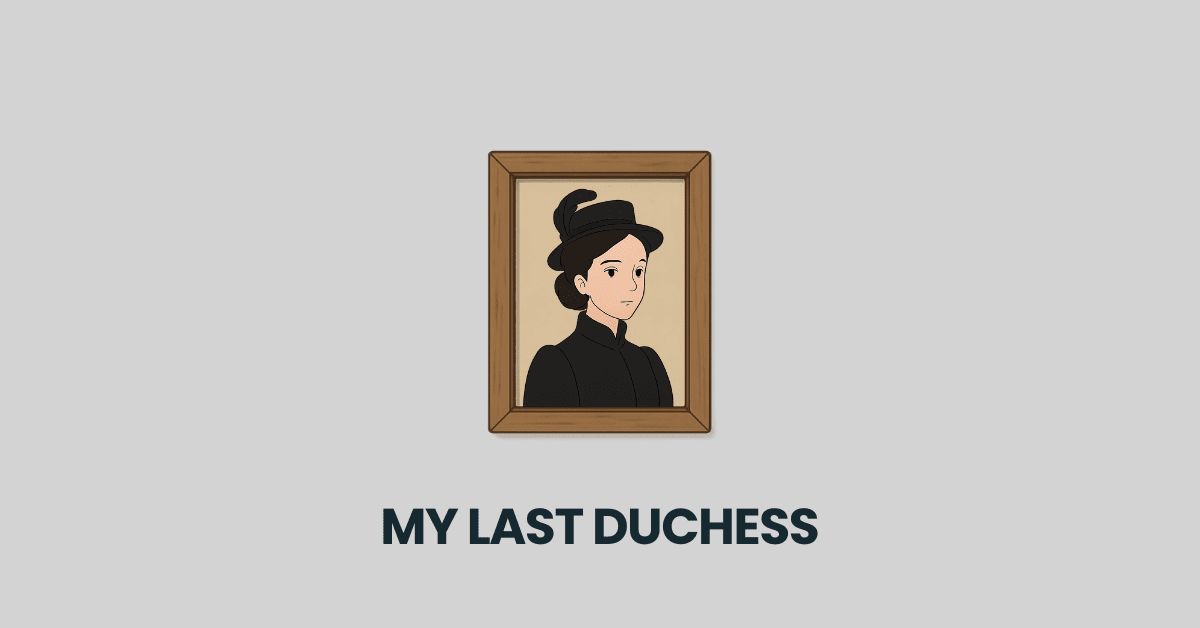
Get summaries, questions, answers, solutions, notes, extras, PDF and guides for Robert Browning’s My last Duchess: WBCHSE Class 11 English Literature textbook A Realm of English (B) Selection, which is part of the Semester III syllabus for students studying under WBBSE (West Bengal Board-Uccha Madhyamik). These solutions, however, should only be treated as references and can be modified/changed.
| Select Notes Version |
| NBSE Class 12 Version |
| WBCHSE Class 11 Version |
A Duke in Italy shows a visitor a painting of his former wife, the Duchess. The portrait is very realistic, making her look as if she is still alive. The Duke keeps this painting behind a curtain, and only he decides who gets to see it. He tells the visitor that he controls who looks at her image now.
The Duke explains that the Duchess had a happy and friendly nature. He describes a blush on her cheek in the painting, which he calls a “spot of joy.” He says she was easily pleased by simple things. She would smile at a pretty sunset, a branch of cherries given to her, or a ride on her white mule. She was kind and thankful to everyone, not just to him.
This made the Duke very upset. He was a proud man with a very old and important family name. He felt that his wife should have valued his love and status above all else. He believed she treated his affection the same as any small, everyday kindness. The Duke felt it was beneath him to correct her behavior. Instead, he says he “gave commands,” and after that, all her smiles stopped forever, suggesting he had her killed.
The Duke is speaking to the visitor because he is arranging a new marriage with a Count’s daughter. As they prepare to leave the room, the Duke points out another of his art pieces. It is a bronze statue of the sea god Neptune taming a sea-horse. This statue is a symbol. The Duke sees himself as the powerful Neptune, a master who controls everything and everyone, just as he controlled his last wife.
FERRARA
This single word sets the location of the poem. Ferrara is a city in Italy that was ruled by a powerful Duke during the Renaissance, a period known for its art and political intrigue. The speaker is the Duke of Ferrara.
That’s my last Duchess painted on the wall, / Looking as if she were alive.
The Duke begins his monologue by pointing to a portrait of his previous, now deceased, wife. He immediately comments on how realistic the painting is, making it seem as if she is still living. This introduces the idea of life versus art.
I call / That piece a wonder, now: Fra Pandolf’s hands / Worked busily a day, and there she stands.
The Duke expresses his admiration for the painting, calling it a “wonder.” He names the painter, “Fra Pandolf,” which suggests the artist is well-known and adds to the value of the artwork. By saying “there she stands,” he speaks of the painting as if it were the actual person, blurring the line between the woman and the object he now possesses.
Will ‘t please you sit and look at her?
The Duke politely asks his guest to sit and view the painting. This is a command disguised as a question, showing that the Duke is in control of the situation and is directing his visitor’s actions. We learn here that the Duke is not speaking to himself; he has an audience.
I said / “Fra Pandolf” by design, for never read / Strangers like you that pictured countenance, / The depth and passion of its earnest glance, / But to myself they turned
The Duke explains that he mentioned the painter’s name on purpose (“by design”). He says that whenever visitors see the intense and passionate expression (“countenance” and “glance”) on the painted face of the Duchess, they always turn to look at him, the Duke.
…(since none puts by / The curtain I have drawn for you, but I)
This is a critical detail revealed in parentheses. The painting is kept hidden behind a curtain, and only the Duke has the authority to pull it aside. This action shows his extreme possessiveness and his desire to control who is allowed to see his late wife’s image.
And seemed as they would ask me, if they durst, / How such a glance came there; so, not the first / Are you to turn and ask thus.
The Duke continues, saying that visitors look as though they want to ask him how the Duchess came to have such a look on her face, but they never dared (“durst”) to actually ask. He assumes his current guest has the same unspoken question, treating it as if the guest has already asked.
Sir, ’twas not / Her husband’s presence only, called that spot / Of joy into the Duchess’ cheek:
The Duke starts to answer the question he assumes was asked. He states that the happy blush (“spot of joy”) on his wife’s cheek was not caused only by his presence. This is the first clear sign of his jealousy and dissatisfaction with her.
perhaps / Fra Pandolf chanced to say, “Her mantle laps / Over my lady’s wrist too much,” or “Paint / Must never hope to reproduce the faint / Half-flush that dies along her throat:”
The Duke speculates on what might have made the Duchess blush. He imagines the painter, Fra Pandolf, making a simple, polite comment, perhaps about adjusting her cloak (“mantle”) or giving her a compliment about the lovely, faint blush on her neck that would be difficult to capture in a painting.
Such stuff. / Was courtesy, she thought, and cause enough / For calling up that spot of joy.
The Duke dismissively refers to these imagined compliments as “Such stuff.” He complains that his wife considered simple politeness (“courtesy”) to be a sufficient reason to blush with happiness. His words show his annoyance that she could be pleased by something so ordinary.
She had / A heart-how shall I say? too soon made glad, / Too easily impressed;
The Duke pauses, pretending to search for the right words, which is a way of making his criticism sound more considered than it is. He accuses her of having a heart that was pleased too quickly and was impressed by things too easily.
she liked whate’er / She looked on, and her looks went everywhere.
Here, his complaint becomes more direct. He claims that she enjoyed everything she saw, and that her friendly gaze was not reserved for him but was given freely to everyone and everything around her.
Sir, ’twas all one! My favour at her breast, / The dropping of the daylight in the West, / The bough of cherries some officious fool / Broke in the orchard for her, the white mule
The Duke exclaims that, to her, everything was the same. A special gift of jewelry from him (“my favour”), a beautiful sunset, a branch of cherries given to her by some meddling (“officious”) person, or the white mule she rode on—she valued them all equally.
She rode with round the terrace-all and each / Would draw from her alike the approving speech, / Or blush, at least.
He continues his list of grievances, explaining that every person and every thing she encountered received the same happy reaction from her, whether it was a kind word or a simple blush.
She thanked men, – good! but thanked / Somehow-I know not how as if she ranked / My gift of a nine-hundred-years-old name / With anybody’s gift.
The Duke says that while it was proper for her to thank people, he hated the way she did it. He felt that she treated his gift of marriage, which included his ancient and noble family name, as if it had no more value than a small present from an ordinary person. This reveals his immense pride and arrogance.
Who’d stoop to blame / This sort of trifling?
The Duke asks a question to which he already knows the answer. He suggests that a man of his high social standing could not possibly lower himself (“stoop”) to correct his wife over such minor issues (“trifling”).
Even had you skill / In speech-(which I have not) – to make your will / Quite clear to such an one, and say, “Just this / Or that in you disgusts me; here you miss, / Or there exceed the mark”
He falsely claims that he lacks the ability with words (“skill in speech”) to explain his feelings to her. This is ironic, as he is speaking very effectively to his guest. He imagines telling her precisely which of her actions disgusted him or fell short of his expectations.
— and if she let / Herself be lessoned so, nor plainly set / Her wits to yours, forsooth, and made excuse- / E’en then would be some stooping; and I choose / Never to stoop.
He argues that even if he had tried to teach her how to behave, and even if she had accepted his criticism without arguing back, the very act of having that conversation would have been beneath him. He declares that he would never lower himself in such a way, showing how his pride prevented any communication.
Oh, sir, she smiled, no doubt, / Whene’er I passed her; but who passed without / Much the same smile?
He acknowledges that she did smile at him whenever he went by, but he immediately complains that she gave that exact same smile to anyone else who happened to pass. He was angered by her failure to reserve a special smile just for him.
This grew; I gave commands; / Then all smiles stopped together.
These are the most chilling lines in the poem. The Duke states that her behavior (“This”) continued and worsened, so he “gave commands.” The direct result was that her smiles stopped forever. The clear implication is that he ordered her to be killed.
There she stands / As if alive.
The Duke turns his attention back to the painting and repeats a phrase from the beginning of the poem. This time, the words have a dark and sinister meaning. She only appears to be alive in the portrait. In reality, she is dead, and he now has her exactly as he wants her: as a beautiful, silent object that he can completely control.
Will’t please you rise? We’ll meet / The company below, then.
The Duke suddenly changes the subject and ends his story. He tells his guest it is time to stand up and go downstairs to join the others. This abrupt shift shows his cold, calculating nature, moving from a confession of murder to social pleasantries without any change in his manner.
I repeat, / The Count your master’s known munificence / Is ample warrant that no just pretence / Of mine for dowry will be disallowed;
The Duke now reveals why the guest is there. The guest is a representative sent by a Count to arrange a marriage between the Duke and the Count’s daughter. The Duke states that he is confident the Count’s famous generosity (“munificence”) will ensure that his demands for a large dowry (a payment from the bride’s family) will be accepted.
Though his fair daughter’s self, as I avowed / At starting, is my object.
The Duke adds, almost as an afterthought, that his main interest (“object”) is, of course, the Count’s daughter herself. His choice of the word “object” is very revealing, as it shows he views his future wife as a possession, much like he views the painting of his last wife.
Nay, we’ll go / Together down, sir.
The Duke insists that he and the guest walk downstairs side-by-side. This is another subtle assertion of his control, directing even the smallest movements of his visitor.
Notice Neptune, though, / Taming a sea-horse, thought a rarity, / Which Claus of Innsbruck cast in bronze for me!.
As they are leaving, the Duke points out another piece of art, a bronze statue of the Roman sea god, Neptune, forcefully controlling a sea-horse. He casually mentions that it is a rare piece made for him by another famous artist. This final image serves as a powerful symbol for the Duke himself—a powerful figure who “tames” what he sees as wild or disobedient, just as he did with his last Duchess. It is a veiled threat and a warning to the Count about what he will expect from his next wife.
1. What type of a lady was the Duchess?
Answer: The Duchess was a lady who had a heart that was too soon made glad and too easily impressed. She was courteous and liked whatever she looked on, and her looks went everywhere. To her, it was all one, whether it was the Duke’s favour, the sunset, a bough of cherries given to her by a fool, or the white mule she rode. She would give an approving speech or at least a blush for each of these things. She thanked men in a way that seemed to rank the Duke’s gift of a nine-hundred-years-old name with anybody’s gift. She smiled at everyone who passed her, not just her husband.
2. What characteristic trait of the Duke’s character can be discerned when he refers to the bronze statue of Neptune?
Answer: When the Duke refers to the bronze statue of Neptune, it shows his pride, possessiveness, and his view of himself as a powerful controller. He points out that the statue is a rarity and that it was made specifically for him by Claus of Innsbruck, which shows he is a proud collector of art and wealth. The image of the god Neptune taming a sea-horse is also a reflection of the Duke’s own personality. He sees himself as a powerful figure who tames and controls others, just as he did with his last Duchess.
3. Analyse My Last Duchess as a dramatic monologue?
Answer: A dramatic monologue is a type of poem where a single character, who is not the poet, speaks to a silent listener. Through this speech, the speaker reveals their own personality and the situation they are in, often without meaning to. My Last Duchess is a perfect example of a dramatic monologue.
The poem features a single speaker, the Duke of Ferrara, who speaks throughout the entire poem. He is addressing a silent listener, who is an envoy from a Count. We know the listener is there because the Duke says things like, Will ‘t please you sit and look at her? and The Count your master’s known munificence.
The Duke speaks at a critical moment, as he is negotiating the dowry for his next marriage to the Count’s daughter. While his main purpose is to discuss the marriage, he uses the story of his last Duchess to reveal his own character. He unintentionally shows that he is arrogant, jealous, and extremely controlling. For instance, he boasts about his nine-hundred-years-old name and the fact that only he can draw the curtain to show the Duchess’s portrait. He reveals his cruelty when he says, I gave commands; Then all smiles stopped together, which suggests he had her killed. In this way, the poem fits the structure of a dramatic monologue by using one speaker’s words to paint a clear picture of his sinister nature.
4. How is power syndrome conveyed in My Last Duchess?
Answer: The Duke’s power syndrome, or his obsession with control and dominance, is conveyed in several ways throughout the poem.
First, he shows his power by controlling his late wife’s portrait. He says that no one puts by the curtain he has drawn except for him. This shows that even after her death, he must have complete control over who sees her image and her smile.
Second, his pride in his nine-hundred-years-old name shows his belief in his superior status. He was disgusted that the Duchess did not value his name more than any other simple gift. He felt his power and status should have been her only focus.
Third, his refusal to correct her behaviour shows his arrogance. He says that even if he had the skill in speech to tell her what disgusted him, doing so would be stooping, and he chooses never to stoop. He believes his authority is so absolute that his wife should have understood his wishes without him having to explain them.
Fourth, the most chilling display of his power is when he says, I gave commands; Then all smiles stopped together. This line implies that he used his ultimate power to have her killed simply because her friendly nature displeased him.
Finally, the Duke treats people like objects in his collection. He talks about his last Duchess as a piece of art, and at the end of the poem, he points out another art object, a bronze statue of Neptune taming a sea-horse, which was made for him. This shows he sees both his wives and his art as possessions that demonstrate his power and wealth.
1. Who is the speaker in the poem? To whom is he speaking?
Answer: The speaker in the poem is the Duke of Ferrara, a powerful nobleman.
He is speaking to an envoy, who is a representative sent by a Count. This envoy is visiting the Duke to negotiate the marriage of the Count’s daughter to the Duke, making the conversation a subtle warning and a display of power.
2. Who was Fra Pandolf? What did he create for the Duke?
Answer: Fra Pandolf was a painter, likely a friar, who was commissioned by the Duke.
He created the lifelike portrait of the Duke’s last Duchess that now hangs on the wall. The Duke mentions that Fra Pandolf’s hands worked busily for a day to create the painting, which he now describes as a wonder.
3. Why does the Duke say he mentioned “Fra Pandolf” by design?
Answer: The Duke says he mentioned the painter’s name, Fra Pandolf, by design, meaning he did it on purpose. He explains that all strangers who see the portrait are struck by the depth and passion of the Duchess’s glance and seem as if they want to ask how such an expression came to be there, so he preemptively brings up the artist’s name.
4. What does the Duke control with a curtain? What does this action reveal?
Answer: The Duke controls the viewing of the portrait of his last Duchess with a curtain that he alone is permitted to draw.
This action reveals his possessive and controlling nature. Now that she is dead, he has complete power over who can see her and her smile, something he could not control when she was alive, showing his desire for absolute authority.
5. What question did other strangers want to ask the Duke about the portrait?
Answer: Other strangers who saw the portrait of the Duchess seemed as though they wanted to ask the Duke how the passionate and earnest glance on her face came to be there. The Duke notes that they looked as if they would ask him this question, if they dared, but were too intimidated to do so.
6. What was the “spot of joy” on the Duchess’s cheek?
Answer: The spot of joy on the Duchess’s cheek was a blush, which the Duke describes as a faint half-flush that dies along her throat. He states that this blush was not caused only by her husband’s presence but could be brought on by any simple courtesy or compliment, which he found irritating.
7. What two things does the Duke suggest Fra Pandolf might have said to the Duchess?
Answer: The Duke suggests two possible polite remarks that the painter, Fra Pandolf, might have made to the Duchess. The first was that her mantle, or cloak, was covering her wrist too much.
The second possible remark was a compliment that paint could never hope to reproduce the faint half-flush that was on her throat. The Duke dismisses these potential comments as such stuff.
8. How did the Duchess react to compliments, according to the Duke?
Answer: According to the Duke, the Duchess reacted to any compliment or simple courtesy with a blush, which he calls a spot of joy. He complains that she had a heart that was too soon made glad and was too easily impressed, meaning she showed pleasure too readily for his liking.
9. What does the Duke mean by the Duchess’s heart being “too soon made glad”?
Answer: When the Duke says the Duchess’s heart was too soon made glad, he is criticizing her for being easily pleased by simple things. He felt that she found joy in everything she looked at and did not properly value his important status and gifts over common, everyday pleasures, which he interpreted as a lack of respect for him.
10. List four things that the Duchess appreciated equally, much to the Duke’s annoyance.
Answer: The Duke lists four things that his last Duchess seemed to appreciate equally, which annoyed him because he felt his gifts should have been valued more. These are:
(i) His favour at her breast, which was a piece of jewelry he gave her.
(ii) The dropping of the daylight in the West, or the sunset.
(iii) A bough of cherries given to her by someone in the orchard.
(iv) The white mule she rode on the terrace.
11. Why did the Duke object to the Duchess thanking other men?
Answer: The Duke objected to the Duchess thanking other men because he felt she gave them the same kind of thanks and approval that she gave him. He believed she ranked his gift of a nine-hundred-years-old name with anybody’s gift. Her friendly smile and blushes were for everyone, not just for him, which he saw as a failure to recognize his superior status.
12. What did the Duke feel the Duchess ranked his “nine-hundred-years-old name” with?
Answer: The Duke felt that the Duchess ranked his gift of a nine-hundred-years-old name, a symbol of his noble heritage and status, with anybody’s gift. He implies that she saw no difference in value between his prestigious name and simple pleasures like a sunset, a branch of cherries, or riding her white mule.
13. Why did the Duke choose “never to stoop” or correct his wife’s behaviour?
Answer: The Duke chose never to stoop or correct his wife’s behaviour because he believed it was beneath his dignity. He explains that even if he had the skill in speech to tell her what disgusted him, and even if she agreed to be taught, the very act of correcting her would be a form of stooping, or lowering himself, which his pride would not allow.
14. What does the line “I gave commands; / Then all smiles stopped together” suggest?
Answer: The line, I gave commands; then all smiles stopped together, strongly suggests that the Duke had his wife killed. The word commands implies he issued a fatal order. The phrase all smiles stopped together is a cold and indirect way of saying that her life, and therefore her constant smiling that so annoyed him, was brought to a permanent end by his authority.
15. What is the Duke’s stated purpose for meeting with the envoy?
Answer: The Duke’s stated purpose for meeting with the envoy is to finalize the arrangements for his next marriage, specifically to the envoy’s master’s daughter. He tells the envoy that the Count’s fair daughter herself is his primary object, though he also makes it clear that he is negotiating the dowry for this new marriage.
16. What does the Duke say about the Count’s “known munificence”?
Answer: The Duke mentions that the Count’s known munificence, or his well-known generosity, is an ample warrant, or a sufficient guarantee. He is confident that because of the Count’s generous reputation, no reasonable request of his for a dowry will be refused. He fully expects a large payment for the marriage.
17. What other piece of art does the Duke point out at the end of the poem?
Answer: At the end of the poem, as he and the envoy prepare to leave the room, the Duke points out another piece of art from his collection. He directs the envoy’s attention to a bronze statue of Neptune, the god of the sea, who is shown taming a sea-horse. The Duke notes that this statue is considered a rarity.
18. Who created the bronze statue of Neptune? What does it depict?
Answer: The bronze statue was created by a sculptor named Claus of Innsbruck, who, as the Duke proudly states, cast it in bronze for him.
The statue depicts the powerful Roman god Neptune taming a wild sea-horse. This image of a dominant male figure controlling a lesser creature is a symbol of the Duke’s own desire for power and control over others, including his wife.
19. Describe the Duke’s attitude towards the portrait of his last Duchess.
Answer: The Duke’s attitude towards the portrait of his last Duchess is one of pride and possessiveness. He refers to the painting as a wonder and proudly mentions that the famous artist Fra Pandolf created it. He is pleased that the portrait is so lifelike, making it seem as if the Duchess were still alive.
However, his pride is mixed with a strong sense of ownership and control. He keeps the portrait hidden behind a curtain that only he is allowed to draw back. This shows that he now has complete control over who can see her image and her smile, a control he clearly did not have when she was alive. The portrait is not just a work of art to him; it is an object he possesses, representing the Duchess in a form he can finally dominate.
20. What impression of the Duchess’s personality do we get from the Duke’s monologue?
Answer: From the Duke’s monologue, we get the impression that the Duchess was a kind, cheerful, and warm-hearted person. The Duke describes her as having a heart that was too soon made glad and too easily impressed. She found joy in simple things and appreciated everything she saw.
For example, a compliment from the painter was enough to bring a blush of joy to her cheek. She was grateful for small gestures, such as when someone gave her a bough of cherries from the orchard. She smiled freely and warmly at everyone she met, not just the Duke. Although the Duke saw this as a flaw, it suggests she was a gracious and friendly lady who treated a sunset, her white mule, and the Duke’s affection with equal delight.
21. How does the Duke reveal his arrogance and pride in his family name?
Answer: The Duke reveals his arrogance and immense pride in his family name through his complaints about his late wife. He speaks of his nine-hundred-years-old name as a precious gift he bestowed upon her. He was deeply offended that she did not seem to value it more than any other simple gift or kindness she received.
His arrogance is also evident in his refusal to correct her behavior. He asks who would stoop to blame such trifling actions. He states that even if he had the skill in speech to explain his displeasure, doing so would be a form of stooping, and he proudly declares that he chooses never to stoop. This shows his belief in his own superiority and that his wife should have instinctively known how to please him without being told.
22. Explain the Duke’s complaint that for the Duchess, “’twas all one”.
Answer: When the Duke complains that for the Duchess, it was all one, he means that she valued everything and everyone equally, without giving him the special importance he felt he deserved. He lists several things that brought her the same amount of pleasure: his favour at her breast, the setting sun, a bough of cherries from an admirer, and her white mule.
He was frustrated because she would offer the same approving speech or happy blush for each of these things. His main grievance was that she seemed to rank his gift of a nine-hundred-years-old name, a symbol of his power and heritage, on the same level as anybody’s simple gift. This lack of discrimination in her affections wounded his pride and made him feel that she did not properly appreciate his status.
23. What does the Duke’s refusal to “stoop” reveal about his character and his view of marriage?
Answer: The Duke’s refusal to stoop reveals his extreme pride, arrogance, and controlling nature. He believes he is so superior that lowering himself to communicate his feelings or expectations to his wife is beneath his dignity. This shows that he views marriage not as a partnership of equals but as a power dynamic where he is the absolute authority.
He expects his wife to be completely subservient, anticipating his desires and obeying his unspoken will. His statement that he chooses never to stoop shows that he is unwilling to engage in the normal give-and-take of a relationship. For him, marriage is about command and control, and the wife’s role is simply to please him without question or guidance.
24. Discuss the sinister implication behind the lines “This grew; I gave commands; / Then all smiles stopped together.”
Answer: These lines carry a very dark and threatening meaning, strongly suggesting that the Duke had his wife murdered. The phrase “This grew” refers to his increasing annoyance with the Duchess’s constant smiling and friendly nature, which he could not control. The next phrase, “I gave commands,” is a cold and chilling statement of his power. It implies that he took decisive and final action to end what he perceived as her misbehavior.
The result, that “all smiles stopped together,” is a euphemism for her death. The smiles stopped because she was no longer alive to give them. The lines are a confession of murder, delivered in a calm and matter-of-fact way that reveals his ruthless and tyrannical character.
25. How does the Duke use the discussion about the portrait as a warning to the envoy?
Answer: The Duke uses the discussion about the portrait as a veiled but clear warning to the envoy, who is there to negotiate the Duke’s next marriage. By telling the story of his last Duchess and her fate, the Duke is indirectly outlining his strict expectations for his future wife. He details what he considered her faults: being too friendly, not valuing his status sufficiently, and smiling at others.
He then reveals the ultimate consequence for this behavior—he “gave commands” and her smiles stopped forever. This chilling tale serves as a warning that his next wife must be completely obedient and must understand his supreme importance. It is a threat, ensuring the envoy understands the kind of behavior the Duke will demand and the severe punishment for failing to meet his standards.
26. Explain the contrast between the lifelike portrait and the fate of the real Duchess.
Answer: There is a stark and unsettling contrast between the portrait and the real Duchess. The portrait is described as a lifelike wonder, capturing the depth and passion in the Duchess’s glance and the faint half-flush of joy on her throat. The painting preserves her vitality forever, making it seem as if she were alive.
In sharp contrast, the real Duchess is dead. The Duke had her killed because he could not control her vibrant and friendly spirit. He replaced the living, breathing woman with a static work of art. The irony is that he now possesses a perfect, smiling image of his wife, but it is an image he can completely control, hiding it behind a curtain. The lifelike art is a permanent monument to the real life he destroyed.
27. What does the Duke’s focus on the dowry reveal about his motives for his next marriage?
Answer: The Duke’s focus on the dowry reveals that his motives for marriage are primarily financial and possessive, rather than romantic. Immediately after implying he had his last wife killed, he smoothly shifts the conversation to the financial arrangements for his next marriage. He confidently states that the Count’s known generosity, or munificence, will guarantee a handsome dowry.
Although he claims that the Count’s daughter herself is his main “object,” his choice of the word “object” is very revealing. It suggests he views his future wife as another valuable possession to be acquired, much like his art collection. This practical and cold-hearted discussion about money shows that he sees marriage as a transaction for increasing his wealth and acquiring a beautiful, and hopefully obedient, wife.
28. How does the final mention of the Neptune statue reinforce the Duke’s character?
Answer: The final mention of the Neptune statue powerfully reinforces the Duke’s character as a cold, arrogant, and controlling man. He points out a bronze statue of Neptune, the powerful Roman god of the sea, who is shown taming a sea-horse. This image serves as a metaphor for the Duke himself. He sees himself as a god-like figure with the right and power to tame and dominate those he considers lesser beings, particularly his wives.
Just as Neptune controls the wild sea-horse, the Duke “tamed” his last Duchess by ending her life. By pointing this out, he is subtly boasting of his power to control and subdue. Furthermore, he mentions that the statue is a rarity made for him by a famous artist, which again highlights his pride, wealth, and his view of women and art as prized possessions in his collection.
29. Critically analyse the character of the Duke of Ferrara as revealed in his monologue.
Answer: The Duke of Ferrara, as he speaks, reveals himself to be an extremely arrogant, possessive, and controlling individual. His pride is evident in his constant reference to his “nine-hundred-years-old name,” which he believes his Duchess did not value sufficiently. He is deeply possessive, not just of his wife’s loyalty, but of her very smiles and moments of happiness. He was angered that she found joy in simple things like a sunset or a bough of cherries, feeling these simple gifts were ranked equally with his own “favour.”
His need for control is absolute. He keeps the portrait of his late wife behind a curtain that only he is allowed to draw, demonstrating his power over her even in death. He reveals his immense pride and refusal to communicate on equal terms when he says he chooses “never to stoop” to correct her behaviour. The most chilling aspect of his character is his cruelty, which is shown in the cold statement, “I gave commands; Then all smiles stopped together.” This line strongly suggests he had her murdered for failing to meet his exacting standards. He is also materialistic and manipulative, discussing the dowry for his next marriage immediately after telling the story of his last one, using it as a veiled threat.
30. How does Robert Browning use dramatic irony to expose the Duke’s true nature?
Answer: Dramatic irony is used masterfully in the poem to reveal the Duke’s true, sinister nature, which is the opposite of the image he tries to project. The Duke intends for his listener, the envoy, to see him as a wronged husband and a powerful nobleman whose wife was ungrateful and too easily pleased. However, the reader understands the real situation. The Duke complains about the Duchess’s heart being “too soon made glad,” but the reader sees this as a sign of her sweet and appreciative nature, not a flaw.
The Duke’s description of her faults—that she liked the sunset, a white mule, and a gift of cherries—only makes her seem more charming and human to the reader. A key moment of irony is when the Duke claims he lacks “skill in speech,” while delivering a highly calculated and manipulative monologue. The greatest irony lies in his confession. He believes he is justifying his actions when he says he “gave commands; Then all smiles stopped together.” He expects this to be seen as a necessary act of control, but the reader is horrified, understanding it as a cold admission of murder. Through his own words, the Duke accidentally paints a portrait of himself as a monster, while intending to paint one of a victim.
31. Discuss “My Last Duchess” as a powerful study of jealousy, possessiveness, and control.
Answer: The poem is a deep exploration of destructive jealousy, possessiveness, and the desire for absolute control. The Duke’s jealousy was not of another man, but of joy itself. He was jealous of the “spot of joy” on the Duchess’s cheek, which could be brought about by a simple compliment from the painter, Fra Pandolf. He was enraged that she smiled at everyone she passed, not just him, asking, “who passed without Much the same smile?” This shows his jealousy extended to every moment of her happiness that was not directly caused by him.
His possessiveness is clear in how he viewed his wife as an object. He was offended that she ranked his “gift of a nine-hundred-years-old name” with “anybody’s gift.” Now that she is dead, he possesses her completely as a portrait on the wall, hidden behind a curtain that only he can pull back. He has turned her into a collectible.
The theme of control is central. The Duke could not control his wife’s free and happy spirit in life. He refused to “stoop” to speak with her about his issues because that would mean acknowledging her as an equal. Unable to control her spirit, he took the ultimate step to control her existence entirely: “I gave commands; Then all smiles stopped together.” He eliminated her life to gain total control over her memory and image, using her story to control the behaviour of his next wife.
32. Analyse the Duke’s perception of women and their role in society based on his comments.
Answer: Based on his monologue, the Duke perceives women not as partners or individuals, but as possessions whose sole purpose is to serve and glorify their husbands. The ideal wife, in his view, should be entirely focused on him, valuing his “favour” and his “nine-hundred-years-old name” above all else. The Duchess’s main fault was her failure to do this. Her heart was “too easily impressed,” and she “liked whate’er She looked on.” This independent capacity for joy was unacceptable to the Duke.
A woman’s role, according to him, is to be an object that reflects her husband’s status. She should not have her own thoughts or feelings that deviate from his expectations. He believes a wife can be “lessoned,” or taught, how to behave properly. The Duchess’s failure to set her wits to his and live only for his approval was, in his mind, a punishable offense. His negotiation for a new wife, where he mentions his object is the “fair daughter’s self” but immediately discusses the dowry, further shows that he sees marriage as a transaction and women as valuable commodities for securing wealth and continuing his lineage.
33. Explain how the Duke uses art, both the portrait and the statue, to assert his power and status.
Answer: The Duke uses the two works of art he mentions, the portrait and the statue, as powerful tools to assert his wealth, status, and dominance. The portrait of his last Duchess, painted by the renowned artist Fra Pandolf, is a symbol of his status as a wealthy patron of the arts. More importantly, it represents his ultimate power over his wife. In life, he could not control her spirit, but in death, he controls her image completely. He keeps her behind a curtain that “none puts by… but I,” turning her into an exclusive possession he can reveal or hide at will. The portrait is a trophy of his victory over her, a beautiful but silenced object that can no longer displease him.
The bronze statue of Neptune taming a sea-horse, made by another famous artist, Claus of Innsbruck, functions as a final statement of his power. The statue is a metaphor for the Duke’s own view of himself. He identifies with Neptune, the powerful god of the sea, who has the strength to tame a wild and beautiful creature like a sea-horse. This sea-horse symbolizes his Duchess, whose vibrant spirit he “tamed” by having her killed. By pointing out this “rarity,” he is not just showing off his wealth but also sending a clear, intimidating message about his own nature as a powerful ruler who dominates and controls everything in his world.
34. How does the form of the dramatic monologue make the poem so effective in revealing character?
Answer: The dramatic monologue form is extremely effective in revealing the Duke’s character because it allows him to expose himself through his own words, without any interference from a narrator. The poem is a single, long speech delivered by the Duke to a silent listener, an envoy from a Count. As the Duke speaks, he tries to present himself in a favourable light, as a sophisticated man of taste who was wronged by his wife. However, his choice of words and the story he tells have the opposite effect on the reader.
We learn about his immense pride when he talks about his “nine-hundred-years-old name” and his refusal to “stoop.” We see his possessiveness in his complaints about her smiles. We understand his cruelty from his casual, chilling line, “I gave commands; Then all smiles stopped together.” Because he is the only one speaking, we get an unfiltered look into his mind. The presence of the silent envoy makes the speech a performance, showing the Duke as a manipulator. The form allows the reader to act as a jury, judging the Duke based on his own testimony and seeing the terrible truth he unintentionally reveals.
35. Examine the theme of appearance versus reality as it is presented in the poem.
Answer: The theme of appearance versus reality is central to “My Last Duchess.” The Duke of Ferrara presents an appearance of being a cultured, powerful, and sophisticated nobleman. He is a patron of the arts, discussing famous painters and sculptors, and he speaks in controlled, elegant verse. He appears to be telling the story of his late wife, the Duchess, whom he portrays as lovely but simple-minded and unappreciative. On the surface, it is a conversation about a piece of art.
The reality, however, is far more sinister. Beneath the Duke’s civilized appearance lies a monstrous and tyrannical man. His polished speech hides a cold, calculating mind consumed by jealousy and an obsessive need for control. The reality is that he is not a grieving husband but a murderer who had his wife killed because her joyful nature did not revolve entirely around him. The Duchess, who appears flawed through his telling, was in reality a kind and vibrant woman who found happiness in life. The entire monologue is an act of deception, where the appearance of a casual conversation hides the reality of a chilling threat to the envoy about the expected behaviour of the Duke’s next wife.
36. Discuss the symbolic importance of the two works of art the Duke mentions: the portrait and the bronze statue.
Answer: The two works of art mentioned by the Duke are rich with symbolic meaning that reveals his character and themes of the poem. The portrait of the last Duchess is a powerful symbol of male possession and the objectification of women. In life, the Duchess was a vibrant person whose spirit the Duke could not control. In death, she is reduced to an image on a wall, “looking as if she were alive,” but she is now an object he completely owns. The curtain he keeps over the painting symbolizes his absolute control; he alone decides who can look upon her. The portrait represents his success in silencing her and turning her into a permanent, manageable part of his collection.
The bronze statue of Neptune taming a sea-horse, which the Duke points out at the end, is a symbol of his own self-image and his belief in his right to dominate. The Duke sees himself in Neptune, the powerful god of the sea. The beautiful but wild sea-horse represents the Duchess, whose free spirit he needed to “tame.” The act of taming is a metaphor for his own actions in controlling and ultimately eliminating his wife. By highlighting this statue, the Duke is symbolically declaring his own god-like power and reinforcing the warning that he will dominate and control what he believes is his.

Only for registered users