Synonyms
More meanings
Tip: select a single word for meaning & synonyms.
Select multiple words normally to copy text.


Get textual answers, explanations, solutions, notes, extras, MCQs, PDF of Chapter 7 Resources of India: WBBSE Class 9 Geography (English medium). However, the educational materials should only be used for reference, and students are encouraged to make necessary changes.
| Select medium |
| English medium notes |
| Bengali medium notes |
This chapter is about the resources of India. Resources mean things that satisfy human needs. A resource is anything with utility that can fulfill human wants. Professor Zimmermann defined a resource as not just a thing but its function in meeting human needs. Resources have many characteristics. They are created by human efforts, constantly changing, and include both material and non-material things. Resources expand with increased knowledge and technology.
Resources can be classified in many ways. By creating factor they can be natural (like coal), human (like labor), and cultural (like education). By comprehensibility they can be material (touchable) and immaterial (untouchable). By stability they can be non-renewable (like iron ore) and renewable (like forests). By availability they can be easily available, overall available, rarely available, and singly available.
Resources can also be classified by location, characteristics, ownership, constancy, and use. Conservation of resources means using them carefully and rationally. It’s important because resources are limited, needed for human consumption, and maintaining ecological balance.
India has rich mineral resources. Iron ore is very important for the economy. Different types of iron ore include magnetite, haematite, limonite, and siderite. The main iron ore producing states are Odisha, Jharkhand, Goa, Chhattisgarh, and Karnataka.
Coal is another key resource. Coal types include peat, lignite, bituminous, and anthracite. Coal is used for steam power, thermal power, steel making, and chemical industries. Major coal belts in India are the Damodar Valley, Sone-Mahanadi-Brahmani, Satpura, and Wardha-Godavari-Indravati regions.
Petroleum is called “Liquid Gold” because of its value. Main oil regions in India are North-East (mainly Assam), Western India (Gujarat), offshore West Coast (Bombay High), and some areas in Southern India.
Power resources are divided into conventional and non-conventional. Conventional power includes thermal power (from coal), hydroelectric power (from water), and nuclear power. Non-conventional sources include solar energy (from sunlight), wind energy, and geothermal energy (from Earth’s heat). Non-conventional energy has many advantages: it’s renewable, pollution-free, low-cost, widely available, and safe for the environment.
1. India stands third position in the world in the Production of :
(a) bauxite
(b) mica
(c) iron ore.
Answer: (c) iron ore.
2. More than 90% of the total coal reserves and production in India is of :
(a) Tertiary type
(b) Gondwana type
(c) Lignite type.
Answer: (b) Gondwana type.
3. The Jog hydel power station is located in :
(a) Tamil Nadu
(b) Karnataka
(c) Kerala.
Answer: (b) Karnataka.
4. Kudremukh in Karanataka has the largest deposit of :
(a) Haematite ore
(b) Magnetite ore
(c) Siderite ore.
Answer: (b) Magnetite ore.
Question:
| Column 1 | Column 2 |
| (i) Talcher | (i) cooking coal |
| (ii) Jharia | (ii) lignite coal |
| (iii) Neveli | (iii) oil field |
| (iv) Naharkatiya | (iv) coal |
Answer:
| Column 1 | Column 2 |
| (i) Talcher | (iv) coal |
| (ii) Jharia | (i) cooking coal |
| (iii) Neveli | (ii) lignite coal |
| (iv) Naharkatiya | (iii) oil field |
1. Why is Nunmati famous?
Answer: Nunmati, located in Guwahati, Assam, is famous primarily for housing the Guwahati Refinery. This refinery holds significance as it was the first public sector refinery in India and the first refinery established by Indian Oil Corporation Ltd., commissioned in 1962.
2. Where is the Korba coal mining region located?
Answer: The Korba coal mining region is located in Madhya Pradesh and Chattishgarh. Korba is one of the principal coal producing regions there.
3. Where is the Haldia oil refinery in West Bengal located?
Answer: The Haldia oil refinery is located in Haldia, an industrial port city in the Purba Medinipur district of West Bengal. It is situated near the confluence of the Haldi River and the Hooghly River.
4. Which state in India ranks first in the production of coal?
Answer: Jharkhand is the state in India that holds the 1st position in India for coal production.
5. Which state in India ranks first in the production of iron ore?
Answer: Odisha is the state in India that occupies the first place in India in the production of iron ore.
6. Give another name of non-conventional sources of energy.
Answer: Another name for non-conventional sources of energy is renewable energy sources. They are also sometimes referred to as alternative energy sources.
7. Name one (hydro)electric centre of North India.
Answer: One hydroelectric centre of North India is Bhakra, which is a major hydro power project in Punjab and Haryana.
8. Which state in India ranks first in the production of petroleum?
Answer: Rajasthan is a leading state in India for the onshore production of petroleum (crude oil), particularly from its fields in the Barmer district.
1. What are the uses of coal in India?
Answer: The principal uses of coal are:
(i) For producing steam power: Coal was widely used after inventing the steam engine by James Watt in the eighteenth century. Coal is used to produce steam which is source of energy for rail, ship, steamer etc.
(ii) For producing thermal power: Approximate 55%-60% heat and energy of world comes from coal. 50% coal of India is used to produce thermo-electric power.
(iii) Raw materials of Iron and Steel Industry: Coke coal (high quality coal) is used to produce iron mould and steel from iron ore. Approximate 5.5% coal is used in Iron and Steel industries.
(iv) Chemical industry: By-products which we get from coal are ammonia, benjole, various insecticides from creozote and napthalyne etc. Near about 44% coal is used to produce fertiliser and cement in India.
(v) For making coal gas: The gas which is produced from coal is called coal gas. It is used for car and light.
(vi) For domestic fuel: Some inferior quality of coal is used as a fuel for cooking and heating room in cold countries.
(vii) Mineral oil: Coal is made of carbon and hydrocarbon. By the synthesis of coal and hydrogen, coal is transferred to petroleum oil.
2. What are the advantages of non-conventional sources of energy?
Answer: Advantages of Non-conventional power resources are:
(i) Renewable power is resource: Non-conventional power is produced from renewable and unlimited resources of our environment, so it has no ending inspite of its huge uses.
(ii) Pollutionless: Non-conventional energy resources do not pollute environment. So, it is a pollution-free energy source.
(iii) Very little producing cost: Non-conventional energy resources are got everywhere easily, so cost of production of energy is very low.
(iv) Available: Conventional energy resources are not available everywhere but nonconventional energy resources are comparatively available.
(v) It is free from danger: As Non-conventional resources of energy are polution free, so they are dangerless for the environment.
(vi) Investment: Uses of non-conventional energy is very little, so huge investment is not necessary for it.
3. Where is the principal coal mining belt of India located?
Answer: The Damodar Valley region is the largest coal producing belt of India. This region comprises of the coalfields of several states, including Jharkhand and West Bengal.
4. Write two important districts of Orissa whose are producing iron ore?
Answer: Two important districts in Odisha (Orissa) where iron ore deposits occur are Sundargarh and Keonjhar.
1. Give an account of the distribution of oil fields of India.
Answer: Now petroleum is raised from four regions, which are: (i) North-East oil regions, (ii) West oil region, (iii) Sea bed oil region of west coast, (iv) South Oil region.
2. Draw an outline map of India and locate thereon the oil fields and oil refineries of the country.
Answer:
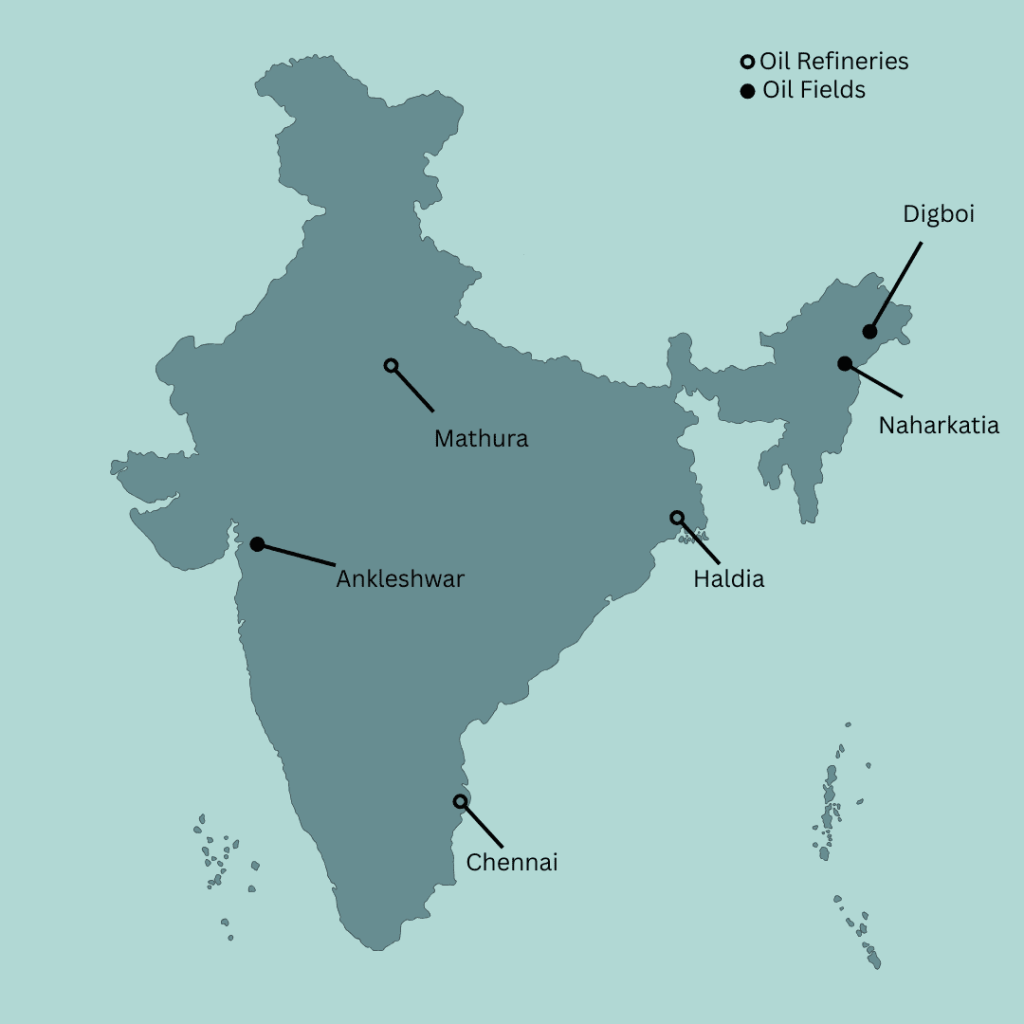
3. Draw an outline map of India and locate thereon the iron ore fields of the country.
Answer:

1. What does resource refer to in Economic Geography?
A. Utility of a thing
B. Material object
C. Static asset
D. Manufactured good
Answer: A. Utility of a thing
2. Which characteristic implies that resources change with human technology?
A. Dynamic
B. Static
C. Fixed
D. Permanent
Answer: A. Dynamic
3. Which of the following is a natural resource?
A. Water
B. Education
C. Labour
D. Technology
Answer: A. Water
4. Which example represents a human resource?
A. Knowledge
B. Iron ore
C. Copper
D. Natural vegetation
Answer: A. Knowledge
5. Which is a cultural resource?
A. Technology
B. Coal
C. Air
D. Soil
Answer: A. Technology
6. Which resource is material?
A. Minerals
B. Skill
C. Knowledge
D. Work ability
Answer: A. Minerals
7. Which is an immaterial resource?
A. Skill
B. Water
C. Forest
D. Mineral oil
Answer: A. Skill
8. Which resource is non-renewable?
A. Petroleum
B. Forest
C. Hydel power
D. Solar power
Answer: A. Petroleum
9. Which of the following is a renewable resource?
A. Wind power
B. Iron ore
C. Coal
D. Petroleum
Answer: A. Wind power
10. Which resource is rarely available?
A. Tin
B. Soil
C. Air
D. Sunlight
Answer: A. Tin
11. Which is an overall available resource?
A. Sunlight
B. Iron ore
C. Tin
D. Gold
Answer: A. Sunlight
12. Which resource is singly available?
A. Cryolite
B. Air
C. Water
D. Sand
Answer: A. Cryolite
13. What type of resource is regional?
A. Petroleum
B. Wind
C. Solar
D. Air
Answer: A. Petroleum
14. Which is a widely available resource?
A. Wind
B. Uranium
C. Tin
D. Coal
Answer: A. Wind
15. Which is a biotic resource?
A. Coal
B. Salt
C. Water
D. Air
Answer: A. Coal
16. Which resource is abiotic?
A. Salt
B. Milk
C. Wood
D. Cotton
Answer: A. Salt
17. Which is an individual resource?
A. Personal car
B. Hospital
C. Railway
D. World Bank
Answer: A. Personal car
18. Which is a social resource?
A. School
B. Railway
C. Personal car
D. World Bank
Answer: A. School
19. Which is a national resource?
A. Railway
B. Personal car
C. Hospital
D. World Bank
Answer: A. Railway
20. Which is an international resource?
A. World Bank
B. School
C. Hospital
D. Railway
Answer: A. World Bank
21. Which is a constant resource?
A. Tajmahal
B. Water resource
C. Human resource
D. Transport medium
Answer: A. Tajmahal
22. Which is a mobile resource?
A. Water
B. Tajmahal
C. Howrah Bridge
D. House
Answer: A. Water
23. Which is a usual resource?
A. Water
B. Palanquin
C. Dynamite
D. Solar power
Answer: A. Water
24. Which is an unusual resource?
A. Palanquin
B. Water
C. Coal
D. Solar power
Answer: A. Palanquin
25. Which is a mis-usual resource?
A. Dynamite
B. Water
C. Coal
D. Solar power
Answer: A. Dynamite
26. Which is a potential resource?
A. Solar power
B. Coal
C. Iron ore
D. Petroleum
Answer: A. Solar power
27. Which is an unknown resource?
A. Rubber
B. Coal
C. Iron ore
D. Petroleum
Answer: A. Rubber
28. What does conservation of resources mean?
A. Rational use
B. Non-use
C. Wasteful use
D. Destruction
Answer: A. Rational use
29. Why is conservation essential?
A. Ecological balance
B. Unlimited reserves
C. Abundant supply
D. No pollution
Answer: A. Ecological balance
30. Which is a method of conservation?
A. Government restriction
B. Unlimited extraction
C. Reckless misuse
D. Ignoring regulation
Answer: A. Government restriction
31. Which refers to use of renewable instead of non-renewable resources?
A. Use renewal
B. Reckless extraction
C. Wasteful use
D. Unlimited use
Answer: A. Use renewal
32. What best describes the economic use of iron ore?
A. Steel industry
B. Agriculture
C. Textile
D. Fishing
Answer: A. Steel industry
33. Iron and steel are called the ______ of modern civilization.
A. Backbone
B. Heart
C. Foundation
D. Skeleton
Answer: A. Backbone
34. Which class of iron ore has iron content of 72.4%?
A. Magnetite
B. Haematite
C. Limonite
D. Siderite
Answer: A. Magnetite
35. Which iron ore is reddish in colour?
A. Haematite
B. Magnetite
C. Limonite
D. Siderite
Answer: A. Haematite
36. India has over what percent of the world’s iron ore reserves?
A. 20%
B. 10%
C. 30%
D. 40%
Answer: A. 20%
37. Which state produces 40% of India’s iron ore?
A. Odisha
B. Goa
C. Chhattisgarh
D. Karnataka
Answer: A. Odisha
38. Which port handles the largest iron ore exports in India?
A. Marmagao
B. Paradeep
C. Vishakhapatnam
D. New Mangalore
Answer: A. Marmagao
39. Which element is mixed with pig iron to produce stainless steel?
A. Chromium
B. Gold
C. Silver
D. Aluminium
Answer: A. Chromium
40. Which type of coal is highest in carbon content?
A. Anthracite
B. Lignite
C. Bituminous
D. Peat
Answer: A. Anthracite
41. Approximately what percent of world heat energy comes from coal?
A. 55-60%
B. 40-45%
C. 65-70%
D. 30-35%
Answer: A. 55-60%
42. Why is coal referred to as ‘black gold’?
A. Chemical uses
B. High lustre
C. Precious price
D. Shiny colour
Answer: A. Chemical uses
43. Which belt produces about 70% of India’s coal?
A. Damodar
B. Satpura
C. Brahmani
D. Wardha
Answer: A. Damodar
44. Which state is the largest producer of lignite in India?
A. Tamil Nadu
B. Gujarat
C. Rajasthan
D. West Bengal
Answer: A. Tamil Nadu
45. Bangladesh is the main importer of which Indian resource?
A. Coal
B. Iron ore
C. Petroleum
D. Uranium
Answer: A. Coal
46. Petroleum is often called ‘liquid ____’.
A. Gold
B. Coal
C. Silver
D. Oil
Answer: A. Gold
47. Which by-product accounts for 42% of petroleum output?
A. Gasoline and petrol
B. Diesel
C. Kerosene
D. Lubricant
Answer: A. Gasoline and petrol
48. Which is India’s oldest oil field, discovered in 1889?
A. Digboi
B. Ankleshwar
C. Bombay High
D. Naharkatia
Answer: A. Digboi
49. What offshore region produces 60% of India’s oil?
A. Bombay High
B. Bassien
C. Aliabet
D. Vimanapalli
Answer: A. Bombay High
50. Which state had the first oil discovery in Gujarat?
A. Ankleshwar
B. Digboi
C. Naharkatia
D. Duliajan
Answer: A. Ankleshwar
51. What percentage of India’s electricity is from thermal power?
A. 71.08%
B. 55%
C. 60%
D. 65%
Answer: A. 71.08%
52. Hydroelectric power is often called ‘white ____’.
A. Coal
B. Gold
C. Oil
D. Diamond
Answer: A. Coal
53. What is India’s estimated hydroelectric potential?
A. 150000 MW
B. 100000 MW
C. 50000 MW
D. 200000 MW
Answer: A. 150000 MW
54. Which was India’s first hydroelectric station in 1902?
A. Shivasamudram
B. Pykara
C. Jog
D. Mettur
Answer: A. Shivasamudram
55. Which elements are chief sources for nuclear power?
A. Uranium and thorium
B. Coal and lignite
C. Copper and iron
D. Oil and gas
Answer: A. Uranium and thorium
56. When did Apsara reactor achieve criticality?
A. 1956
B. 1969
C. 1974
D. 1984
Answer: A. 1956
57. Which was India’s first nuclear power station?
A. Tarapur
B. Kaiga
C. Kalpakkam
D. Narora
Answer: A. Tarapur
58. Solar cells convert sunlight into what?
A. Electricity
B. Heat
C. Water
D. Wind
Answer: A. Electricity
59. Which is the largest solar plant in India?
A. Madhapur
B. Delhi
C. Sundarban
D. Lamba
Answer: A. Madhapur
60. Which site is the largest wind farm in Asia?
A. Lamba
B. Muppandal
C. Nagercoil
D. Puri
Answer: A. Lamba
1. What is the definition of a resource in Economic Geography?
Answer: In Economic Geography the word ‘resource’ means the functionability or utility of a thing which renders service to satisfy human demands.
2. How does E. W. Zimmermann define ‘resource’?
Answer: According to Prof. E. W. Zimmermann, “The word ‘resource’ does not refer to a thing or a substance but to a function which a thing or a substance may perform or to an operation in which it may take part, namely, the function or operation of attaining a given end such as satisfying a want”.
3. Give two important characteristics of resources.
Answer: Two important characteristics of Resources are:
(i) Resource is functional and operational
(ii) Resource is made or created by efforts of man
4. What are natural resources? Provide one example.
Answer: Natural Resource: The element or matter or resource coming from nature directly, is called natural resource. Such as : Salt.
5. What are human resources? Provide one example.
Answer: Human Resource: Human resource refers to the different type of activities which help to produce resources such as work ability.
6. What are cultural resources? Provide one example.
Answer: Cultural Resource: The elements co-related with the developing man and their characteristics are called cultural resources. These are education.
7. On the basis of stability, what are the two types of resources?
Answer: On the basis of stability, resources are mainly of two types like : (a) Depositional or Non-renewable Resource and (b) Renewable Resource.
8. On the basis of location, what are regional resources?
Answer: Regional Resource: This resource is found in some fixed geographical regions, such as Petroleum, Uranium, Thorium, Iron ore etc.
9. On the basis of characteristics, what are biotic resources?
Answer: Biotic resource : Resources which come directly or indirectly from organism, are called biotic resources, e.g. coal, petroleum, milk etc.
10. On the basis of characteristics, what are abiotic resources?
Answer: Abiotic resource : Resources which do not come from any organic matter are called abiotic resources such as water, salt etc.
11. What does conservation of resources entail?
Answer: Conservation of resources means the careful and rational use of natural resources and their preservation from reckless misuse or exploitation and destruction. It does not mean not to use resources but conservation means the careful and rational use of resources.
12. List two methods for conserving resources.
Answer: Two methods for conserving resources are:
(i) Economical and scientific use of resources.
(ii) Government restriction should be implied for limitless extraction of resources.
13. What percentage of the world’s iron ore reserves does India possess?
Answer: India possesses over 20% of the world’s total iron ore reserves.
14. Which state contributes 40 per cent of India’s iron ore production?
Answer: Odisha contributes about 40% of India’s total iron ore production.
15. Name the four classes of iron ore.
Answer: The four classes of iron ore are:
I. Magnetite (Fe₃O₄)
II. Haematite (Fe₂O₃)
III. Limonite
IV. Siderite
16. Mention two economic uses of iron ore.
Answer: Two economic uses of iron ore or pig iron are:
17. What are the four types of coal based on carbon content?
Answer: According to the presence of carbon, coal is to be classified in 4 types: (A) Peat (B) Lignite (C) Bituminous (D) Anthracite.
18. Which geological age do 99 per cent of India’s coal reserves belong to?
Answer: 99% coal of India is of Gandowana ages.
19. Name any two uses of coal.
Answer: Two uses of coal are:
(i) For producing steam power: Coal was widely used after inventing steam engine by James Watt in eighteenth century : Coal is used to produce steam which is source of energy for rail, ship, steamer etc.
(ii) For producing thermal power: Approximate 55%—60% heat and energy of world comes from coal. 50% coal of India is used to produce thermo-electric power.
20. Why is coal referred to as ‘black gold’?
Answer: Coal is referred to as ‘black gold’ because it is used in various chemical and other industries. Chemical Industries such as explosives, dyes, fertilizers, perfumes, plastics and depend upon the by-products of coal.
21. What by-products are obtained from crude oil besides fuel oils?
Answer: Besides fuel oils, the by-products obtained from crude oil are Paraffin, Octane, Vaseline, Nylon, Polymer, Ethelene, Coal-tar, and Grease.
22. Where and in which year was the first petroleum well in India discovered?
Answer: The first petroleum mine in India was found in Digboi, Assam, in 1889.
23. What combined percentage of petroleum output is accounted for by gasoline and petrol?
Answer: Gasoline and petrol jointly account for 42% of petroleum output.
24. Which offshore region contributes at least 60 per cent of India’s oil production?
Answer: The Bombay High offshore region contributes at least 60% of India’s petroleum production.
25. Approximately what percentage of India’s electricity is generated by thermal power?
Answer: Approximately 71.08% of power in India is thermo-electric power.
26. Name one thermal power centre in West Bengal.
Answer: One thermal power centre in West Bengal is Bandel.
27. What nickname is given to hydro-electric power?
Answer: Hydro-electric power is known as ‘White coal’ to some people.
28. Which was the first hydro-electric power station in India and when was it commissioned?
Answer: The first hydel power station in India was set up at Shivasamudram on the river Kaveri in Karnataka in 1902.
29. List two geographical conditions favourable for hydro-electric power generation.
Answer: Two geographical conditions favourable for hydro-electric power generation are:
(i) Rugged Topography: Rugged topography increases the velocity of stream. Strong current water is very helpful for producing hydro-electric. Velocity of river is increased with increasing of ruggedness of landscape. So, maximum amount of electricity can be produced from there.
(ii) Supply of Ice-melt water: Ice melt water supply is very important for producing hydro-electric power. The river fed by ice melt water flow throughout the year. So electricity can be produced from here throughout the year.
30. When did the Apsara reactor attain criticality?
Answer: The Apsara reactor, India’s first research reactor, attained criticality in August 1956.
31. What is the installed capacity of the Tarapur nuclear power station?
Answer: The installed capacity of the Tarapur nuclear power station is 420 mw-hours.
32. Define non-conventional sources of power.
Answer: Sources of power which are not popular economically or commercially on large scale are called non-conventional power. For example- solar energy, wind energy etc.
33. Name two non-conventional energy sources discussed.
Answer: According to the syllabus, three types of non-conventional sources of energy have been discussed: (1) Solar Energy, (2) Wind Energy and (3) Geo-thermal Energy.
34. Where is the largest solar plant in India located?
Answer: The largest solar plant in India is located at Madhapur near Bhuj, to sterilise milk cans.
35. Name the location and capacity of India’s only geo-thermal power plant.
Answer: There is only one geo-thermal plant with a capacity of 5 kwatt at Manikaran of Himachal Pradesh in India.
36. Which wind-energy centre in Asia is the largest, and where is it?
Answer: The wind power plant at Lamba in Gujarat in the Gulf of Kutch is the largest in India and in Asia.
37. Explain the concept of resource conservation and its importance in today’s context.
Answer: Conservation of resources does not mean that not to use resources but conservation means the careful and rational use of resources. Therefore, the conservation of resources may be defined as the careful and rational use of natural resources and their preservation from the reckless misuse or exploitation and destruction.
Conservation of resources is very essential today due to following reasons: (i) reservation of resources is very limited and it is exhaustible. So it is very essential for conservation. (ii) For prolonged human consumption of resources conservation is essential. (iii) For maintaining the ecological balance and controlling the environmental pollution resources should be conserved.
38. Discuss the classification of resources by ownership and provide examples for each category.
Answer: On the basis of ownership, Proprietarily resources are:
(a) Individual resource: The resource which can be enjoyed personally by any people are called individual resources, such as intellect, personal car etc.
(b) Social resource : The resource which can be used for social welfare is called social resource, such as School, Hospital etc.
(c) National resource: The resource which can be used to meet demand the utility of all the people of the nation are called national resources, such as National law, Railway etc.
(d) International Resource : The resource which can be enjoyed for whole world are called international resources, such as World bank, South pole.
39. Analyse the economic and strategic significance of India’s iron ore reserves.
Answer: India’s position is almost enviable in the reserves of iron ore, and the country exports substantial quantities of these, besides meeting the internal demand fully.
The economic uses of iron ore or pig iron are:
Economically, it may be said that the economic growth of a country is dependent on the production of iron and its uses. All the things from a tiny pin to a gigantic skyscraper, foils, utensils, etc., are made of iron and steel. Thus, iron & steel are said to be the backbone of modern civilization. Every sort of human activity depends solely on iron and steel. So it is rightly remarked that “we live in the age of iron.” In a word, we can say that iron is the backbone of all industries.
India is one of the best-endowed countries in the magnitude and quality of Iron ores. The country possesses over 20% of the world’s total reserves, second largest after the reserves of the former Soviet region. The quality of reserves of the Indian ores is very high. The total in situ reserves of iron-ore in India are about 1,23,17,275 thousand tonnes of haematite and 53,95,214 thousand tonnes of magnetite. Most of these reserves are concentrated in the peninsular region.
India is the third largest iron ore exporting country in the world, accounting for 6% of the world’s total export. Japan is the leading buyer of Indian iron ore. Hungary, Italy, Romania, Holland, Germany, Poland, North Korea, South Korea and many other countries import Indian iron ore.
40. Describe the distribution and characteristics of the Damodar Valley coal belt.
Answer: The Damodar Valley region is the largest coal producing belt of India. Near about 70% of coal is produced from here. This region comprises the coalfields of several states.
The coal found in this belt is primarily of Gandwana ages, which constitutes 99% of India’s coal and is of high quality.
41. Examine the development of the petroleum industry in India, including its major producing regions and by-products.
Answer: Mineral oil is basically known as petroleum. Mineral oil is not only the source of energy and fuel; the by-products which we get from it have unlimited economic importance. Many industries are built depending on by-products of mineral oil. So, we can say that the economic growth of any country is dependent on the account of petroleum or mineral oil of this country. Petroleum is considered as “Liquid Gold” for its value of uses and economic importance.
The following by-products are got from 191 litre mineral oil after purification:
Now petroleum is raised from four regions, which are:
(i) North-East oil regions, (ii) West oil region, (iii) Sea bed oil region of west coast. (iv) South Oil region.
42. Compare thermal and hydro-electric power in terms of their advantages and limitations.
Answer: Thermal electricity is produced in India from low quality coal or Lignite coal. But little amount of electricity is now produced from natural gas. For this reason there are highest number of thermo-electric plants in the coal region of Eastern India. 71.08% power in India are thermo-electric power.
Hydro-electric power is known as ‘White coal’ to some people. Water is a renewable resource. It circulates in our earth with the help of water cycle. So, water used to produce electricity is a natural renewable power source.
The distinction between thermal power and hydel power is as follows:
| Thermal Power | Hydel Power |
| 1. Power generated by heating fossil fuels such as coal, petiolium and natural gases. | 1. Power generated using the force of running or falling water |
| II. It is non-renuewble source of energy. | II. It is renewable source of energy. |
| III. Thermal power causes air pollution. | III. It is pollution-free. |
| IV. It is expensive. | IV. It is ecornomical. |
Hydel power has several advantages: (a) most economical source of power ; (b) clean source of energy ; (c) no emission of greenhouse gases ; (d) no consumption of fuel ; (e) no need of high technology ; (f) flow resource.
43. Evaluate the potential and challenges of solar and wind energy in meeting India’s future energy needs.
Answer: Solar Energy: The energy which is produced from the Sun’s heat and light is called Solar Energy. So, the sun is a huge and large energy container. If it would be completely used, there would be no lack of power in the world.
Wind Energy: The energy which is produced from wind is called wind energy.
Non-conventional energy resources, like solar and wind energy, have several advantages:
(i) Renewable power is resource: Non-conventional power is produced from renewable and unlimited resources of our environment, so it has no ending inspite of its huge uses.
(ii) Pollutionless: Non-conventional energy resources do not pollute environment. So, it is a pollution-free energy source.
(iii) Very little producing cost: Non-conventional energy resources are got everywhere easily, so cost of production of energy is very low.
(iv) Available: Conventional energy resources are not available everywhere but nonconventional energy resources are comparatively available.
(v) It is free from danger: As Non-conventional resources of energy are polution free, so they are dangerless for the environment.
(vi) Investment: Uses of non-conventional energy is very little, so huge investment is not necessary for it.

Only for registered users