Synonyms
More meanings
Tip: select a single word for meaning & synonyms.
Select multiple words normally to copy text.

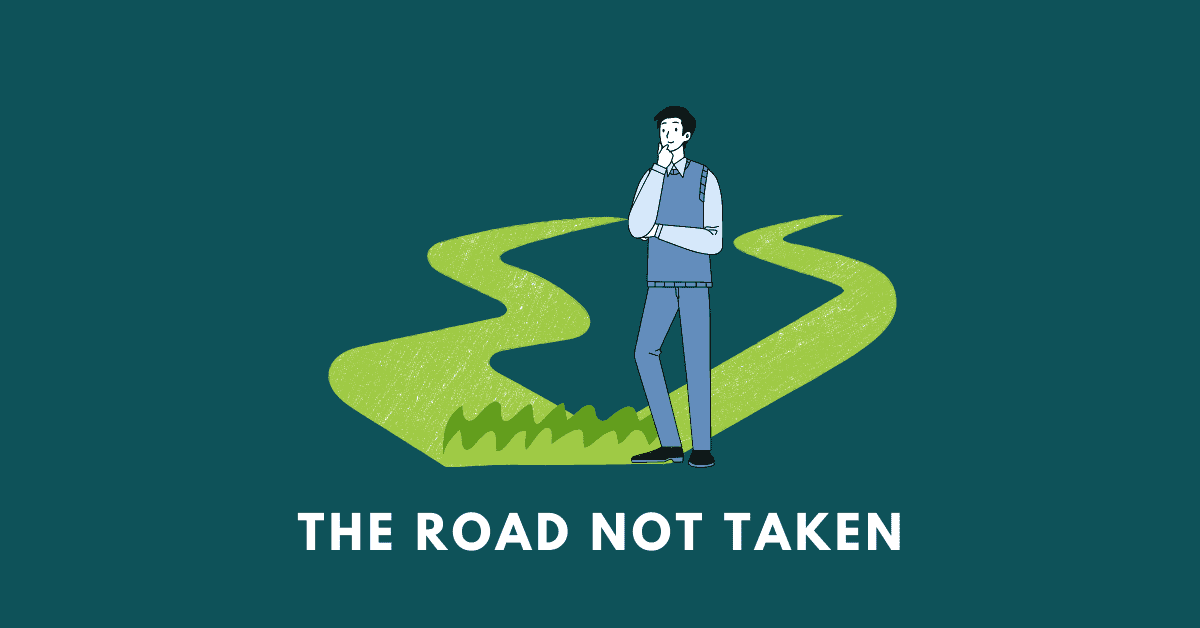
Get here the summary, questions, answers, textbook solutions, extras, pdf of the poem The Road not Taken by Robert Frost of SEBA Class 9 English textbook (Beehive). However, the given notes/solutions should only be used for references and should be modified/changed according to needs.
Robert Frost’s “The Road Not Taken” is a narrative poem that describes a scenario in which the poet is obliged to pick a path in life despite having no idea where it will lead.
The first verse begins with the poet, Frost, in a struggle as he stands in the woods between two roads, trying to decide which will be better for him. The poet stands reflecting on which road to follow, against the backdrop of autumn. Frost, who is on the point of making a major decision, hopes he could simplify his dilemma by taking both paths before making a final decision. But he understands that once he starts down one path, he cannot return to walk down the other. So he waits there for a long time, trying to imagine the path ahead as far as humanly can, but as the roads bend away in the undergrowth, he loses sight of the end.
After weighing both options, the poet makes a decision in the second verse. He chooses the one that appears to be less travelled. Frost believes that both routes appeared equally appealing at the moment, but the second road had the more enticing grassy layer of the two, therefore his decision was leaned in favour of it.
In the third stanza, the poet questions his choice once more. He claims that the leaves on the ground were new and hadn’t been walked on that morning. They were green because no one tread on them. He chose to choose one way and leave the other for another day. Despite the fact that he knew he wouldn’t be able to return because one route led to another. This occurs in real life as well. We make a decision and go on that path. If we fail, we believe we will be given a second opportunity. However, this does not occur.
The poet states in the final line that someday in the future, he will take a deep breath and describe how once in a lifetime he had to make a difficult decision. He was standing at a fork in two roadways. Both had a good look at him. As a result, he decides to take the path less travelled. As a result, it shaped him into the man he is today. That single choice altered his future.
I. 1. Where does the traveller find himself? What problem does he face?
Answer: While walking through a forest, the traveller comes to a fork in the road. He must decide which of two paths to take to continue his journey.
2. Discuss what these phrases mean to you. (i) a yellow wood (ii) it was grassy and wanted wear (iii) the passing there (iv) leaves no step had trodden black (v) how way leads on to way
Answer: (i) a yellow wood: a yellowed forest caused by the arrival of autumn
(ii) it was grassy and wanted wear: It was grass-covered, and no one had walked on it.
(iii) the passing there: the number of people who had passed through the path
(iv) leaves no step had trodden black: Nobody had stepped on the leaves.
(v) how way leads on to way: How one path frequently leads to another.
3. Is there any difference between the two roads as the poet describes them
(i) in stanzas two and three?
(ii) in the last two lines of the poem?
Answer: The poet says in stanzas two and three that both roads were almost equally appealing. Both, he claims, appeared to have been used equally, and the leaves on both paths lay undisturbed the next morning.
However, in the poem’s final two lines, the poet claims that the path he chose was less travelled by.
4. What do you think the last two lines of the poem mean? (Looking back, does the poet regret his choice or accept it?)
Answer: As he looks back, I believe the poet accepts his decision and adds colour to it by claiming that he chose the less travelled path and as a result found success, despite the fact that he previously stated that both paths were “just as fair” and “the passing there had worn them really about the same.”
II. 1. Have you ever had to make a difficult choice (or do you think you will have difficult choices to make)? How will you make the choice (for what reasons)?
Answer: Yes, we’ve all had to make difficult decisions at some point in our lives. When faced with such a decision, I would weigh the pros and cons of each option and perhaps consult with someone who has made a similar decision or gone through a similar experience. Sometimes there is no turning back after making a decision, so I would make a proper decision after weighing all of the pros and cons of my options and not choose on a whim. In this way, I hope to avoid going down one path blindly and then realising I’ve made a mistake when it’s too late.
2. After you have made a choice, do you always think about what might have been or do you accept the reality?
Answer: It is human nature to speculate on what could have been. But I make every effort to avoid dwelling on the past and instead focus on the future. I try to make the best of a bad situation and accept reality.
1. Do you believe people should be able to change their minds after making a decision? Why or why not?
Answer: Robert Frost’s selection demonstrates that he is an adventurous person who does not like to tread on well-worn paths. He investigates the situation and takes his time coming to his own conclusions. He decides to explore the unexplored because he is not afraid of taking on challenges in life. He is well aware that once a decision is made, it cannot be reversed, so he opts for the more difficult option. He is aware that his decision will have an impact on his life, and he is prepared to accept the consequences. He knows that if he had taken the other path, his life would have been very different. People should not, in my opinion, regret their choices or decisions after they have been made. To begin with, life provides a plethora of opportunities and possibilities, so there is never a need to be disappointed. Second, because humans are limited by time and space, it is impossible for them to accomplish everything that needs to be done. So, instead of regretting, I believe it is more important to keep moving forward in life without looking back. Time will decide whether the paths chosen were correct or incorrect. Third, we must accept personal responsibility for the decisions and choices we make in our lives.
2. In the first stanza, what do the two roads represent? What is the significance of picking a path?
Answer: The two roads that the poet encounters on his walk or journey represent the choices that we must make in our lives. The journey or a simple walk itself is a metaphor for the great journey of life, whether spiritualism or materialism is chosen. In this poem, the poet, after much deliberation, decides to take the road less travelled, which is the road of spiritualism, with all of its challenges and uncertainties. The decision is final and irreversible, with its own set of consequences, which can be favourable or unfavourable. In real life, we are also confronted with critical situations where we must make life-altering decisions. The choice we make is critical. We should think about our options first and then decide on our priorities. Once we make a decision and act on it, we can never go back on it. Life takes its own course and does not give us a second chance to change our minds and change our path. As a result, we must make wise decisions about our choices.
3. What is the theme of “The Road Not Taken”?
Answer: The theme of the poem “The Road not Taken” is making a decision when faced with two seemingly equal options. It laments our inability to predict where each will lead us and laments the fact that we will never know what would have happened if we had chosen the second option. It is also about accepting one’s choices and seeing them as being responsible for one’s success in life.
4. Which path did the poet take, and why?
Answer: The poet chose the second road because he needed to make a decision because he couldn’t stay in the woods indefinitely. He admits that the paths were similar, so he chose one, hoping to walk the other one later.
5. Though as for that the passing there
Had worn them really about the same.
a. What exactly does the poet mean by “passing”?
Answer: The poet’s use of the word “passing” refers to the movement of people on the paths.
(b) Is the poet implying that the two paths are distinct in these lines?
Answer: In these lines, the poet claims that both paths have been equally worn by those who have passed along them, and thus they are the same.
6. Two roads diverged in a wood, and I
I took the one less travelled by,
And that has made all the difference.
(a) Where is the poet when these lines are spoken?
Answer: The poet imagines himself speaking these lines many years in the future, to an audience, as he recounts the events of that day.
(b) “I took the one less travelled by” Is this a true statement? Why?
Answer: No, the claim is false, because the poet admits in the second and third stanzas that the two paths were quite similar in terms of how much each had been trodden.
(c) What does the poet mean when he says it has made all the difference?
Answer: The poet’s assertion is his expression of his thoughts in the future, when he would like to think that he stood out from the crowd and chose the path that many others did not, and that it made a difference in his life. That decision had determined the course of his life.
7. How does the poet resolve the quandary? Which path does he take, and why?
Answer: The two roads represent two perspectives on life. They represent two paths in life, two attitudes, and even two careers. The dilemma is deciding which option is both correct and rewarding. Two roads diverge in opposite directions. They both appear to be attractive and fair. The poet abandons the first path for another day. He chooses the less travelled path and the ‘wanted wear.’ He chooses a less conventional, popular, and risk-free option.
8. The song ‘The Road Not Taken’ is a life metaphor. Justify.
Answer: Frost uses a fork in the road as a metaphor for the decisions we make in life in ‘The Road Not Taken.’ As a result, the two paths represent two distinct ways of life. They represent the poet’s two possible paths and options. He’s made up his mind. He’s taken the “less travelled by” route. He puts the first one away ‘for another day.’ Returning to the road one has left becomes impossible. A person’s decision makes “all the difference” in his or her life. As a result, the title is fitting and logical.
9. Did the poet feel bad about his decision? Use a poem example to demonstrate your point.
Answer: The poet was free to make his or her choice. The two roads were, in fact, two life options that he had before him. The poet abandoned his more conventional and less risky way of life. He chose the less travelled path because he ‘wanted wear.’ He decided to save the first road for another day. His decision made all the difference in his life. He appeared to be dissatisfied with his decision. ‘I shall tell this with a sigh.’ Somewhere in the distant past, but he couldn’t do anything now. His decision had changed the course of his life.

Only for registered users
Questions are too easy to learn.
Those who have written this i literally want to thank him/her from the heart ❤️