Synonyms
More meanings
Tip: select a single word for meaning & synonyms.
Select multiple words normally to copy text.

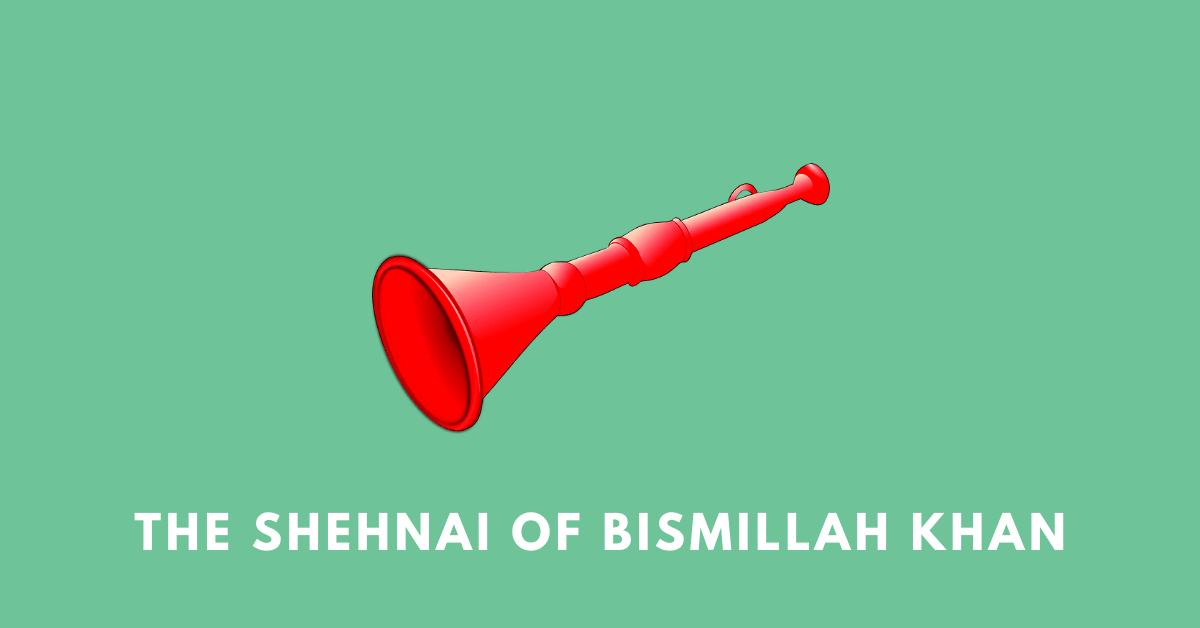
Get here the summary, questions, answers, textbook solutions, extras, pdf of chapter 2The Sound of Music Part II The Shehnai of Bismillah Khan of Assam Board (SEBA) Class 9 English textbook (Beehive). However, the given notes/solutions should only be used for references and should be modified/changed according to needs.
The prose “The Shehnai of Bismillah Khan” tells the story of this world-famous shehnai exponent. The piece follows the development of both the shehnai and Bismillah Khan. On March 21, 1916, Ustad Bismillah Khan was born into a well-known musical family. He took to music quickly after being born into a family of acclaimed shehnai players. Bismillah was captivated by the shehnai even at the age of three, and began accompanying his uncle, Ali Bux, to the Vishnu temple of Benaras, where his uncle was hired to play.
He soon began receiving lessons from his uncle and spent hours upon hours practising on the Ganga’s banks. The Ganga’s flowing waters inspired him to innovate and invest in Raagas that were previously thought to be beyond the shehnai’s reach. Bismillah Khan’s big break came with the establishment of All India Radio in Lucknow, and he quickly rose to prominence.
He delivered a number of memorable national and international performances. On 15 August 1947, Ustad Bismillah Khan was the first to greet the nation after independence from atop the Red Fort. His talent, creativity, and expertise with the shehnai were quickly recognised, and he received numerous awards and accolades. The Indian government also bestowed various honours on the maestro, such as the Bharat Ratna in 2001. He died on August 21, 2006, at the age of 90. On the death of this great man, the Government of India declared a day of national mourning, despite the fact that he remained humble and down to earth despite achieving such great heights. Ustad Bismillah Khan was a true son of the soil who remained indelibly in love with India, particularly his Benaras and the Ganges, until his death.
1. The (shehnai, pungi) was a ‘reeded noisemaker’.
Answer: Pungi
2. (Bismillah Khan, A barber, Ali Bux) transformed the pungi into a shehnai.
Answer: A barber
3. Bismillah Khan’s paternal ancestors were ( barbers, professional musicians).
Answer: Professional musicians
4. Bismillah Khan learnt to play the shehnai from.
Answer: Ali Bux
5. Bismillah Khan’s first trip abroad was to (Afghanistan, the U.S.A., Canada).
Answer: Afghanistan
1. Why did Aurangzeb ban the playing of the pungi?
Answer: The shrill, unpleasant sound of the pungi had been banned in the royal residence by Emperor Aurangzeb.
2. How is a shehnai different from a pungi?
Answer: In comparison to the pungi, the shehnai is made from a wider and longer pipe with a natural hollow stem. Furthermore, it has a much more pleasant sound than the pungi, which makes a shrill noise.
3. Where was the shehnai traditionally played? How did Bismillah Khan change this?
Answer: Historically, the shehnai was one of nine instruments found in royal courts. It was only played in temples and at weddings until recently. By introducing the shehnai to the classical stage, Bismillah Khan changed this.
4. When and how did Bismillah Khan get his big break?
Answer: Bismillah Khan’s big break came in 1938, with the establishment of All India Radio in Lucknow. For he began playing there on a regular basis and quickly became a well-known and frequently heard shehnai player on radio.
5. Where did Bismillah Khan play the shehnai on 15 August 1947? Why was the event historic?
Answer: On August 15, 1947, Bismillah Khan performed the shehnai from the top of the Red Fort.
Bismillah Khan’s performance was historic because it took place on the anniversary of India’s independence, and it was followed by Jawaharlal Nehru’s famous “Tryst with Destiny” speech. On our very first independence day, Bismillah Khan became the first Indian to greet the nation from the red fort, and his audience included the great men of the time.
6. Why did Bismillah Khan refuse to start a shehnai school in the U.S.A.?
Answer: Bismillah was completely in love with India, particularly Benaras. He refused to open a shehnai school in the United States because he couldn’t bear the thought of being away from India and the Ganges.
7. Find at least two instances in the text which tell you that Bismillah Khan loves India and Benaras.
Answer: First, he turned down an offer from one of his students to relocate to the United States and open a shehnai school there because he couldn’t bear being away from his beloved Ganga. Second, he is presumed to have stated that whenever he is in a foreign country, he longs to visit India.
1. How did Bismillah Khan’s students intend to recreate Benaras’ atmosphere in the United States?
Answer: Bismillah Khan’s student intended to recreate the atmosphere of Benaras in the United States by replicating all of the temples that once stood there.
2. What did Bismillah Khan think about music education for children?
Answer: Bismillah Khan wished for parents to instil in their children a love of music. After receiving the Bharat Ratna in 2001, he stated that children should be taught music by their parents because it is Hindustan’s richest tradition, which even the West is emulating.
3. What is the name of the auditorium named after Bismillah Khan?
Answer: The Tahar Monsiquee Ustaad Bismillah Khan auditorium in Tehran is named after Bismillah Khan.
4. Cite two examples from the text that demonstrate Bismillah Khan was a truly international figure.
Answer: In recognition of his talent, he has an auditorium named after him in Tehran, the Tahar Monsiquee Ustaad Bismillah Khan auditorium. Second, the Afghan King was so taken with Bismillah Khan’s music that he presented him with priceless Persian carpets and other mementoes.
5. Where and how did Bismillah Khan learn to play the shehnai?
Answer: Bismillah Khan began learning to play the shehnai with the help of his maternal uncle, Ali Bux, who was a skilled shehnai player himself. Bismillah Khan went to Benaras with his mother when he was three years old, and he became so enthralled by watching his maternal uncles play the shehnai that he began accompanying his uncle to his performances. And it was his uncle, Ali Bux, who first introduced him to the art. He was taught to play the instrument and would sit for hours on end practising it on the banks of the Ganga or at the temples of Balaji or Mangala Maiya in Benaras.
6. When and how old was Bismillah Khan when he died?
Answer: Bismillah Khan died on August 21, 2006, at the age of ninety-one.
7. Name the Tehran auditorium named after him.
Answer: Tahar Mosiquee Ustaad Bismillah Khan is the auditorium named after him.
8. Why did Aurangzeb forbid the pungi from being played?
Answer: Emperor Aurangzeb prohibited the pungi’s use because he saw it as a reeded noisemaker due to its loud, shrill, and unpleasant sound. He forbade its use in the royal court.
9. How did the pungi come to be known as a generic term for “reeded noisemakers”?
Answer: The pungi made loud, unpleasant, and jarring music. Aurangzeb outlawed shrill music in the royal palace as a result of it. Because it was made of reed and made loud noises, it became a generic term for “reeded noisemakers.”
10. What distinguishes a ‘shehnai’ from a pungi?
Answer: A shehnai is a reeded instrument similar to a pungi, but it differs in width and sound. It has a longer and wider stem than a pungi and makes soft, melodious sounds rather than the loud, unsettling sounds of a pungi.
11. Who resurrected the pungi, and what form did it take?
Answer: When Aurangzeb prohibited the pungi from being played in the royal residence, a barber from a family of professional musicians revived it by taking a wider and longer hollow stem and drilling seven holes in it. Soft and sweet sounds were produced by the improved pungi.
12. Where did the name ‘shehnai’ come from?
Answer: It is thought that the barber (nai) who improved the pungi performed his instrument in the emperor’s chamber (shah). The name ‘shehnai’ was formed by combining the words ‘shah’ and ‘nai.’
13. What was the significance of the shehnai in temples and weddings?
Answer: The shehnai’s music was soft and melodious. It was thought to be auspicious at the time. As a result, the shehnai was played in holy temples and on happy auspicious occasions such as weddings.
14. How did Bismillah Khan introduce the ‘shehnai’ to classical music?
Answer: The shehnai was traditionally played in the royal court as one of nine instruments known collectively as naubat. Bismillah Khan established it as an independent instrument and placed its music alongside other classical instrumental music.
15. What was Bismillah Khan’s family background?
Answer: Bismillah Khan was born into a musical family in the Indian state of Bihar. Rasool Bux Khan’s grandfather was a shehnai player in Bhojpur’s king’s royal court. His father, Paigambar Bux, and a slew of paternal and maternal uncles were all ‘shehnai vaadaks’ (players).
16. Where did Ali Baux work, and what impact did he have on Bismillah Khan?
Answer: Ali Bux was Bismillah Khan’s maternal uncle and could be considered his mentor and trainer. He was a great shehnai player who was hired to play in Benaras’ Vishnu temple. Bismillah Khan began accompanying him and learning to play the shehnai from him when he was very young. The young boy would sit for hours listening to his uncle and then practise all day.
17. Where were young Bismillah Khan’s favourite places to practise music? Why?
Answer: The temples of Balaji and Mangala Maiya, as well as the banks of the Ganga, were favourite haunts of young Bismillah Khan because he could practise his music alone there. The Ganga’s flowing waters inspired him to improvise and invent raagas that were previously thought to be beyond the scope of the shehnai.
18. When and how did Bismillah Khan’s big break come?
Answer: Bismillah Khan’s “big break” came in 1938, when All India Radio was established in Lucknow. Khansaab was frequently invited to play the shehnai and quickly rose to prominence as a radio shehnai player.
19. On August 15, 1947, where did Bismillah Khan perform the shehnai? What made the occasion historic?
Answer: Bismillah Khan performed the shehnai at the Red Fort in New Delhi on August 15, 1947, prior to Pandit Nehru’s speech. It was a historic occasion because India gained independence from the British on this day. Bismillah Khan was the first Indian to greet the nation, and he poured his heart out on his shehnai while playing the melodious Raag Kafi.
20. What inspired Vijay Bhatt to name his film “Gunj Uthi Shehnai”?
Answer: Vijay Bhatt, the film director, once heard Bismillah Khan’s shehnai recital at a festival. He was so taken with the performance that he named his next film “Gun Uthi Shehnai” after the instrument.
21. How was Bismillah Khan’s music received and recognised on a global scale?
Answer: Bismillah Khan’s music was so well received on a global scale that he became the first Indian to be invited to perform at the prestigious Lincoln Central Hall in the United States. He took part in the Montreal World Exposition, the Cannes Art Festival, and the Osaka Trade Fair. An auditorium in Teheran was named after him.
22. How did India honour and reward Bismillah Khan, the great musician?
Answer: India honoured Bismillah Khan with three of the country’s highest honours: the Padmashri, the Padma Bhushan, and the Padma Vibhushan. In 2001, he was also given the Bharat Rama, India’s highest civilian award.
23. Why did Bismillah Khan refuse to open a shehnai school in the United States of America?
Answer: Bismillah Khan was a devoted patriot who fell madly in love with India’s Benaras and Dumraon. He was smitten by the Ganga and couldn’t stay away from the holy river. As a result, he declined the offer to settle in the United States and establish a shehnai school there.
24. What were Bismillah Khan’s repeated musical themes?
Answer: Bismillah Khan was at heart a true Indian. His music was characterised by common themes of temple ethics and human relationships. The Ganga’s flowing waters influenced him to perfect and invent ‘raagas.’
25. How did the barber transform the pungi’s tone into Shehnai’s melodious voice?
Answer: The barber selected a pipe with a natural hollow stem. It was longer and wider than the word ‘pungi.’ On the body of the pipe, he drilled seven holes. He was having fun with it. The sounds were soft and melodious. It was named Shehnai after the barber who performed it for royalty.
26. Make a note about the Shehnai’s origin.
Answer: It is said that in the old days, a musical instrument called pungi was played in palaces before the Kings and Nawabs. The screechy and uncomfortable sound of the pungi, on the other hand, bothered Aurangzeb. As a result, he outlawed the use of this musical instrument in the royal residence. There was a barber from a musical family. He had significant exposure to the royal palace. He worked hard to improve the instrument’s tone: Ile chose a pipe with a natural hollow stem that was longer and wider than the original pungi. On the body of the item, seven holes have been carved. When he played on it, it produced a remarkable sonorous tonal sound. The barber performed it in front of the king and his courtiers. Everyone was taken aback. The musical instrument It was named Shehnai because it was created in the Shah’s chamber by a ‘nai’ (barber). There is another story about Shehnai’s origin. It is said to have been invented by an Iranian doctor. I laquim Bu All Saina was his name, and the instrument was named after him.

Only for registered users
Some answers are available for registered ones that one I need