Synonyms
More meanings
Tip: select a single word for meaning & synonyms.
Select multiple words normally to copy text.

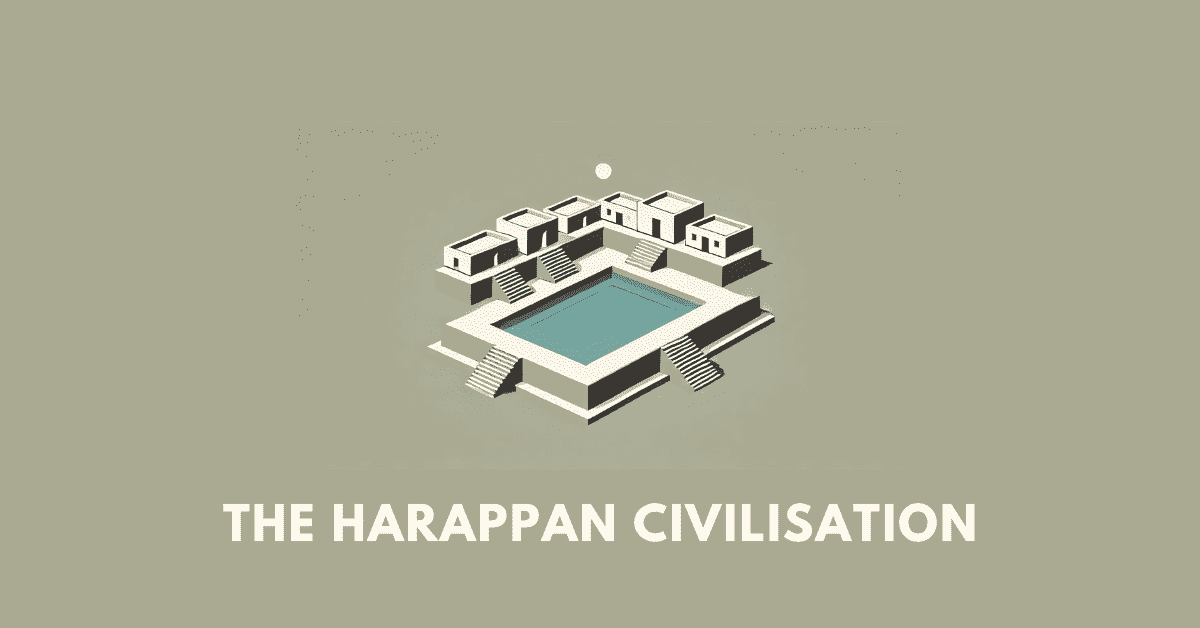
Get notes, summary, questions and answers, MCQs, extras, and PDFs of Chapter 1 “The Harappan Civilisation” which is part of ICSE Class 9 History (Total History). However, the notes should only be treated as references and changes should be made according to the needs of the students.
The Harappan Civilisation, also known as the Indus Valley Civilisation, is one of the earliest urban cultures in the northwestern region of the Indian subcontinent. It flourished around 2500 BCE along the Indus River and its tributaries. This civilisation was contemporary with the Mesopotamian and Egyptian civilisations and is distinguished for its advanced urban planning, architecture, and social organisation.
The Harappan culture is primarily known through archaeological findings such as buildings, pottery, sculptures, seals, and cemeteries, as no decipherable written records have been discovered. Key sites include Harappa, Mohenjo-daro, and Dholavira. The Great Bath of Mohenjo-daro is a significant structure, indicating advanced engineering and possibly used for ritual bathing. The Citadel, another prominent feature, housed important buildings and suggests a well-organised society with social and political hierarchies.
Harappan cities were meticulously planned with a grid system, featuring wide main streets intersected by smaller lanes. Houses were built with baked bricks and had private wells and drainage systems, showcasing an advanced understanding of sanitation and urban living. The presence of granaries, especially in Harappa, indicates large-scale storage and possibly controlled distribution of food grains, hinting at a complex economic structure.
Trade was a vital part of the Harappan economy, both within the region and with distant lands such as Mesopotamia. Evidence of seals used to mark trade goods and the discovery of Harappan artifacts in other regions support the existence of extensive trade networks. Art and craft were highly developed, as seen in the intricate designs on pottery, the production of beads, and the sophisticated bronze statues, like the famous Dancing Girl.
The decline of the Harappan Civilisation around 1800 BCE remains a subject of debate. Possible causes include natural disasters such as floods and earthquakes, climatic changes leading to increased aridity, deforestation, and possibly invasions by the Aryans. Despite its decline, many aspects of Harappan culture, such as urban planning, crafts, and certain religious practices, influenced later Indian civilizations and can still be seen today.
The Harappan Civilisation’s achievements in urban planning, trade, and art mark it as a cornerstone of ancient history, reflecting a highly organised and innovative society .
1. The period when man used both stone and copper tools is known as:
A. Bronze Age Period
B. Chalcolithic Period
C. Mesopotamian Civilisation Period
D. Egyptian Period
Answer: B. Chalcolithic Period
2. Name the term archaeologists use for a group of objects distinctive in style, usually found together within a specific geographic area and period of time.
A. Civilisation
B. Culture
C. Period
D. History
Answer: B. Culture
3. Which of the following insights about the Harappan Civilisation was provided by the citadel?
A. There were public buildings for specific purposes.
B. There was ceremonial bathing.
C. There was overseas trade.
D. The people were literate.
Answer: A. There were public buildings for specific purposes.
4. Which of the following is NOT a feature of the Dockyard at Lothal?
A. World’s oldest dockyard
B. Presence of mud brick platform
C. Surrounded by wall of baked bricks
D. Connected by channels to Gulf of Cambay
Answer: B. Presence of mud brick platform
5. What made the pool at the Great Bath watertight?
A. Burnt bricks
B. Mortar lined with bitumen and gypsum
C. Mud brick platforms
D. Both (a) and (b)
Answer: D. Both (a) and (b)
6. Which of the following is a feature of the Great Bath?
A. Tank in a courtyard
B. Tank surrounded by corridors
C. Porticos and rooms
D. All of the above
Answer: D. All of the above
7. Bronze statues were made by a special process called:
A. Moulded clay process
B. Lost wax process
C. Clay wax process
D. Lost clay process
Answer: B. Lost wax process
8. Features of the Indus script include:
A. Alphabetical order
B. Written from right to left
C. Written from left to right
D. All of the above
Answer: B. Written from right to left
9. Seals were made of:
A. Steatite
B. Terracotta
C. Agate
D. All of the above
Answer: D. All of the above
10. Seals are not a source of information for:
A. Script
B. Trade
C. Beliefs
D. Society
Answer: D. Society
11. Bearded man, found in Mohenjo-daro, is a statue of a meditative man wearing:
A. An amulet
B. A shawl
C. A bangle
D. An elaborate headdress
Answer: B. A shawl
12. The ‘Dancing Girl’ has which of the following features?
A. Half-closed eyes
B. Heavily-bangled left arm
C. Elaborate headdress
D. Seated cross-legged
Answer: B. Heavily-bangled left arm
1. (A) The period when man used both stone and copper tools is known as the Chalcolithic Period.
(B) The Harappan Civilisation emerged in the Chalcolithic Period.
a) (B) contradicts (A)
b) (B) is the reason for (A)
c) (A) is true but (B) is false
d) (A) and (B) are independent of each other.
Answer: b) (B) is the reason for (A).
Explanation: The Chalcolithic Period refers to the time when both stone and copper tools were used by humans. During this period, the Harappan Civilisation emerged as one of the earliest urban cultures in the northwestern regions of the Indian subcontinent. The ability to use copper, along with stone, marked a significant technological advancement, which contributed to the development of more complex societies like the Harappans. Thus, the emergence of the Harappan Civilisation is directly related to the Chalcolithic Period, as the use of metal tools was a key factor in its rise.
2. (A) The Harappan Civilisation is considered as the first civilisation that arose in the northwestern regions of the Indian subcontinent.
(B) The Harappan Civilisation is also known as the Indus Valley Civilisation.
a) (B) contradicts (A)
b) (B) is the reason for (A)
c) (A) is true but (B) is false
d) (A) and (B) are independent of each other.
Answer: b) (B) is the reason for (A).
Explanation: The Harappan Civilisation, which developed along the Indus River and its tributaries, is often referred to as the Indus Valley Civilisation. This is because its most significant sites, such as Harappa and Mohenjo-daro, were located in the valley of the Indus River. The name “Indus Valley Civilisation” reflects its geographical context and emphasizes its position as the first major urban culture in the northwestern regions of the Indian subcontinent. Therefore, the name “Indus Valley Civilisation” provides a geographical reference that helps to identify the Harappan Civilisation as the earliest known civilisation in this region.
3. (A) The Harappan Civilisation is also known as the Harappan Culture.
(B) The term ‘Culture’ refers to a group of distinctive objects such as seals, weights, stone blades, and baked bricks found within a specific geographical area and time period.
a) (B) contradicts (A)
b) (B) is the reason for (A)
c) (A) is true but (B) is false
d) (A) and (B) are independent of each other.
Answer: b) (B) is the reason for (A).
Explanation: Archaeologists often use the term “culture” to describe a collection of distinctive objects that are found together within a specific geographical area and time period. In the case of the Harappan Civilisation, the term “Harappan Culture” is used because of the distinctive objects, such as seals, weights, and baked bricks, that are characteristic of this civilisation. These artifacts provide insights into the lifestyle, trade, and technological advancements of the Harappan people. Thus, the use of the term “Harappan Culture” is directly related to the distinct group of objects associated with this civilisation, justifying the use of (B) as the reason for (A).
4. (A) One of the important sources of information about the Harappan Civilisation are the seals.
(B) The script used for the letters engraved on seals has not been deciphered.
a) (B) contradicts (A)
b) (B) is the reason for (A)
c) (A) is true but (B) is false
d) (A) and (B) are independent of each other.
Answer: d) (A) and (B) are independent of each other.
Explanation: The seals from the Harappan Civilisation are indeed crucial sources of information, providing insights into the trade, religious beliefs, and social practices of the time. These seals often feature engravings of animals, mythical figures, and a script that has yet to be deciphered. However, the fact that the script has not been deciphered does not directly affect the seals’ importance as sources of historical information. The two statements are independent of each other: (A) highlights the seals’ significance in studying the Harappan Civilisation, while (B) discusses the current limitations in understanding the script used on these seals.
5. (A) The Great Bath has a large rectangular tank in a courtyard surrounded by a corridor on all four sides.
(B) The water for the Great Bath was provided by the Indus River.
a) (B) contradicts (A)
b) (B) is the reason for (A)
c) (A) is true but (B) is false
d) (A) and (B) are independent of each other.
Answer: c) (A) is true but (B) is false.
Explanation: The Great Bath at Mohenjo-daro is one of the most remarkable structures of the Harappan Civilisation, featuring a large rectangular tank surrounded by a corridor. However, the water for the Great Bath was not directly sourced from the Indus River. Instead, it was likely supplied by a well located within the complex. The bath was lined with bitumen to make it watertight, indicating a sophisticated understanding of construction and water management. Therefore, while statement (A) accurately describes the structure of the Great Bath, statement (B) is incorrect in its claim about the water source.
6. (A) The Great Bath is one of the largest public buildings at Mohenjo-daro.
(B) The massive structure of the Great Bath indicates the existence of a ruling class.
a) (B) contradicts (A)
b) (B) is the reason for (A)
c) (A) is true but (B) is false
d) (A) and (B) are independent of each other.
Answer: b) (B) is the reason for (A).
Explanation: The Great Bath is indeed one of the most significant public structures in Mohenjo-daro, and its size and complexity suggest that it was not merely a communal facility but a symbol of authority and religious significance. The ability to mobilize the labor and resources needed to build such a massive structure implies the existence of a powerful ruling class that could organize large-scale construction projects. This indicates a hierarchical society with a central authority capable of directing and overseeing major public works, supporting the idea that the Great Bath’s massive structure reflects the presence of a ruling class.
7. (A) About 2000 Harappan seals have been discovered.
(B) The seals were mainly used for religious purposes.
a) (B) contradicts (A)
b) (B) is the reason for (A)
c) (A) is true but (B) is false
d) (A) and (B) are independent of each other.
Answer: c) (A) is true but (B) is false.
Explanation: While it is true that approximately 2000 seals from the Harappan Civilisation have been discovered, their primary purpose was not religious. The seals were mostly used in trade, serving as markers of ownership and authenticity, similar to modern-day trademarks. They were pressed into clay to seal goods and indicate that the contents had not been tampered with. Some seals may have had religious or symbolic motifs, but their main function was economic, making statement (B) incorrect.
8. (A) The Bearded Man is a three-dimensional stone sculpture discovered from Mohenjo-daro.
(B) According to some scholars, it is a statue of a yogi or a priest.
a) (B) contradicts (A)
b) (B) is the reason for (A)
c) (A) is true but (B) is false
d) (A) and (B) are independent of each other.
Answer: d) (A) and (B) are independent of each other.
Explanation: The Bearded Man is indeed a three-dimensional stone sculpture discovered at Mohenjo-daro, which is well-known for its artistic depiction of a man with a beard. Statement (A) accurately describes this artifact. Statement (B) introduces a scholarly interpretation that this figure might represent a yogi or a priest, based on the figure’s meditative posture and dignified appearance. However, these two statements do not directly depend on one another; (A) describes a fact about the artifact, while (B) provides an interpretation of its possible identity. Therefore, the statements are independent of each other.
9. (A) Overseas trade was carried out at Lothal.
(B) Lothal was a port with a dockyard.
a) (B) contradicts (A)
b) (B) is the reason for (A)
c) (A) is true but (B) is false
d) (A) and (B) are independent of each other.
Answer: b) (B) is the reason for (A).
Explanation: Lothal, one of the major sites of the Harappan Civilisation, is renowned for its dockyard, which is considered one of the earliest known examples of such a structure. This dockyard was connected to a network of channels that linked it to the Arabian Sea, facilitating overseas trade. The existence of this dockyard at Lothal enabled the Harappans to engage in trade with regions as far as Mesopotamia. Therefore, the presence of the dockyard is the reason why Lothal was able to participate in overseas trade, making (B) the reason for (A).
10. (A) The lower town had the residential buildings where people lived and worked.
(B) The residential buildings were built on a high mound to protect them from floods.
a) (B) contradicts (A)
b) (B) is the reason for (A)
c) (A) is true but (B) is false
d) (A) and (B) are independent of each other.
Answer: b) (B) is the reason for (A).
Explanation: In the Harappan cities, the lower town was where the majority of the population lived and worked. The residential buildings in this area were often constructed on raised mounds. This elevation was a deliberate architectural choice to protect the inhabitants from the seasonal flooding of the Indus River and its tributaries. By building on higher ground, the Harappans ensured that their homes and streets remained dry during floods, allowing the city to function even during the rainy season. Therefore, the need to protect residential areas from floods is the reason for their construction on high mounds, making (B) the reason for (A).
1. Name two important sources of information about the Harappan Civilisation.
Answer: The two important sources of information about the Harappan Civilisation are buildings and the seals.
2. Name one important public building of Indus Valley Civilisation and its importance.
Answer: The Great Bath is an important public building of the Indus Valley Civilisation. It indicates the high degree of perfection in the art of building, the existence of a ruling class that could mobilise labour, and the importance of ceremonial bathing in religious practices.
3. Give any two characteristic features of the citadel.
Answer: Two characteristic features of the citadel are:
4. How were seals used? What information do they give about Harappan trade?
Answer: Seals were used by traders to stamp their goods. After a bag with goods was tied, a layer of wet clay was applied on the knot, and the seal was pressed on it leaving an impression. If the bag reached its destination with its seal intact, it indicated that it had not been tampered with. The seals convey the identity of the sender or the owner and indicate that Harappan trade had spread over a vast area.
5. Briefly describe granaries at Harappa.
Answer: Granaries at Harappa consisted of two rows of six granaries each. To the south of the granaries were working floors with rows of circular brick platforms, believed to be meant for threshing grain. These granaries were built on raised platforms to protect them from floods and had ventilation to prevent grains from becoming mildewed.
6. Briefly describe the ornaments worn by the Harappans.
Answer: The Harappans wore ornaments made of gold, silver, precious stones, and ivory. Common ornaments included necklaces, finger-rings, bangles, armlets, anklets, nose rings, fan-shaped head-dress, and earrings.
7. Briefly describe the statue of the dancing girl.
Answer: The statue of the dancing girl is a bronze figure found at Mohenjo-daro. It shows a young girl in a confident pose, with her right arm on her hip and her left arm heavily bangled, holding a small bowl against her left leg. This statue demonstrates a high degree of development in the art of sculpture.
8. Mention the types of dress worn by the Indus Valley people.
Answer: The Indus Valley men wore a dhoti and a shawl as an upper garment. The women wore skirts and used a cloak to cover their arms and shoulders. Needles and buttons found at some sites indicate that some of the clothes were stitched.
9. State two features of the internal trade in the Indus Valley Civilisation.
Answer: Two features of the internal trade in the Indus Valley Civilisation are:
10. State any two evidences that show the Harappans also had trade relations with foreign countries.
Answer: Two evidences of trade relations with foreign countries are:
11. Name the four animals depicted on the Pashupati seal.
Answer: The four animals depicted on the Pashupati seal are the elephant, tiger, buffalo, and rhinoceros.
12. State any two causes that led to the decline of the Harappan Civilisation.
Answer: Two causes that led to the decline of the Harappan Civilisation are:
13. What types of weights and measures did the Indus people use?
Answer: The Indus people used sets of cubical stone weights. The basic unit was 16, and larger weights were multiples of 16 like 32, 48, and 64. Smaller weights were fractions of 16.
14. State any two ways to show the value of Indus Script as a source of historical information.
Answer: Two ways to show the value of the Indus Script as a source of historical information are:
15. In what two respects is Harappan Civilisation our greatest heritage?
Answer: Two respects in which the Harappan Civilisation is our greatest heritage are:
16. How did Indus pottery reflect the potter’s artistic skill?
Answer: Indus pottery, made glossy and shining, reflected the potter’s artistic skill through decorations with black geometrical designs. The large jars with narrow necks and red pots with black decoration demonstrated their artistic craftsmanship.
17. Name and briefly describe the process by which sculpture in metal was done.
Answer: The process by which sculpture in metal was done is called the lost wax process. In this process, wax figures were covered with a coating of clay. The wax was melted by heating, and the hollow mould was filled with molten metal, which took the original shape of the wax object.
18. Briefly describe the social classification of Harappans as pointed out by the citadel.
Answer: The social classification of Harappans, as pointed out by the citadel, indicates the presence of a ruling class that lived in the citadel. The citadel housed important public buildings such as the Great Bath and the granary, suggesting a degree of political organisation and social stratification. This indicates that the Harappan society had a hierarchical structure with a class of rulers and possibly priests or officials who oversaw various aspects of urban life and governance.
1. With reference to Harappan Culture, answer the following questions:
(a) Discuss briefly the indigenous origin of the Harappan Civilisation.
Answer: The recent researches show that roots of the Harappan Civilisation lie deep in the Indian soil. According to some historians, the urban Harappan culture was only an outgrowth of the extensive local village cultures and not of foreign origin. These cultures probably contributed to the growth of the Harappan Civilisation, together with the external stimulus provided by trade contacts with Mesopotamia. These historians found some marked similarities between the pre-Harappan and proto-Harappan cultures at Kot Diji, Amri and Kalibangan in terms of granary, defensive walls and long-distance trade in these settlements. From this, historians concluded that the Harappan Civilisation evolved from these agricultural communities.
(b) Describe the extent of the civilisation.
Answer: The entire area of the Harappan civilisation is triangular in shape and accounts for about 1.3 million sq. km and was the largest area amongst the ancient civilisations. It extended from Sutkagendor (on the sea-coast of South Baluchistan) in the west, to Alamgirpur (in the upper Ganga-Yamuna Doab in western UP) in the east and from Manda (in Jammu) in the north to Bhagatrav in Narmada estuary in the south. The Harappan culture covered parts of Punjab, Haryana, Sindh, Baluchistan, Gujarat, Rajasthan and the fringes of Western Uttar Pradesh. Consequent to the partition of India, the main centres of civilisation, i.e., Harappa, Mohenjo-daro, Chanhudaro and Sutkagendor are now in Pakistan. Some of the centres of this civilisation in India are Manda, Banawali, Kalibangan, Alamgirpur, Lothal, Rupar and Rangpur. In recent years, many more extensions of this civilisation in Gujarat and Punjab have been discovered. Dholavira in Gujarat is the most prominent among them. The largest sites of the Harappan Civilisation, however, are Mohenjo-daro, Harappa, Kalibangan and Lothal.
(c) Name any four cities of the Harappan Civilisation and a significant feature of each city.
Answer:
2. With reference to the chief features of the Harappan Civilisation, answer the following:
(a) Any three characteristic features of town planning.
Answer:
(b) Three special features of the houses of the people.
Answer:
(c) Mention any two common elements between Mohenjo-daro and Harappa.
Answer:
3. Study the picture given on the right and answer the following questions:
(a) Identify the structure. List any two of its characteristic features.
Answer: The structure is the Great Bath. Two characteristic features are:
(b) State the importance of this structure as a source of information about Harappan Civilisation.
Answer: The Great Bath is an important source of information as it indicates that the art of building had reached a high degree of perfection at that time and it suggests that there might have been a ruling class that could mobilise labour and collect taxes to build such a huge structure for public use .
(c) Name another architectural structure of this period. How does this structure show that Harappan Civilisation was highly developed?
Answer: Another architectural structure of this period is the Citadel. The Citadel shows that Harappan Civilisation was highly developed through its elaborate planning, which included specific buildings for public purposes and houses of the ruling class, indicating some sort of political organisation and social classification .
4. Study the picture of the seal given on the right and answer the following questions:
(a) Identify the seal in the given picture. Which animal is depicted on this seal?
Answer: The seal in the given picture is the Unicorn Seal. The animal depicted on this seal is a one-horned bull .
(b) Of what material were these seals made? Why were the seals used?
Answer: These seals were made of materials such as terracotta, steatite, and agate. The seals were used by traders to stamp their goods, indicating that the bag with goods had not been tampered with and conveying the identity of the sender or the owner .
(c) What do the seals reveal about the Harappans?
Answer: The seals reveal that the Harappans had a script that has not yet been deciphered, indicating a form of literacy. They also show the Harappans’ artistic skills and provide insights into their trade, religion, and beliefs, as evidenced by the images and inscriptions on the seals .
1. What was the first metal to be discovered and used by man?
A. Bronze
B. Iron
C. Copper
D. Tin
Answer: C. Copper
2. Which period is known as the Chalcolithic Period?
A. When only stone tools were used
B. When only copper tools were used
C. When both stone and copper tools were used
D. When bronze tools were used
Answer: C. When both stone and copper tools were used
3. By about 2500 BC, how many bronze age civilisations had emerged?
A. Two
B. Three
C. Four
D. Five
Answer: C. Four
4. In which year was the site of Harappa discovered?
A. 1901
B. 1911
C. 1921
D. 1931
Answer: C. 1921
5. What is the Harappan Civilisation also known as?
A. Indus Valley Civilisation
B. Mesopotamian Civilisation
C. Egyptian Civilisation
D. Chinese Civilisation
Answer: A. Indus Valley Civilisation
6. Which archaeological site was designated as a World Heritage site by UNESCO and is one of the best-preserved urban settlements of the Harappan Civilisation?
A. Harappa
B. Mohenjo-daro
C. Lothal
D. Dholavira
Answer: D. Dholavira
7. The Great Bath, an important source of information about the Harappan Civilisation, is located in which city?
A. Harappa
B. Mohenjo-daro
C. Dholavira
D. Lothal
Answer: B. Mohenjo-daro
8. What did the Citadel, a raised area in Harappan cities, owe its height to?
A. Natural hills
B. Stone platforms
C. Mud brick platforms
D. Wooden platforms
Answer: C. Mud brick platforms
9. What kind of objects were distinctive to the Harappan culture?
A. Gold ornaments
B. Iron tools
C. Seals, weights, stone blades, and baked bricks
D. Silver coins
Answer: C. Seals, weights, stone blades, and baked bricks
10. What did the construction of the Great Bath indicate about the Harappan Civilisation?
A. Their expertise in pottery
B. Their knowledge of astronomy
C. Their advanced building techniques
D. Their use of iron tools
Answer: C. Their advanced building techniques
11. What does the Citadel of Harappan civilisation indicate about the urban planning of its cities?
A. Political disorganisation
B. Lack of social classification
C. Elaborate city planning
D. Absence of public buildings
Answer: C. Elaborate city planning
12. How many seals have been discovered from the Harappan civilisation?
A. 500
B. 1000
C. 2000
D. 3000
Answer: C. 2000
13. What is depicted on the seals of Pashupati found in the Harappan civilisation?
A. A single-horned bull
B. A three-faced deity
C. A tiger
D. A rhinoceros
Answer: B. A three-faced deity
14. Where was the bearded man statue, believed to be a priest or yogi, discovered?
A. Harappa
B. Mohenjo-daro
C. Lothal
D. Kalibangan
Answer: B. Mohenjo-daro
15. The bronze statue of a dancing girl found at Mohenjo-daro shows what aspect of Harappan culture?
A. Religious practices
B. Agricultural techniques
C. Artistic development
D. Military strategy
Answer: C. Artistic development
16. The dockyard discovered at Lothal indicates what about the Harappan civilisation?
A. It had advanced agriculture
B. It had no external trade
C. It had significant internal and external trade
D. It lacked hydraulic knowledge
Answer: C. It had significant internal and external trade
17. How many signs are known to be part of the Harappan script?
A. 50-100
B. 100-200
C. 200-300
D. 375-400
Answer: D. 375-400
18. What theory about the origin of the Harappan civilisation has been rejected due to lack of evidence of early trade?
A. Indigenous origin
B. Foreign origin from Mesopotamia
C. Influence of Egyptian civilisation
D. Trade with China
Answer: B. Foreign origin from Mesopotamia
19. Who led the excavation at Harappa in 1921?
A. R.D. Banerjee
B. N.G. Mazumdar
C. Daya Ram Sahni
D. S.R. Rao
Answer: C. Daya Ram Sahni
20. The script of the Harappan civilisation was written in which direction?
A. Left to right
B. Top to bottom
C. Bottom to top
D. Right to left
Answer: D. Right to left
21. What material was commonly used for making Harappan seals?
A. Gold
B. Silver
C. Terracotta
D. Iron
Answer: C. Terracotta
22. What type of script is the Harappan script considered to be?
A. Alphabetical
B. Pictographic
C. Logographic
D. Syllabic
Answer: B. Pictographic
23. What does the discovery of seals in different regions indicate about the Harappan civilisation?
A. They had limited trade
B. They were isolated
C. They had widespread trade
D. They only traded locally
Answer: C. They had widespread trade
24. Which site is believed to have one of the oldest dockyards in the world?
A. Harappa
B. Mohenjo-daro
C. Lothal
D. Kalibangan
Answer: C. Lothal
25. Which animal is commonly depicted on the Harappan seals?
A. Lion
B. Bear
C. One-horned bull
D. Horse
Answer: C. One-horned bull
26. The Harappan civilisation is believed to have originated from which local cultures?
A. Mesopotamian
B. Egyptian
C. Pre-Harappan and proto-Harappan
D. Chinese
Answer: C. Pre-Harappan and proto-Harappan
27. Who led the excavation at Mohenjo-daro in 1922?
A. Daya Ram Sahni
B. N.G. Mazumdar
C. S.R. Rao
D. R.D. Banerjee
Answer: D. R.D. Banerjee
28. What was the main purpose of the Harappan seals?
A. Religious rituals
B. Agricultural documentation
C. Commercial purposes
D. Military commands
Answer: C. Commercial purposes
29. The bronze statue of the dancing girl found at Mohenjo-daro suggests what about the Harappan society?
A. They had no artistic abilities
B. They had advanced agricultural techniques
C. They valued art and culture
D. They were primarily warriors
Answer: C. They valued art and culture
30. Which of the following materials was NOT used to make Harappan seals?
A. Steatite
B. Terracotta
C. Agate
D. Wood
Answer: D. Wood
31. Which civilisation was the largest among ancient civilisations?
A. Mesopotamian
B. Egyptian
C. Harappan
D. Greek
Answer: C. Harappan
32. From which location in the west did the Harappan civilisation extend?
A. Manda
B. Alamgirpur
C. Sutkagendor
D. Lothal
Answer: C. Sutkagendor
33. Which Harappan city is located in Gujarat?
A. Harappa
B. Mohenjo-daro
C. Chanhudaro
D. Lothal
Answer: D. Lothal
34. Where is the city of Kalibangan situated?
A. Punjab
B. Rajasthan
C. Gujarat
D. Haryana
Answer: B. Rajasthan
35. In which year were the ruins of Mohenjo-daro designated a UNESCO World Heritage site?
A. 1975
B. 1980
C. 1985
D. 1990
Answer: B. 1980
36. Which river is Harappa located on the bank of?
A. Indus
B. Ravi
C. Ganga
D. Yamuna
Answer: B. Ravi
37. How were Harappan cities planned in contrast to Sumerian cities?
A. Circular pattern
B. Grid pattern
C. Radial pattern
D. Concentric pattern
Answer: B. Grid pattern
38. Which feature is common in both Mohenjo-daro and Harappa?
A. Presence of temples
B. Indoor plumbing
C. Wooden houses
D. Circular streets
Answer: B. Indoor plumbing
39. What was the primary purpose of the Great Bath in Mohenjo-daro?
A. Religious rituals
B. Public meetings
C. Bathing
D. Storage of water
Answer: C. Bathing
40. Which items were granaries at Harappa associated with?
A. Stone tools
B. Animal bones
C. Wheat and barley grains
D. Pottery
Answer: C. Wheat and barley grains
41. Which Harappan city was a centre for bangle-making?
A. Lothal
B. Chanhudaro
C. Harappa
D. Kalibangan
Answer: B. Chanhudaro
42. Where was the trading colony established by Harappans to facilitate trade with Central Asia?
A. Mesopotamia
B. Northern Afghanistan
C. Bahrain
D. Egypt
Answer: B. Northern Afghanistan
43. What was the ancient name given to the Indus region by Mesopotamians?
A. Dilmun
B. Makan
C. Meluha
D. Harappa
Answer: C. Meluha
44. What material was imported by the Harappans from North Karnataka and Afghanistan?
A. Copper
B. Gold
C. Lead
D. Silver
Answer: B. Gold
45. What was the basic unit of weight used by Harappans?
A. 12 grams
B. 14 grams
C. 16 grams
D. 18 grams
Answer: C. 16 grams
46. Which Harappan site provided evidence of ship usage?
A. Harappa
B. Mohenjo-daro
C. Lothal
D. Kalibangan
Answer: C. Lothal
47. What craft were Lothal and Chanhudaro centres for?
A. Pottery-making
B. Bead-making
C. Metalworking
D. Textile weaving
Answer: B. Bead-making
48. What kind of pottery was characteristic of the Harappan civilisation?
A. Polished stoneware
B. Painted black-on-red ware
C. Glazed ceramics
D. Terracotta figurines
Answer: B. Painted black-on-red ware
49. Which material was commonly used by Harappans for sculpture?
A. Marble
B. Bronze
C. Granite
D. Limestone
Answer: B. Bronze
50. Which city is known for having the Great Bath and elaborate drainage system?
A. Harappa
B. Mohenjo-daro
C. Lothal
D. Kalibangan
Answer: B. Mohenjo-daro
51. What is the most important terracotta image found in Harappan settlements?
A. Dancing Girl
B. Mother Goddess
C. Bearded Males
D. Animals
Answer: B. Mother Goddess
52. What process was used to create bronze statues in the Harappan civilization?
A. Carving
B. Lost wax process
C. Molding
D. Casting
Answer: B. Lost wax process
53. What garment did the Indus Valley men wear as depicted on a potsherd from Harappa?
A. Skirt
B. Shawl
C. Dhoti
D. Tunic
Answer: C. Dhoti
54. What material were the common ornaments in Harappan civilization made of?
A. Wood
B. Plastic
C. Gold, silver, and precious stones
D. Copper
Answer: C. Gold, silver, and precious stones
55. What were the main musical instruments of the Harappan people?
A. Flute and drum
B. Lyre and drum
C. Sitar and tabla
D. Violin and drum
Answer: B. Lyre and drum
56. Around which year did the Harappan civilization decline?
A. 1500 B.C.
B. 2000 B.C.
C. 1800 B.C.
D. 2200 B.C.
Answer: C. 1800 B.C.
57. According to some scholars, what natural disaster led to the abandonment of Mohenjo-daro?
A. Drought
B. Earthquake
C. Floods
D. Volcanic eruption
Answer: C. Floods
58. Which river drying up is believed to have contributed to the decline of the Harappan civilization?
A. Indus
B. Ganges
C. Yamuna
D. Ghaggar
Answer: D. Ghaggar
59. What was a possible cause of deforestation in the Indus Valley civilization?
A. Excessive farming
B. Bronze production
C. Construction
D. Animal husbandry
Answer: B. Bronze production
60. Who believed that the Aryans destroyed the Indus settlements?
A. R.L. Raikes
B. Mortimer Wheeler
C. D.P. Agarwal
D. Sood
Answer: B. Mortimer Wheeler
1. What was the first metal to be discovered?
Answer: Copper.
Q. What period is known when man used both stone and copper tools?
Answer: The Chalcolithic Period.
Q. What alloy did man create by mixing copper with tin or zinc?
Answer: Bronze.
Q. By about which year did four bronze age civilisations emerge?
Answer: By about 2500 BC.
Q. Which civilisation emerged in northern and western parts of India and Pakistan?
Answer: The Harappan Civilisation.
Q. On which river’s banks did the Mesopotamian Civilisation emerge?
Answer: River Euphrates and Tigris.
Q. In which valley did the Chinese Civilisation emerge?
Answer: The valley of the Hwang Ho and Yangtze rivers.
Q. On which river’s banks did the Egyptian Civilisation emerge?
Answer: The Nile river.
Q. What is another name for the Harappan Civilisation?
Answer: The Indus Valley Civilisation.
Q. When was the site of Harappa discovered?
Answer: In 1921.
Q. What pushed back the history of India by at least a thousand years?
Answer: The discovery of the Harappan Civilisation.
Q. What distinctive objects are associated with Harappan culture?
Answer: Seals, weights, stone blades, and baked bricks.
Q. What is our knowledge of the Harappan civilisation based on?
Answer: Archaeological remains.
Q. How many seals have been discovered in Harappan sites?
Answer: About 2000 seals.
Q. What animal is commonly depicted on Harappan seals?
Answer: The one-horned bull.
Q. What were the primary materials used by man before the discovery of metals, and how did the discovery of metals change the tools and implements used?
Answer: Before the discovery of metals, man primarily used stone for making tools and implements. The discovery of metals, starting with copper, provided more durable materials for a variety of tools, implements, and weapons. Metals like bronze, created by mixing copper with tin or zinc, were harder and more ductile than copper, making them more suitable for the manufacture of tools and weapons, leading to the development of the Bronze Age Civilisations.
Q. Describe the significance of the Harappan Civilisation in the context of Indian history and its comparison with other Bronze Age civilisations.
Answer: The Harappan Civilisation, discovered in the north-western regions of the Indian subcontinent, pushed back the history of India by at least a thousand years, placing it on par with other ancient Bronze Age civilisations like the Mesopotamian and Egyptian Civilisations. This discovery was significant as it altered the understanding of Indian history, which was previously thought to have begun with the advent of the Aryans.
Q. What is the term ‘Culture’ as used by archaeologists, and what distinctive objects are associated with Harappan culture?
Answer: Archaeologists use the term ‘Culture’ to refer to a group of objects distinctive in style that are usually found together within a specific geographical area and period of time. In the case of Harappan culture, these distinctive objects include seals, weights, stone blades, and baked bricks.
Q. What are the primary sources of knowledge about the Harappan civilisation, and why are written records not considered adequate?
Answer: Our knowledge of the Harappan civilisation is based entirely on archaeological remains such as buildings, pottery, sculpture, seals, and cemeteries. Written records are not considered adequate because the script found on some seals has not been deciphered yet, leaving archaeological evidence as the main source of information.
Q. Discuss the features and significance of the Great Bath in the Harappan Civilisation.
Answer: The Great Bath, one of the largest public buildings at Mohenjo-daro, features a large rectangular tank in a courtyard surrounded by a corridor on all four sides, with two flights of steps leading into the tank. To make the pool watertight, burnt bricks and mortar lined with bitumen and gypsum were used. Water for the bath was provided by a well in an adjacent room. Surrounding the bath were porticos, sets of rooms, and a stairway to an upper storey. Scholars believe it was used for ritual bathing, highlighting the Harappans’ advanced building techniques, social organisation, and the significance of ceremonial bathing.
Q. Explain the importance of the Citadel in Harappan cities and what it indicates about the civilisation.
Answer: The Citadel, a raised area in Harappan cities, was built on mud brick platforms and housed the ruling class and important buildings like the Great Bath, granary, assembly hall, and workshops. It indicates that the Harappan civilisation was an urban civilisation with elaborate planning and social stratification. The presence of public buildings on the Citadel suggests political organisation and a capacity for large-scale construction projects, reflecting the existence of a ruling class capable of mobilising resources and labour.
Q. What information do the Harappan seals provide about the civilisation, and how were they used?
Answer: Harappan seals provide insights into the script, trade, religion, and beliefs of the Harappans. They often feature short inscriptions and images of animals like the one-horned bull, buffalo, and elephant. Seals depicting Pashupati indicate religious beliefs, while the unicorn seal shows mythical beliefs. These seals were mainly used for commercial purposes, such as stamping goods for trade, indicating the owner’s identity and ensuring the integrity of the goods. They were also used as amulets, similar to modern identity cards, suggesting widespread trade and social practices.
Q. Describe the urban planning and architectural advancements evident in the Harappan Civilisation, citing specific examples.
Answer: The Harappan Civilisation showcased remarkable urban planning and architectural advancements. Cities were well-planned with grid layouts, standardised bricks, and advanced drainage systems. The Citadel, a raised area in each city, housed significant structures like the Great Bath, which was a large public bathing area, indicating advanced construction techniques with watertight bricks and efficient water management. Residential areas featured uniform housing with access to public amenities. The presence of granaries and workshops suggests organised economic activities. These features highlight the Harappans’ expertise in urban planning, reflecting a high degree of social organisation and technical proficiency, which were essential for sustaining large urban populations and complex social structures.
Q. Where was the stone sculpture of the bearded man discovered?
Answer: Mohenjo-daro.
Q. What does the bearded man statue wear over his left shoulder?
Answer: A shawl.
Q. What is the condition of the bearded man statue’s eyes?
Answer: Half-closed.
Q. From which material is the dancing girl statue made?
Answer: Bronze.
Q. Where was the bronze statue of the dancing girl found?
Answer: Mohenjo-daro.
Q. What rests on the hip of the dancing girl statue?
Answer: The right arm.
Q. Which arm of the dancing girl statue is heavily bangled?
Answer: The left arm.
Q. Where was a rectangular dockyard discovered?
Answer: Lothal.
Q. What surrounded the dockyard at Lothal?
Answer: A massive brick wall.
Q. What kind of script did the Harappans use?
Answer: Pictographic.
Q. How many signs are known in the Harappan script?
Answer: Between 375 and 400.
Q. Which direction was the Harappan script written?
Answer: From right to left.
Q. Who excavated Harappa in 1921?
Answer: Daya Ram Sahni.
Q. Who led the excavation of Mohenjo-daro in 1922?
Answer: R.D. Banerjee.
Q. Who discovered Kalibangan in 1953?
Answer: B.B. Lal and A.N Ghosh.
Q. In which district is Harappa located?
Answer: Montgomery district of Punjab.
Q. In which district is Mohenjo-daro located?
Answer: Larkana district of Sindh.
Q. What evidence supports the belief that the stone sculpture of the bearded man represents a yogi or a priest?
Answer: The bearded man statue from Mohenjo-daro has half-closed eyes, suggesting a state of meditation, which leads some scholars to believe it represents a yogi or a priest.
Q. What characteristics make the bronze statue of the dancing girl a masterpiece of art?
Answer: The bronze statue of the dancing girl, found at Mohenjo-daro, shows vigour, variety, and ingenuity, with her right arm resting on her hip and her left arm heavily bangled, holding a small bowl against her left leg.
Q. What indicates that the dockyard at Lothal was scientifically designed to withstand water flow and current?
Answer: The dockyard at Lothal had a massive brick wall for flood protection, channels connecting to the Gulf of Cambay, and a water locking system to keep the water in, indicating a scientific design to withstand water flow and current.
Q. What suggests that the Harappan script was used by many people?
Answer: The Harappan script was found inscribed on a wide variety of objects, including seals, copper tools, jars, tablets, jewellery, and an ancient signboard, suggesting that many people were literate.
Q. What are the two main theories about the origin of the Harappan Civilisation?
Answer: The two main theories about the origin of the Harappan Civilisation are the Foreign Origin theory, suggesting a migration from Mesopotamia, and the Indigenous Origin theory, indicating that it evolved from local village cultures in India.
Q. What areas did the Harappan civilisation cover?
Answer: The Harappan civilisation covered parts of Punjab, Haryana, Sindh, Baluchistan, Gujarat, Rajasthan, and the fringes of Western Uttar Pradesh, with extensions found in Gujarat and Punjab, and prominent sites in both India and Pakistan.
Q. What does the discovery of the rectangular dockyard at Lothal suggest about the Harappan civilisation’s knowledge and practices?
Answer: The rectangular dockyard at Lothal suggests that the Harappan civilisation had advanced knowledge and practices in several areas:
Q. How do the script and its usage on various objects provide insight into the literacy and communication methods of the Harappans?
Answer: The Harappan script provides significant insight into the literacy and communication methods of the civilisation:
Q. What are the key features and significance of the urban planning in Harappan cities like Harappa and Mohenjo-daro?
Answer: The urban planning in Harappan cities like Harappa and Mohenjo-daro is notable for several key features and its significance:
Q. Discuss the differences and similarities between the Foreign Origin and Indigenous Origin theories regarding the origin of the Harappan Civilisation.
Answer: The Foreign Origin and Indigenous Origin theories offer contrasting perspectives on the origin of the Harappan Civilisation:
Q. What was the most striking feature of the Harappan civilisation?
Answer: The most striking feature was its urban planning.
Q. How did the Indus cities differ from the Sumerian cities?
Answer: Indus cities followed a grid pattern, unlike the circular pattern of Sumerian cities.
Q. What were the two main parts of each city in the Harappan civilisation?
Answer: The citadel and the lower town.
Q. What was the purpose of the citadel’s height?
Answer: It owed its height to buildings constructed on mud brick platforms.
Q. How were the streets in the Indus cities aligned?
Answer: The streets followed a grid pattern.
Q. Where did the house drains empty waste water?
Answer: House drains emptied waste water into the street drains.
Q. What material were Harappan houses made of?
Answer: Harappan houses were made of brick and wood.
Q. Where were the kitchen and storerooms located in Harappan houses?
Answer: The kitchen was in a sheltered corner of the courtyard, and the ground floor contained storerooms and well chambers.
Q. How were the granaries protected from floods?
Answer: Granaries were built on raised platforms.
Q. What is the basic unit of weight used by Harappans?
Answer: The basic unit of weight was 16 (equal to modern 14 grams).
Q. How were the streets of the Indus cities designed?
Answer: The streets of the Indus cities were designed following a grid pattern, running from north to south or from east to west. The streets crossed the main roads at right angles, dividing the city into square or rectangular blocks. This layout facilitated movement and organized the city’s structure efficiently.
Q. What were the variations in the size of Harappan houses?
Answer: The Harappan houses varied in size from single-room tenements to bigger houses with courtyards. Some houses had up to twelve rooms, private wells, and toilets. Each house had covered drains connected to street drains, and entrances from narrow lanes cutting the streets at right angles.
Q. Describe the significance of granaries in the Harappan civilisation.
Answer: Granaries played a crucial role in the Harappan civilisation, serving as storage facilities for food grains. They were found at several sites like Mohenjo-daro, Harappa, Lothal, and Kalibangan. At Harappa, granaries were built in rows, and working floors for threshing grain were discovered. Their location near rivers suggests that grains were transported by boat.
Q. What evidence suggests that the Harappans engaged in trade with other regions?
Answer: Evidence of Harappan trade includes granaries, numerous seals, a uniform script, and regulated weights and measures across a wide area. They traded internally within the Indus civilisation and externally with West Asia and Central Asia. The discovery of Mesopotamian records referring to Meluha (Indus region) and trade items like gold, copper, and lead from different regions supports this.
Q. What types of ornaments did the Harappans wear?
Answer: The Harappans wore various ornaments made of gold, silver, precious stones, and ivory. Common ornaments included necklaces, finger rings, bangles, armlets, anklets, nose rings, fan-shaped headdresses, and earrings. Both men and women adorned themselves with these ornaments, indicating a sophisticated sense of fashion and craftsmanship.
Q. What were the main characteristics of town planning in the Harappan civilisation?
Answer: The main characteristics of town planning in the Harappan civilisation included:
Q. How did the Harappans manage waste and drainage in their cities?
Answer: The Harappans had a sophisticated waste management and drainage system. House drains emptied all waste water into the street drains, ensuring cleanliness and hygiene. The streets had a network of drains running along their sides, connected to the house drains. This systematic approach to waste disposal and drainage reflects the advanced urban planning and engineering skills of the Harappans, contributing to the overall health and sanitation of the cities.
Q. Describe the construction and purpose of Harappan houses.
Answer: Harappan houses were constructed according to a set plan on high mounds to protect them from floods, with deep foundations. The size of houses varied from single-room tenements to large houses with courtyards, up to twelve rooms, private wells, and toilets. Entrances to houses were from narrow lanes cutting the streets at right angles. Kitchens were placed in sheltered corners of courtyards, and ground floors contained storerooms and well chambers. Houses were made of brick and wood, with doors, windows, and ventilators, which opened on the side streets rather than the main roads.
Q. What was the role of the citadel in Harappan cities?
Answer: The citadel in Harappan cities played a significant role as the raised area where important buildings were located. Its height resulted from buildings constructed on mud brick platforms. The citadel housed key structures like the Great Bath, granary, assembly hall, and workshops. It was separated from the lower town by a wall. The citadel’s elevated position provided protection from floods and possibly served administrative and ceremonial functions, reflecting the organised and hierarchical nature of Harappan society.
Q. Discuss the importance of trade in the Harappan civilisation, including both internal and external trade.
Answer: Trade was a vital aspect of the Harappan civilisation, supporting its elaborate social structure and high standard of living. Internally, the Harappans traded extensively in stone, metal, shell, and other materials within the Indus civilisation zone. Common products found across different areas indicate a well-developed trade network. They used barter for exchanges instead of metal money. Cities like Mohenjo-daro, Harappa, and Lothal were centres for metallurgy, producing tools, weapons, kitchenware, and other objects for wide distribution. Rice was imported from Gujarat to Punjab, and cotton from Lothal and Surkotada supported the expanding townships.
Externally, the Harappans had commercial contacts with West Asia and Central Asia. Coastal towns like Lothal, Surkotada, and Balakot facilitated trade with Mesopotamia and other regions. Mesopotamian records from around 2350 BC refer to trade relations with Meluha (the Indus region). Two intermediate trading stations, Dilmun and Makan, were identified as Bahrain on the Persian Gulf. The Harappans exported and imported goods, including gold from North Karnataka and Afghanistan, copper from Rajasthan, South India, Baluchistan, and Arabia, and lead from East or South India. This extensive trade network highlights the Harappans’ economic prosperity and their significant role in ancient global trade.
Q. When did the Harappan Civilisation decline?
Answer: Around 1800 B.C.
Q. What natural disasters contributed to the decline of Mohenjo-daro?
Answer: Floods and earthquakes.
Q. What was found covering the houses and streets at Mohenjo-daro?
Answer: Silty clay left by the floodwaters.
Q. What did the people of Mohenjo-daro do after the floods receded?
Answer: They built houses and streets on top of the debris of previous buildings.
Q. Who suggested that earthquakes might have raised the level of the flood plains of the Indus river?
Answer: R.L. Raikes.
Q. Which river’s drying up is associated with the increased aridity causing the decline of the Harappan civilisation?
Answer: The river Ghaggar.
Q. Which historians suggested that increased aridity led to the decline of the Harappan civilisation?
Answer: D.P. Agarwal and Sood.
Q. What natural resource was heavily used by the Indus valley civilisation for various purposes?
Answer: Wood.
Q. Who believed that the Aryans destroyed the Indus settlements?
Answer: Mortimer Wheeler.
Q. What was one of the most remarkable achievements of the Harappan people in agriculture?
Answer: The cultivation of cotton.
Q. What were the inferred reasons for the abandonment of Mohenjo-daro due to flooding?
Answer: Scholars inferred that floods led to the abandonment of Mohenjo-daro because houses and streets were covered with silty clay left by floodwaters, indicating that the flood had submerged the area.
Q. What did the increased aridity and drying up of the river Ghaggar cause, according to D.P. Agarwal and Sood?
Answer: The increased aridity and drying up of the river Ghaggar caused ecological disturbances and shifts in the drainage pattern, leading to the decline of the Harappan civilisation.
Q. How did deforestation potentially contribute to the decline of the Indus valley civilisation?
Answer: The need for large quantities of wood to produce bronze, bake bricks, pottery, stoneware, and to make boats and furniture likely led to deforestation, which in turn may have caused climatic changes contributing to the civilisation’s decline.
Q. What evidence did Mortimer Wheeler provide to support his theory of the Aryan attack on Mohenjo-daro?
Answer: Mortimer Wheeler provided evidence of skeletons of 13 males, females, and one child found lying in a room, suggesting that men, women, and children were massacred in the streets and houses during the last phase of Mohenjo-daro.
Q. What cultural traits of the Harappan civilisation were adopted by later civilisations?
Answer: Later civilisations adopted the Harappan way of making baked pottery, bricks, beads, jewellery, textiles, and their religious practices such as the worship of Pashupati Shiva, the female deity as Mother Goddess, and the use of sacred trees, animals, serpents, and religious symbols.
Q. How did floods and earthquakes contribute to the decline of Mohenjo-daro?
Answer: Floods in Mohenjo-daro led to its abandonment as the streets and houses were submerged by floodwaters, covering them with silty clay. People rebuilt on top of the debris after the floods receded, but eventually, they abandoned the settlement due to repeated flooding. R.L. Raikes suggested that such flooding was not normal and could have been caused by earthquakes raising the flood plains of the Indus river, blocking its passage to the sea and inundating the hinterland of Mohenjo-daro.
Q. What role did increased aridity play in the decline of the Harappan civilisation, according to D.P. Agarwal and Sood?
Answer: According to D.P. Agarwal and Sood, increased aridity and the drying up of the river Ghaggar, due to tectonic disturbances that redirected the Sutlej and Yamuna rivers, played a significant role in the decline of the Harappan civilisation. The ecological disturbance from this increased aridity and shift in drainage patterns created an environment that was no longer sustainable for the Harappan people, leading to their civilisation’s decline.
Q. In what ways did deforestation impact the Indus valley civilisation?
Answer: The Indus valley civilisation, being a Bronze Age culture, required large quantities of wood for producing bronze, making jewellery, baking bricks, pottery, and stoneware, as well as constructing boats and furniture. This extensive use of wood likely led to deforestation, which in turn may have caused significant climatic changes in the region. These changes could have disrupted the ecological balance, contributing to the decline of the civilisation.
Q. Describe the evidence Mortimer Wheeler used to support his theory of an Aryan attack on Mohenjo-daro.
Answer: Mortimer Wheeler supported his theory of an Aryan attack on Mohenjo-daro by citing the discovery of skeletons of 13 males, females, and one child found lying in a room, indicating that they were massacred in the streets and houses. This evidence suggested a violent end to the settlement, supporting the notion that the Aryans attacked and destroyed the Indus settlements during the last phase of Mohenjo-daro.
90. Discuss the various factors that contributed to the decline of the Harappan Civilisation, providing details on each factor.
Answer: The decline of the Harappan Civilisation around 1800 B.C. can be attributed to several factors:

Only for registered users