Synonyms
More meanings
Tip: select a single word for meaning & synonyms.
Select multiple words normally to copy text.


Get summaries, questions, answers, solutions, notes, extras, PDF and guide of Class 11 (first year) Economics textbook, chapter 9 Theory of Supply which is part of the syllabus of students studying under AHSEC/ASSEB (Assam Board). These solutions, however, should only be treated as references and can be modified/changed.
The chapter on the theory of supply focuses on how sellers behave in a market. It begins by defining supply as the amount of a commodity a seller is willing to offer at a given price during a specific time period. This willingness to sell can differ from the actual quantity sold. Supply is directly linked to the price of a commodity and is expressed as a flow over time, such as per day or per year. A distinction is made between “supply,” which refers to the amount a seller is prepared to sell, and “stock,” which is the total available quantity.
Next, the chapter explains the difference between individual and market supply. Individual supply refers to the quantity a single seller is willing to offer, while market supply is the combined quantity all sellers are ready to provide. The chapter uses an example of three firms producing sugar at different quantities to show how market supply is the sum of individual contributions.
Various factors influence supply. The most important is the commodity’s price: higher prices lead to more supply as sellers expect higher profits. Other factors include the prices of related goods, input costs, technology improvements, and government policies like taxes and subsidies. The goals of the firm also matter. Some firms may aim for profit, while others focus on sales or reducing risks.
The law of supply states that the quantity supplied increases when the price rises, assuming other conditions remain the same. The chapter highlights exceptions to this law, such as when sellers expect future price changes or deal in perishable goods, which must be sold quickly, regardless of price.
Also, the chapter discusses price elasticity of supply, which measures how much supply responds to changes in price. Elastic supply means even a small price change leads to a large change in quantity supplied. Conversely, inelastic supply indicates that price changes have little effect on supply. Various methods, such as percentage and geometric methods, help measure this elasticity.
1. Define supply.
Answer: Supply refers to the quantity of a commodity that a firm is willing and able to offer for sale at a given price during a given period of time.
2. Define market supply of a good.
Answer: Market supply refers to the quantity of a commodity that all firms are willing and able to offer for sale, at each possible price during a given period of time.
3. State any two factors determining supply.
Answer:
4. Define supply function.
Answer: The supply function states the functional relationship between the quantity supplied of a commodity and its determinants. It may be written as:
S₁ (x) = f (P).
(Here, S = Supply of commodity X; f = Functional relation; P = Price of commodity X)
5. What is the shape of a supply curve?
Answer: The shape of a supply curve is upward sloping, indicating that as price increases, the quantity supplied also increases.
6. What is a supply schedule?
Answer: A supply schedule is a table that shows the relationship between the price of a commodity and the quantity of the commodity that a producer is willing to supply.
7. State the law of supply.
Answer: The law of supply states that, other things being equal, the quantity supplied of a commodity rises directly with its price.
8. When is the supply curve of a firm a vertical straight line parallel to the X-axis?
Answer: The supply curve of a firm is a vertical straight line parallel to the X-axis when the supply is perfectly inelastic.
9. What is meant by change in supply?
Answer: Change in supply refers to an increase or decrease in the supply of a commodity due to factors other than its own price. These factors can include changes in input prices, technology, number of firms, government policies, and expectations of future prices.
10. What is meant by change in quantity supplied?
Answer: Change in quantity supplied refers to a movement along the supply curve due to a change in the commodity’s own price, keeping other factors constant.
11. What effect does an increase in input price have on supply curve?
Answer: An increase in input price shifts the supply curve to the left, as it increases the marginal cost of production, leading producers to supply less at the same price level.
12. What causes a movement along a supply curve of a good?
Answer: A movement along a supply curve of a good is caused by a change in the price of the good itself.
13. What is meant by extension of supply?
Answer: Extension of supply refers to an increase in the quantity supplied due to a rise in the price of the commodity, which leads to a movement along the supply curve.
14. What is meant by contraction of supply?
Answer: Contraction of supply refers to a decrease in the quantity supplied due to a fall in the price of the commodity, which leads to a movement along the supply curve.
15. Define increase in supply.
Answer: Increase in supply refers to a situation where more quantity of a commodity is supplied at the same price due to factors such as improvement in technology, reduction in input costs, or favorable government policies. It leads to a rightward shift in the supply curve.
16. Define decrease in supply.
Answer: Decrease in supply refers to a situation where less quantity of a commodity is supplied at the same price due to factors like a rise in input costs, adverse government policies, or reduction in the number of firms. It leads to a leftward shift in the supply curve.
17. What causes a downward movement along a supply curve?
Answer: Decrease in price .
18. What causes an upward movement along the supply curve of a commodity?
Answer: Increase in price .
19. If a farmer grows rice and wheat, how will an increase in the price of wheat affect the supply curve of rice?
Answer: The supply of rice will decrease as the farmer shifts resources to growing more wheat, which has become more profitable due to the price increase .
20. What is meant by price elasticity of supply?
Answer: Price elasticity of supply means the degree of responsiveness of supply of a commodity due to change in its price. It is measured as:
Price elasticity of supply = Percentage change in quantity supplied / Percentage change in price .
21. How is elasticity of supply measured?
Answer: Elasticity of supply is measured using the following formula:
Price elasticity of supply = Percentage change in quantity supplied / Percentage change in price .
22. Draw a supply curve with unitary elasticity.
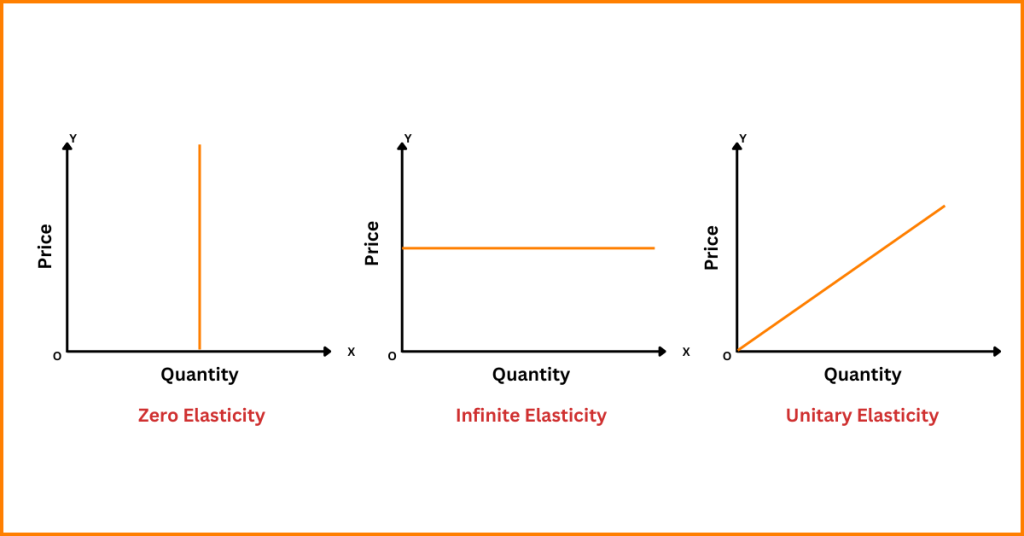
Answer: A straight-line supply curve passing through the origin indicates unitary elasticity. This means the percentage change in quantity supplied equals the percentage change in price .
23. Price elasticity of supply of a good is 0.8. Is the supply ‘elastic’ or ‘inelastic’, and why?
Answer: The supply is inelastic because the value of price elasticity of supply is less than one .
1. Distinguish between supply and stock.
Answer: Supply refers to the quantity of a commodity that producers are willing to offer for sale at different prices during a given period, while stock refers to the total quantity of a commodity available with the producers for sale at any given time.
2. State any three factors affecting supply of a commodity.
Answer:
3. Explain how the supply of a commodity is affected by the prices of other related commodities. (or) Explain the effect of fall in prices of other goods on the supply of a given good.
Answer: The supply of a commodity is affected by the prices of other related commodities, particularly substitute goods. If the price of a related good (such as a substitute) increases, producers may shift their resources towards producing the more profitable good. This will reduce the supply of the given commodity. Conversely, if the price of a related good falls, producers will find it less profitable to produce that good and may increase the supply of the given commodity instead.
For example, if a farmer grows both wheat and rice, and the price of rice increases, the farmer may allocate more land to growing rice, thus reducing the supply of wheat. Similarly, if the price of rice falls, the farmer may decide to produce more wheat, increasing its supply.
4. Define market supply. What is the likely effect on the supply of a good if a unit tax is imposed on that good? Explain.
Answer: Market supply refers to the total quantity of a good that all producers in the market are willing to offer at various prices during a given period. If a unit tax is imposed on a good, the cost of production increases, leading to a decrease in supply as producers will offer less at the same price.
5. What is a supply schedule? What is the effect on the supply of a good when Government gives a subsidy on the production of that good? Explain.
Answer: A supply schedule is a table that shows the relationship between the price of a commodity and the quantity supplied. If the government provides a subsidy on the production of a good, it reduces the cost of production, which typically increases supply since producers are willing to supply more at the same price.
6. What is supply? How does the state of technology affect it? (or) Explain the role of technical progress as a determinant of firms supply curve.
Answer: Supply is the amount of a commodity that a seller (or a firm) is willing to sell in a market at a given price in a given period of time. Technological progress reduces the marginal cost of production, allowing firms to produce more with the same or fewer resources. This increase in efficiency shifts the supply curve to the right, indicating an increase in the quantity supplied at the same price.
7. Explain the effect of the following on supply of a commodity: (a) Fall in the prices of factor inputs (b) Rise in the prices of other commodities.
Answer: (a) Fall in the prices of factor inputs: A fall in the prices of factor inputs reduces the cost of production, making it more profitable for firms to supply more at the same price. This leads to an increase in supply, causing a rightward shift of the supply curve. (b) Rise in the prices of other commodities: A rise in the prices of other commodities can make their production more attractive to firms. As a result, firms may divert resources to produce these other commodities, reducing the supply of the current commodity and causing a leftward shift of the supply curve.
8. Explain the meaning of ‘increase in supply’, and increase in quantity supplied with the help of a schedule.
Answer: Increase in supply refers to a situation where the supply of a commodity rises due to a change in factors other than its own price. This results in a rightward shift of the supply curve. Increase in quantity supplied refers to a rise in the amount of a commodity offered for sale as a result of an increase in its own price, represented as a movement along the supply curve.
Example schedule:
| Price per unit (₹) | Quantity Supplied (Units) |
|---|---|
| 10 | 100 |
| 10 | 120 |
In the example, the quantity supplied increases from 100 units to 120 units without a change in price, indicating an increase in supply.
9. State any three causes of a leftward shift of supply curve? (or) State any three causes of decrease in supply.
Answer: Three causes of a leftward shift of the supply curve (decrease in supply) are:
10. Give three causes of an increase in the supply of a commodity? (or) State any three causes of a rightward shift of supply curve.
Answer: Three causes of an increase in the supply of a commodity (rightward shift of the supply curve) are:
11. Explain the effect of change in price of inputs used on the supply of a product.
Answer: A firm uses different inputs like raw materials, machines, etc., in its production process. If the prices of these inputs increase, then the profitability of the firm will fall. In such a case, the firm will supply less than before at the prevailing price level. On the other hand, if there is a fall in input prices, then the possibility to earn profit increases. So in that situation, the firm will be willing to supply more than before. Thus, changes in the prices of inputs influence the supply of a product in the market.
12. Explain the law of supply with the help of a supply schedule.
Answer: A supply schedule is a tabular statement showing various quantities which producers are willing to produce and sell at various alternative prices during a given period of time. It states the relationship between the price of a commodity and the quantity that would be supplied. The individual supply schedule for any product indicates different quantities supplied per period by the producer at different possible prices of that commodity.
Example:
| Price per unit (₹) | Quantity supplied of X per month (Units) |
|---|---|
| 2 | 20 |
| 3 | 40 |
| 4 | 60 |
| 5 | 80 |
| 6 | 100 |
This table clearly shows that more quantity of commodity X is being offered for sale as the price of the commodity increases and vice versa.
13. State the law of supply. What is meant by the assumption ‘others remaining the same’?
Answer: The law of supply states that, other things being equal, the quantity supplied of a commodity rises directly with its price. In other words, when the price of a commodity rises, the quantity supplied increases, and when the price falls, the quantity supplied decreases, other things remaining the same.
The assumption “others remaining the same” refers to the idea that all other factors affecting the supply, such as the prices of related goods, the state of technology, and the prices of inputs, remain unchanged.
14. What is meant by elasticity of supply? State the formula for measuring it.
Answer: Elasticity of supply refers to the degree of responsiveness of the quantity supplied to a change in the price of a product. It measures how much the quantity supplied of a commodity changes in response to a given percentage change in its price.
The formula for measuring elasticity of supply is:
Es = % change in quantity supplied / % change in price
Or,
Es = (ΔQ/Q) / (ΔP/P)
Where:
ΔQ = Change in quantity supplied
Q = Initial quantity supplied
ΔP = Change in price
P = Initial price
15. Draw straight line supply curves with price elasticity of supply:
(i) equal to one (ii) less than one (iii) more than one
Answer: (i) Equal to one: A straight-line supply curve passing through the origin represents unitary elasticity of supply. At all points along this curve, the percentage change in quantity supplied equals the percentage change in price.
(ii) Less than one: A steep straight-line supply curve that cuts the X-axis below the origin represents inelastic supply, where the percentage change in quantity supplied is less than the percentage change in price.
(iii) More than one: A flat straight-line supply curve that cuts the Y-axis above the origin represents elastic supply, where the percentage change in quantity supplied is greater than the percentage change in price.
1. Explain any four determinants of the market supply of a commodity.
Answer:
2. State and explain the law of supply with the help of a schedule and a diagram.
Answer: The law of supply states that other things being equal, the quantity supplied of a commodity rises directly with its price. In other words, when the price of a commodity rises, the quantity supplied increases, and vice versa, other things being equal. An important point to be noted here is that the relationship between price and quantity supplied is direct while the relationship between price and quantity demanded is inverse.
Supply Schedule: A supply schedule is a tabular statement showing various quantities that producers are willing to produce and sell at various alternative prices during a given period of time. It states the relationship between the price of a commodity and the quantity that would be supplied. The supply schedule is of two types:
Example:
| Price per unit (₹) | Quantity supplied of X per month (Units) |
|---|---|
| 2 | 20 |
| 3 | 40 |
| 4 | 60 |
| 5 | 80 |
| 6 | 100 |
This table shows that as the price of the commodity increases from ₹2 to ₹6, the quantity supplied increases from 20 units to 100 units.
3. Distinguish between expansion of supply and increase in supply. Explain briefly.
Answer:
| Expansion of Supply | Increase in Supply |
|---|---|
| 1. It implies a change in quantity supplied due to a rise in the price of the commodity. | 1. It implies an increase in supply due to factors other than the price of the commodity. |
| 2. A movement along the supply curve indicates an expansion in supply. | 2. A rightward shift of the supply curve indicates an increase in supply. |
| 3. In this case, the supply curve remains unchanged, and the producer moves from one point to another along the same curve. | 3. In this case, the entire supply curve shifts to the right, implying that a greater quantity is supplied at each price. |
| 4. The supply increases as a result of a price increase for the same supply curve. | 4. The supply increases because of changes in factors like input prices, technology, etc. |
4. State the law of supply. What are the reasons for the upward slope of the curve?
Answer: The law of supply states that other things being equal, the quantity supplied of a commodity increases as the price increases, and decreases as the price decreases. In simple terms, there is a direct relationship between the price of a commodity and its quantity supplied.
Reasons for the upward slope of the supply curve:
5. Distinguish between movements along a supply curve and shifts of the curve.
Answer:
| Movement along the Supply Curve | Shift of the Supply Curve |
|---|---|
| 1. It implies a change in quantity supplied due to a change in the commodity’s own price. | 1. It implies a change in supply (either an increase or a decrease in the supply) of a commodity at a given price. |
| 2. A movement from the left to the right along any supply curve indicates an expansion in quantity supplied due to an increase in the price of the commodity. | 2. A rightward shift of the supply curve implies an increase in supply at each possible price. |
| 3. A movement from the right to the left along the supply curve indicates a contraction in quantity supplied due to a fall in the price of the commodity. | 3. A leftward shift of the supply curve implies a decrease in supply at each possible price. |
| 4. Here, all other factors except the price of the commodity are assumed to remain unchanged. | 4. Here, given the price of the commodity, all other factors (such as input prices, technology, etc.) are assumed to be flexible. |
| 5. Here, the price of the commodity affects its quantity supplied. | 5. Here, supply affects the price. |
6. Explain any three causes of ‘Increase’ of supply of a commodity.
Answer: Three causes of an increase in supply are:
7. Explain any two causes of ‘decrease’ in supply of a good.
Answer: Two causes of a decrease in supply are:
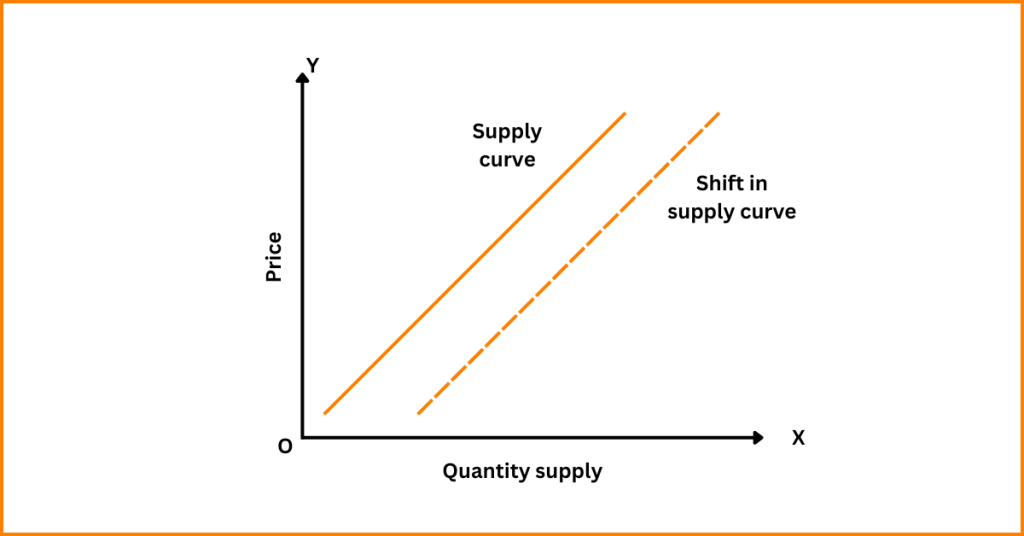
8. Explain the distinction between change in quantity supplied and change in supply. Use diagram.
Answer:
9. Define price elasticity of supply and explain its any two determinants.
Answer: Price elasticity of supply means the degree of responsiveness of supply of a commodity due to a change in its price. It is measured as:
Price elasticity of supply = (Percentage change in quantity supplied) / (Percentage change in price)
Two determinants of price elasticity of supply are:
10. Define price elasticity of supply. How can it be measured? Explain.
Answer: Price elasticity of supply is the degree of responsiveness of the quantity supplied of a commodity to a change in its price. It is calculated as:
Price elasticity of supply = (Percentage change in quantity supplied) / (Percentage change in price)
It can be measured using two methods:
11. Explain the geometric methods of measuring elasticity of supply.
Answer: The geometric method of measuring elasticity of supply involves drawing a straight-line supply curve and determining elasticity at different points. The procedure is as follows:
1. You are given the following information:
Price ( per unit) : 10 12 14 16 18 20
Supplied by Firm A (units) : 100 150 200 250 300 350
Supplied by Firm B (units) : 200 300 400 500 600 700
Assuming that there are only two firms in the market, compute market supply schedule.
Original Table:
| Price (per unit) | Supplied by Firm A (units) | Supplied by Firm B (units) |
|---|---|---|
| 10 | 100 | 200 |
| 12 | 150 | 300 |
| 14 | 200 | 400 |
| 16 | 250 | 500 |
| 18 | 300 | 600 |
| 20 | 350 | 700 |
Answer:
To calculate the market supply, we sum the quantities supplied by Firm A and Firm B for each price level:
For Price = 10: Market Supply = 100 (Firm A) + 200 (Firm B) = 300 units
For Price = 12: Market Supply = 150 (Firm A) + 300 (Firm B) = 450 units
For Price = 14: Market Supply = 200 (Firm A) + 400 (Firm B) = 600 units
For Price = 16: Market Supply = 250 (Firm A) + 500 (Firm B) = 750 units
For Price = 18: Market Supply = 300 (Firm A) + 600 (Firm B) = 900 units
For Price = 20: Market Supply = 350 (Firm A) + 700 (Firm B) = 1050 units
Updated Table:
| Price (per unit) | Supplied by Firm A (units) | Supplied by Firm B (units) | Market Supply (A+B) |
|---|---|---|---|
| 10 | 100 | 200 | 300 |
| 12 | 150 | 300 | 450 |
| 14 | 200 | 400 | 600 |
| 16 | 250 | 500 | 750 |
| 18 | 300 | 600 | 900 |
| 20 | 350 | 700 | 1050 |
2. Consider a market with two firms in the following table. Columns labelled as SS₁ and SS₂ give the supply of firm 1 and firm 2 respectively. Compute the market supply schedule.
Original Table:
| Price (₹) | SS₁ (Kg) | SS₂ (Kg) |
| 2 | 0 | 0 |
| 3 | 1 | 2 |
| 4 | 2 | 3 |
| 5 | 3 | 4 |
| 6 | 4 | 5 |
| 7 | 5 | 6 |
| 8 | 6 | 7 |
| 9 | 7 | 8 |
Answer:
To compute the market supply, we add SS₁ and SS₂ for each price level:
For Price = 2: Market Supply = 0 (SS₁) + 0 (SS₂) = 0 Kg
For Price = 3: Market Supply = 1 (SS₁) + 2 (SS₂) = 3 Kg
For Price = 4: Market Supply = 2 (SS₁) + 3 (SS₂) = 5 Kg
For Price = 5: Market Supply = 3 (SS₁) + 4 (SS₂) = 7 Kg
For Price = 6: Market Supply = 4 (SS₁) + 5 (SS₂) = 9 Kg
For Price = 7: Market Supply = 5 (SS₁) + 6 (SS₂) = 11 Kg
For Price = 8: Market Supply = 6 (SS₁) + 7 (SS₂) = 13 Kg
For Price = 9: Market Supply = 7 (SS₁) + 8 (SS₂) = 15 Kg
Updated Table:
| Price (₹) | SS₁ (Kg) | SS₂ (Kg) | Market Supply (SS₁ + SS₂) |
| 2 | 0 | 0 | 0 |
| 3 | 1 | 2 | 3 |
| 4 | 2 | 3 | 5 |
| 5 | 3 | 4 | 7 |
| 6 | 4 | 5 | 9 |
| 7 | 5 | 6 | 11 |
| 8 | 6 | 7 | 13 |
| 9 | 7 | 8 | 15 |
3. There are three identical firms in a market. The following table shows the supply schedule of firm 1: Complete the market supply schedule:
Original Table:
| Price (₹) | SS₁ (Kg) |
| 1 | 0 |
| 2 | 0 |
| 3 | 2 |
| 4 | 5 |
| 5 | 10 |
| 6 | 15 |
| 7 | 20 |
| 8 | 25 |
Answer: Since there are three identical firms, the market supply will be three times the individual supply of Firm 1 at each price level.
For Price = 1: Market Supply = 3 × 0 = 0 Kg
For Price = 2: Market Supply = 3 × 0 = 0 Kg
For Price = 3: Market Supply = 3 × 2 = 6 Kg
For Price = 4: Market Supply = 3 × 5 = 15 Kg
For Price = 5: Market Supply = 3 × 10 = 30 Kg
For Price = 6: Market Supply = 3 × 15 = 45 Kg
For Price = 7: Market Supply = 3 × 20 = 60 Kg
For Price = 8: Market Supply = 3 × 25 = 75 Kg
Updated Table:
| Price (₹) | SS₁ (Kg) | Market Supply (3 × SS₁) |
| 1 | 0 | 0 |
| 2 | 0 | 0 |
| 3 | 2 | 6 |
| 4 | 5 | 15 |
| 5 | 10 | 30 |
| 6 | 15 | 45 |
| 7 | 20 | 60 |
| 8 | 25 | 75 |
4. Price of a commodity falls by 10%. As a result, its supply falls by 15%. Find out elasticity of supply. State whether supply is elastic or inelastic.
Answer: Elasticity of supply (e) is calculated using the formula:
e = (%Δ in supply) ÷ (%Δ in price)
Given:
%Δ in price = -10%
%Δ in supply = -15%
So,
e = (-15%) ÷ (-10%) = 1.5
Since elasticity of supply is greater than 1, the supply is elastic.
5. Calculate elasticity of supply from the following data:
| Price (per kg) | Supply (in kg) |
|---|---|
| 10 | 1000 |
| 12 | 1500 |
Answer: Elasticity of supply (e) is calculated using the formula:
e = (%Δ in supply) ÷ (%Δ in price)
%Δ in price = (12 – 10) ÷ 10 × 100 = 20%
%Δ in supply = (1500 – 1000) ÷ 1000 × 100 = 50%
So,
e = 50% ÷ 20% = 2.5
6. If the market price of a commodity is ₹4, seller is willing to sell 600 units of the commodity. When the price rises to ₹5, he is willing to sell 750 units of the commodity. What is the seller’s elasticity of supply?
Answer: Elasticity of supply (e) is calculated using the formula:
e = (%Δ in supply) ÷ (%Δ in price)
%Δ in price = (5 – 4) ÷ 4 × 100 = 25%
%Δ in supply = (750 – 600) ÷ 600 × 100 = 25%
So,
e = 25% ÷ 25% = 1
The elasticity of supply is unitary elastic.
7. If the price of a commodity falls from ₹60 per unit to ₹58 per unit, its supply contracts from 400 units to 300 units. Find out its elasticity of supply.
Answer: Elasticity of supply (e) is calculated using the formula:
e = (%Δ in supply) ÷ (%Δ in price)
%Δ in price = (58 – 60) ÷ 60 × 100 = -3.33%
%Δ in supply = (300 – 400) ÷ 400 × 100 = -25%
So,
e = (-25%) ÷ (-3.33%) = 7.5
8. As a result of a 10% fall in price of a commodity, its supply decreases from 80 units to 60 units. Find out elasticity of supply.
Answer: Elasticity of supply (e) is calculated using the formula:
e = (%Δ in supply) ÷ (%Δ in price)
%Δ in price = -10%
%Δ in supply = (60 – 80) ÷ 80 × 100 = -25%
So,
e = (-25%) ÷ (-10%) = 2.5
The elasticity of supply is elastic.
9. The price of a commodity rises from ₹5 per unit to ₹6 per unit. Consequently, its supply increases by 20%. Find out elasticity of supply.
Answer: Elasticity of supply (e) is calculated using the formula:
e = (%Δ in supply) ÷ (%Δ in price)
%Δ in price = (6 – 5) ÷ 5 × 100 = 20%
%Δ in supply = 20%
So,
e = 20% ÷ 20% = 1
The elasticity of supply is unitary elastic.
10. The quantity supplied of a commodity at a price of ₹8 per unit is 400 units. Its price elasticity of supply is 2. Calculate the price at which its quantity supplied will be 600 units.
Answer: Elasticity of supply (e) is calculated using the formula:
e = (%Δ in supply) ÷ (%Δ in price)
Given e = 2, initial price P₁ = ₹8, initial quantity Q₁ = 400 units, final quantity Q₂ = 600 units.
%Δ in supply = (600 – 400) ÷ 400 × 100 = 50%
Now,
e = 50% ÷ %Δ in price = 2
%Δ in price = 50% ÷ 2 = 25%
So,
%Δ in price = (P₂ – 8) ÷ 8 × 100 = 25%
P₂ = 8 + 2 = ₹10
The price at which the quantity supplied will be 600 units is ₹10 per unit.
11. At a price of ₹8 per unit, the quantity supplied of a commodity is 200 units. Its price elasticity of supply is 1.5. If its price rises to ₹10 per unit, calculate its quantity supplied at this new price.
Answer:
Elasticity of supply (e) is calculated using the formula:
e = (%Δ in supply) ÷ (%Δ in price)
Given:
e = 1.5,
Initial price (P₁) = ₹8,
Final price (P₂) = ₹10,
Initial quantity supplied (Q₁) = 200 units.
First, calculate %Δ in price:
%Δ in price = ((10 – 8) ÷ 8) × 100 = 25%
Now, %Δ in supply = e × %Δ in price
%Δ in supply = 1.5 × 25% = 37.5%
Now, calculate the change in quantity supplied:
ΔQ = Q₁ × (%Δ in supply ÷ 100)
ΔQ = 200 × (37.5 ÷ 100) = 75 units.
So, the new quantity supplied (Q₂) = Q₁ + ΔQ
Q₂ = 200 + 75 = 275 units.
The new quantity supplied at ₹10 per unit is 275 units.
12. At a price of ₹40 per unit, the quantity supplied of a commodity is 400 units. When its price falls by 10%, its quantity supplied falls by 36 units. Calculate its elasticity of supply. Is its supply elastic? Give reason for your answer.
Answer:
Elasticity of supply (e) is calculated using the formula:
e = (%Δ in supply) ÷ (%Δ in price)
Given:
Initial price (P₁) = ₹40,
Quantity supplied at ₹40 = 400 units,
Price falls by 10%,
Change in quantity supplied = 36 units.
Now,
New price (P₂) = ₹40 – 10% of ₹40 = ₹36.
%Δ in price = ((36 – 40) ÷ 40) × 100 = -10%.
%Δ in supply = (36 ÷ 400) × 100 = 9%.
Now, calculate the elasticity of supply:
e = (9%) ÷ (-10%) = 0.9
Since the elasticity of supply is less than 1, the supply is inelastic.
13. When the price of a good falls from ₹10 to ₹9 per unit, total revenue declines from ₹1200 to ₹918. Calculate its price elasticity of supply.
Answer:
Elasticity of supply (e) is calculated using the formula:
e = (%Δ in supply) ÷ (%Δ in price)
Given:
Initial price (P₁) = ₹10,
Final price (P₂) = ₹9,
Initial total revenue (TR₁) = ₹1200,
Final total revenue (TR₂) = ₹918.
First, calculate %Δ in price:
%Δ in price = ((9 – 10) ÷ 10) × 100 = -10%.
Now,
Quantity supplied at P₁ = TR₁ ÷ P₁ = 1200 ÷ 10 = 120 units,
Quantity supplied at P₂ = TR₂ ÷ P₂ = 918 ÷ 9 = 102 units.
%Δ in supply = ((102 – 120) ÷ 120) × 100 = -15%.
Now, calculate the elasticity of supply:
e = (-15%) ÷ (-10%) = 1.5.
14. A firm received revenue of ₹3600 when the price of a commodity was ₹20 per unit. Its revenue fell to ₹2700 when the price increased by 10%. Calculate the elasticity of supply.
Answer:
Elasticity of supply (e) is calculated using the formula:
e = (%Δ in supply) ÷ (%Δ in price)
Given:
Initial revenue (TR₁) = ₹3600,
Initial price (P₁) = ₹20,
New revenue (TR₂) = ₹2700,
Price increases by 10%, so new price (P₂) = ₹22.
First,
Quantity supplied at P₁ = TR₁ ÷ P₁ = 3600 ÷ 20 = 180 units,
Quantity supplied at P₂ = TR₂ ÷ P₂ = 2700 ÷ 22 = 122.73 units (approximately).
%Δ in price = 10%,
%Δ in supply = ((122.73 – 180) ÷ 180) × 100 = -31.82%.
Now, calculate the elasticity of supply:
e = (-31.82%) ÷ (10%) = 1.67.
15. When the price of a commodity is ₹10, the quantity supplied is 20 units. As price increases to ₹15, the quantity supplied increases to 30 units. Find out the elasticity of supply.
Answer: Elasticity of supply (e) is calculated using the formula:
e = (%Δ in supply) ÷ (%Δ in price)
Given:
Initial price (P₁) = ₹10,
Final price (P₂) = ₹15,
Initial quantity supplied (Q₁) = 20 units,
Final quantity supplied (Q₂) = 30 units.
%Δ in price = ((15 – 10) ÷ 10) × 100 = 50%,
%Δ in supply = ((30 – 20) ÷ 20) × 100 = 50%.
Now,
e = 50% ÷ 50% = 1.
The elasticity of supply is unitary elastic.
1. What is supply in economics defined as?
A. Desired quantity
B. Actual quantity
C. Fixed quantity
D. Unlimited quantity
Answer: A. Desired quantity
Q. What variable is supply always related to?
A. Time
B. Price
C. Demand
D. Quantity
Answer: B. Price
Q. How is supply different from stock?
A. Supply is the same as stock
B. Stock refers to actual quantity, while supply refers to desired quantity
C. Supply is always larger than stock
D. Stock refers to the price of goods
Answer: B. Stock refers to actual quantity, while supply refers to desired quantity
Q. What does market supply refer to?
A. Supply of one firm
B. Sum of supplies from all firms in the market
C. Demand in the market
D. Price offered by one firm
Answer: B. Sum of supplies from all firms in the market
Q. Which factor affects the quantity of goods supplied directly according to the law of supply?
A. Cost of production
B. Profit margins
C. Price of goods
D. Demand for goods
Answer: C. Price of goods
Q. Which of the following is an exception to the law of supply?
A. Technological improvements
B. Perishable goods
C. Government policy
D. Input prices
Answer: B. Perishable goods
Q. What is the effect on supply when input prices increase?
A. Supply increases
B. Supply remains unchanged
C. Supply decreases
D. Supply is unaffected by input prices
Answer: C. Supply decreases
Q. What happens when the number of firms in a market increases?
A. Supply decreases
B. Supply remains the same
C. Supply increases
D. Price increases
Answer: C. Supply increases
Q. What is the supply curve based on?
A. Demand changes
B. Market expectations
C. Price and quantity supplied
D. Government regulations
Answer: C. Price and quantity supplied
Q. What does a shift in the supply curve represent?
A. Change in demand
B. Change in price
C. Change in supply due to other factors than price
D. Change in the number of firms
Answer: C. Change in supply due to other factors than price
Q. What is reserve price?
A. Maximum price sellers are willing to charge
B. Minimum price sellers are willing to accept
C. Price set by the government
D. Price at which all goods are sold
Answer: B. Minimum price sellers are willing to accept
Q. What happens during the expansion of supply?
A. Supply decreases due to price decrease
B. Supply increases due to price increase
C. Supply remains the same despite price changes
D. Supply increases due to more firms entering the market
Answer: B. Supply increases due to price increase
Q. When does contraction of supply occur?
A. When prices rise
B. When prices fall
C. When demand increases
D. When government taxes are imposed
Answer: B. When prices fall
Q. What kind of supply is shown by a perfectly inelastic supply curve?
A. Supply increases with price
B. Supply does not change with price
C. Supply decreases with price
D. Supply is infinite
Answer: B. Supply does not change with price
Q. What does a leftward shift in the supply curve indicate?
A. Increase in supply
B. Decrease in supply
C. No change in supply
D. Increase in demand
Answer: B. Decrease in supply
Q. What determines price elasticity of supply?
A. Change in demand
B. Change in market regulations
C. Change in price
D. Change in profits
Answer: C. Change in price
Q. What happens when supply is perfectly elastic?
A. Supply remains the same regardless of price
B. Supply increases only if price increases
C. Supply changes without any price change
D. Supply decreases when price increases
Answer: C. Supply changes without any price change
Q. How is unitary elastic supply defined?
A. Percentage change in supply equals percentage change in price
B. Percentage change in supply is less than percentage change in price
C. Percentage change in supply is greater than percentage change in price
D. Supply does not change at all
Answer: A. Percentage change in supply equals percentage change in price
19. What happens in the case of inelastic supply?
A. Supply changes more than price
B. Supply changes less than price
C. Supply remains constant
D. Supply becomes perfectly elastic
Answer: B. Supply changes less than price
1. What is the meaning of supply in economics?
Answer: Supply is the amount of a commodity that a seller (or a firm) is willing to sell in a market at a given price in a given period of time. Sellers may offer different quantities of a commodity for sale at different prices. Therefore, supply can also be defined as a schedule of quantities that will be offered for sale at various prices.
There are three important aspects of supply:
Economists distinguish between supply and quantity supplied. Supply refers to the set of quantities offered for sale at various prices, whereas quantity supplied refers to the specific quantity offered for sale at a certain price.
Q. How is supply different from stock?
Answer: Supply refers to the quantity of a commodity that producers are willing to offer at a certain price, whereas stock indicates the total quantity of a commodity available with producers for sale. Stock represents actual supply, while supply represents desired supply.
For example, if a farmer has produced 300 quintals of wheat but is prepared to sell only 100 quintals at the current market price of ₹800 per quintal, the stock is 300 quintals, while the supply is 100 quintals. If the farmer sells the entire stock at the current price, then supply would coincide with the stock.
Q. What is the difference between individual supply and market supply?
Answer: Individual supply refers to the quantity of a commodity that a single firm is willing to produce and offer for sale at a particular price during a specific period. On the other hand, market supply refers to the total quantity that all firms in the market are willing to produce and offer for sale at a particular price during a specific period. Market supply is the sum of the individual supplies of all firms.
For example, if firms A, B, and C produce sugar and are willing to sell 200, 300, and 250 quintals per month at ₹30 per kg, respectively, the market supply of sugar will be 750 quintals per month (200 + 300 + 250).
Q. What are the major determinants of the supply of a commodity?
Answer: The major determinants of the supply of a commodity are:
Q. How does future price expectation influence supply?
Answer: If producers expect the price of a commodity to rise in the near future, they may reduce their current supply to be able to offer more goods in the future at a higher price. Conversely, if they expect prices to fall, they may increase the current supply to avoid future losses.
Q. How does the state of technology affect the supply of a commodity?
Answer: If there is an improvement in production technology, firms may be able to produce more with the same resources. This can reduce the average cost of production, allowing firms to supply more at the same price. Therefore, technological innovation plays a key role in increasing the supply of a product.
Q. What is the role of government policy in determining the supply of a commodity?
Answer: Government policies, such as taxes and subsidies, can significantly impact the supply of a commodity. If the government imposes a sales tax, the seller may need to raise the price to maintain profit margins, reducing supply at lower prices. On the other hand, if the government provides subsidies, the seller may reduce the price, increasing supply at a lower cost to consumers.
Q. What is the law of supply and what is meant by reserve price?
Answer: According to the law of supply, other things being equal, the quantity supplied of a commodity rises directly with its price. In other words, when the price of a commodity rises, the quantity supplied increases and vice versa, provided other factors remain constant. The relationship between price and quantity supplied is direct, while the relationship between price and quantity demanded is inverse.
Reserve Price: The price cannot fall below a certain level. If the price falls too much, the seller may refuse to sell. The price below which producers and sellers are not willing to sell their goods is called the reserve price or minimum supply price. The reserve price depends on factors such as:
Q. What are the assumptions of the law of supply?
Answer: The phrase “other things being equal” in the law of supply refers to the assumptions that all determinants of supply other than price remain unchanged. The assumptions are:
Q. What is a supply schedule and what are its types?
Answer: A supply schedule is a tabular statement showing various quantities that producers are willing to produce and sell at various alternative prices during a given period. It shows the relationship between the price of a commodity and the quantity that would be supplied. There are two types of supply schedules:
Q. How is a supply curve represented and what types are there?
Answer: A supply curve is the graphical representation of the relationship between the price of a commodity and the quantity supplied, assuming all other factors influencing supply are constant. There are two types of supply curves:
Q. What are the reasons behind the operation of the law of supply?
Answer: The law of supply operates due to two main reasons:
Q. What are the exceptions to the law of supply?
Answer: The law of supply has the following exceptions:
Q. What is the difference between a change in quantity supplied and a change in supply?
Answer: A change in quantity supplied refers to movement along the same supply curve due to a price change. When quantity supplied increases because of a price rise, it is called an expansion of supply. When price falls and quantity supplied decreases, it is called contraction of supply.
A change in supply, however, refers to a shift in the supply curve due to changes in factors other than price, such as technology, input costs, or producer expectations.
Q. What does a shift in the supply curve mean, and how does it affect supply?
Answer: A shift in the supply curve means that at each price, a different quantity is supplied. This shift occurs due to factors other than the commodity’s own price, such as the goal of the firm, technology, number of firms in the market, tax rate, or interest rate. The change in supply can either be an increase or a decrease. If a larger quantity is supplied due to these factors, it is called an increase in supply. If the quantity supplied falls, it is called a decrease in supply.
Q. Explain the two aspects of increase in supply.
Answer:
Q. Explain the two aspects of decrease in supply.
Answer:
Q. What is the distinction between movement along the supply curve and shift of the supply curve?
Answer:
Q. What is price elasticity of supply, and how is it measured?
Answer: Price elasticity of supply measures the degree of responsiveness of the quantity supplied to changes in the product’s price. It can be calculated as:
es=Percentage change in quantity suppliedPercentage change in its price×100e_s = \frac{\text{Percentage change in quantity supplied}}{\text{Percentage change in its price}} \times 100es=Percentage change in its pricePercentage change in quantity supplied×100
Where:
When the percentage change in supply is greater than the percentage change in price, supply is elastic (es > 1). When the percentage change in supply is smaller, it is inelastic (es < 1). Price elasticity of supply is always positive, as price and supply move in the same direction.
Q. What are the five types of price elasticity of supply?
Answer:
Q. What does a perfectly inelastic supply curve look like, and what does it indicate?
Answer: A perfectly inelastic supply curve is vertical, parallel to the Y-axis. This indicates that the quantity supplied remains fixed at a certain level, regardless of changes in price. This type of supply is often seen in rare goods where supply cannot change in response to price changes. The numerical value of elasticity in this case is zero.
Q. What are the two popular methods of measuring price elasticity of supply?
Answer: The two popular methods of measuring price elasticity of supply are:
Q. Explain the geometric method of measuring price elasticity of supply using the concept of straight-line supply curves.
Answer: In the geometric method, a straight-line upward-sloping supply curve is taken, and a perpendicular is drawn from any point on the curve (point S) to find the quantity supplied. The supply curve is extended leftwards, intersecting the X-axis at point M. The elasticity is found using the ratio of the horizontal segment (Mq) to the quantity supplied (Oqo). There are three possible cases:
Q. Describe the price elasticity of supply for three constant supply curves shown in Fig. 9.16.
Answer: The three constant elasticity supply curves have the following characteristics:
Q. What are the determinants of price elasticity of supply?
Answer: The determinants of price elasticity of supply are:
Q. How does the time-period affect the elasticity of supply?
Answer: The elasticity of supply is affected by the time-period in the following ways:
Q. How does the availability of resources and facilities affect price elasticity of supply?
Answer: If resources and facilities like irrigation, power, and transportation are easily and adequately available, producers can respond quickly to changes in price, making the supply more elastic. However, if these resources are scarce or inadequate, supply becomes inelastic because producers cannot adjust their output easily.
28. How does the nature of the commodity produced influence the elasticity of supply?
Answer: The nature of the commodity greatly affects its elasticity of supply:

Only for registered users